Voice Search Optimization for Local SEO
Read more about this topic
Voice search is transforming how customers find local businesses, and optimizing for it is no longer optional—it’s essential for staying ahead in local search rankings. By focusing on conversational, natural-language queries that people speak into their smartphones, smart speakers, and virtual assistants, you can capture high-intent, nearby customers who are ready to act. Pairing voice search with local SEO means targeting phrases like “best coffee shop near me” or “plumber open now,” ensuring your business appears in featured snippets, Google’s Local Pack, and map results. This approach boosts your visibility for mobile and hands-free searches, drives foot traffic, and builds trust with voice-activated users who expect instant, accurate answers. Whether you’re a small business owner, blogger, or digital marketer, mastering voice search optimization helps you dominate hyper-local queries, improve your Google Business Profile, and turn spoken questions into loyal customers. Start refining your content with long-tail keywords, schema markup, and location-specific details to win the voice search game and grow your local presence effortlessly. 🎯📱🗺️
1 article

Articles in Voice Search Optimization for Local SEO
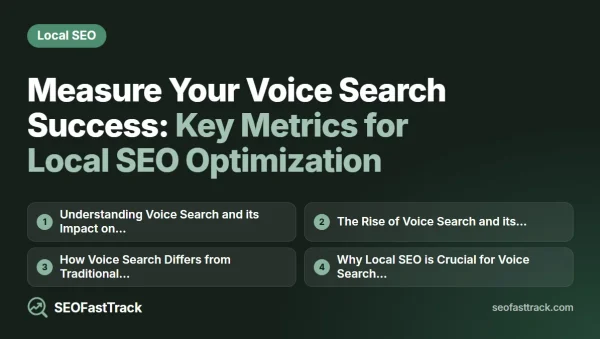
Voice Search Optimization for Local SEO: Your Gateway to Nearby Customers
Voice search is no longer a futuristic trend—it’s how millions of people find local businesses every day. When someone asks their smartphone “Where’s the best pizza near me?” or “What time does the pharmacy open?”, your business needs to be the answer. This subcategory of Local SEO on SEOFastTrack focuses exclusively on optimizing your online presence for spoken queries, Google Assistant, Siri, and Alexa. Here, you’ll learn how to capture high-intent local traffic, improve your Google Business Profile visibility, and stay ahead of competitors who ignore this rapidly growing search method.
📱 Understanding How Voice Search Differs from Typed Search
Voice searches are longer, more conversational, and almost always location-specific. Instead of typing “plumber Chicago,” users say, “Who’s the best plumber available now in Chicago?” This means your keyword strategy must shift from short-tail to natural-language phrases. You’ll discover how to identify question-based keywords, long-tail modifiers like “near me,” and intent words such as “open,” “available,” or “price.”
We break down real user behavior data, showing that voice queries are 3x more likely to be local. Optimizing for these patterns means structuring your content as direct answers—often within the first 50 words—and using schema markup for FAQ and local business. By aligning your website copy with how people actually speak, you improve your chances of earning featured snippets, which voice assistants typically read aloud first.
🗺️ Optimizing Google Business Profile for Voice Discovery
Your Google Business Profile (GBP) is the single most important asset for voice search success. Voice assistants rely heavily on GBP data to answer queries about hours, address, phone number, and services. We guide you step-by-step to ensure your profile is fully completed, verified, and updated weekly. Key fields include service areas, attributes like “wheelchair accessible,” and precise categories that match voice phrasing.
We also emphasize the power of Q&A posts and regular photo uploads, which signal freshness and reliability to Google’s local algorithm. Learn how to insert natural-language FAQs into your GBP description, such as “Do you offer emergency repair?” This increases the chance of your business being named in voice responses. Additionally, we cover how to manage and respond to reviews, as positive sentiments boost your local rank and voice visibility.
🔍 Building Content That Answers Spoken Questions
Voice search favors content that directly answers a question with clear, concise, and factual information. You’ll learn the art of creating “position zero” content—short paragraphs, bullet lists, and tables that are easy for search engines to extract. We show you how to use tools like AnswerThePublic and Google’s “People Also Ask” to compile authentic voice queries specific to your industry.
Each piece of content should include the location name, a clear answer within the first paragraph, and conversational subheadings like “How much does roof repair cost in Austin?” You’ll also learn to embed a FAQ section with structured data, which can boost your eligibility for voice responses. By publishing consistent, question-focused guides and service pages, you build authority that assistants trust and recommend to users.
⚡ Speed, Mobile-Friendliness, and Schema Markup for Voice
Voice searches happen almost exclusively on mobile devices, and speed is non-negotiable. A site that loads slowly will lose voice traffic instantly. We cover practical steps: compressing images, enabling lazy loading, and using mobile-first design. Your site must be touch-friendly with no intrusive pop-ups, as Google penalizes mobile irritants in voice-related rankings.
Schema markup is the hidden language that tells search engines exactly what your business offers. We teach you how to implement LocalBusiness, Speakable, and FAQ schema without code using plugins or manual JSON-LD. Speakable schema is especially valuable—it allows Google to identify sections of your page that can be read aloud. This technical edge can place you ahead of competitors in audio responses, especially for news, events, and time-sensitive information.
📊 Measuring Voice Search Performance and Adjusting Strategy
Tracking voice search is trickier than traditional SEO because queries come through audio. Yet you can still measure meaningful metrics. We explain how to parse Google Search Console for long-tail queries with question words and location modifiers. You’ll set up custom reports that isolate voice-type phrases and monitor their click-through rates.
We also guide you on using call tracking software and website chat logs to see which questions customers ask after arriving. Regularly auditing your local keywords and competitor rankings helps you adapt to seasonal voice trends. By combining analytics with customer feedback, you create a feedback loop that keeps your voice optimization fresh and effective, ensuring long-term visibility in this booming channel.
Frequently Asked Questions
Do I need a separate website for voice search optimization?
No. Optimize your existing website by adding conversational content, FAQ sections, and schema markup. Ensure it’s fast and mobile-responsive. A separate site would split your authority and confuse Google’s local signals. Focus on enhancing your main domain with voice-friendly structure.
How long does it take to see results from voice search optimization?
Typically 3 to 6 months, depending on your current local SEO health and competition. Voice search relies on standard indexing and citation ranking, so building consistent content and citations yields gradual gains. Patience and regular updates are key.
Are voice searches only on smartphones?
No. Smart speakers like Google Home and Amazon Echo generate many local voice queries, especially for directions, store hours, and recommendations. Optimizing for these devices means ensuring your business name and address are consistent across all directories, including smart speaker databases.
What is the best schema type for voice search?
LocalBusiness schema is essential, while Speakable helps your content become eligible for audio answers. FAQ schema also pairs well with voice, as it provides concise, structured answers. Use a combination of these, coded correctly on your service and contact pages, for maximum effect.
Can small local businesses compete with big brands in voice search?
Yes, because voice assistants often prioritize relevance and proximity over brand size. A well-optimized local business with a complete profile, fast site, and direct answer content can outrank national chains. Focus on your unique neighborhood keywords and personalized responses to win the local voice game.
Related topics