Local SEO for Hotels and Hospitality
Read more about this topic
Local SEO for Hotels and Hospitality is your digital concierge to capturing travelers actively searching for accommodations in your area. This targeted strategy ensures your property appears in Google’s local pack, maps, and organic results when guests search for “hotels near me” or “boutique stays in [city].” By optimizing your Google Business Profile, cultivating authentic guest reviews, and building geo-specific landing pages, you can dominate high-intent, location-based searches. For hotels, B&Bs, and resorts, local search visibility directly translates into more direct bookings, reduced reliance on OTAs, and stronger brand trust. Our actionable insights help you rank higher, showcase your amenities, and turn local searches into confirmed reservations—boosting your revenue and reputation with every click. Whether you’re a boutique inn or a sprawling resort, mastering local SEO means being the top recommendation in your neighborhood, season after season.
1 article

Articles in Local SEO for Hotels and Hospitality
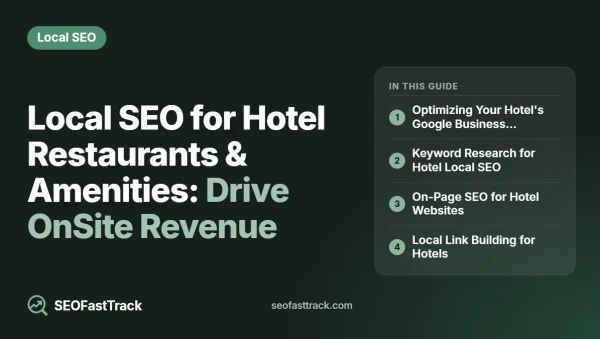
Local SEO for Hotels and Hospitality: Turn Local Searches into Bookings
Welcome to SEOFastTrack’s dedicated guide on Local SEO for Hotels and Hospitality. In today’s competitive travel market, travelers rarely scroll past the first page of Google. They search for “hotels near me,” “boutique stays in [city],” or “best family-friendly resorts,” and they expect instant, accurate answers. This subcategory focuses on helping hoteliers, B&B owners, and hospitality marketers dominate local search results, drive direct bookings, and outshine OTAs (Online Travel Agencies) like Booking.com and Expedia. You’ll learn hyper-local strategies, Google Business Profile optimization, review management, and schema markup—all tailored to the unique needs of accommodation businesses. Whether you operate a single inn or a chain, these tactics will position your property as the top choice in your geographic area.
📍 Optimizing Your Google Business Profile for Maximum Visibility
Your Google Business Profile (GBP) is the digital front door for your hotel. A fully optimized GBP doesn’t just show your address and phone number—it displays photos, amenities, virtual tours, and real-time booking links. Start by verifying your property and ensuring NAP (Name, Address, Phone) consistency across all platforms. Add primary and secondary categories like “Hotel” and “Resort,” then upload high-resolution images of rooms, lobby, and dining areas. Use the “Q&A” feature to pre-empt common traveler questions, and publish Google Posts weekly highlighting seasonal offers or events. Most importantly, enable messaging so guests can ask questions directly.
Beyond the basics, leverage GBP’s advanced attributes—free Wi-Fi, pet-friendly, pool, parking—to match user filters. Respond to every review within 24 hours, thanking positive feedback and addressing negatives professionally. Also, create a short, keyword-rich business description that mentions your city, landmark proximity, and unique selling points. For multi-location hotels, use location-specific profiles to avoid duplication. Remember, GBP is your top real estate for local pack rankings; treat it as a living webpage that requires daily attention, not a set-and-forget listing.
🏨 Building Local Citations and Consistent NAP Data
Citations—mentions of your hotel’s name, address, and phone number on external websites—are the backbone of local ranking signals. Start by submitting your property to authoritative directories like Google, Bing Places, Yelp, TripAdvisor, and the local Chamber of Commerce. Then, focus on hospitality-specific platforms: Trustpilot, Booking.com, Airbnb (if applicable), and regional tourism boards. Consistency is critical; a single typo in your suite number or a missing area code can confuse search engines and harm rankings. Use a tool like Moz Local or BrightLocal to audit your current citation landscape and identify gaps.
For hospitality, don’t ignore event and venue directories. If you host weddings or conferences, list your property on sites like The Knot, WeddingWire, and local convention bureau websites. These citations often include backlinks and drive referral traffic. Also, seek out local bloggers and travel influencers who round up “best places to stay” in your city; a mention in their listicle creates a powerful contextual citation. Avoid low-quality spam directories—they dilute trust. Instead, prioritize relevance and authority. Aim for 30–50 high-quality citations for a single hotel property, and ensure each one points back to your website’s booking page.
⭐ Managing Online Reviews and Reputation for Hotels
In hospitality, reviews are your social proof currency. Google’s local algorithm heavily weights review quantity, velocity, and sentiment. Encourage every guest to leave a review—not just the delighted ones—by sending a follow-up email with a direct link to your Google review page. Train front-desk staff to ask in person at check-out, and place QR codes on room keys or invoices. Respond to all reviews, both positive and negative, within 48 hours. For negative feedback, apologize publicly, offer a solution offline, and demonstrate you’ve taken action. This shows future guests you care, and it signals to Google that you’re actively engaged.
Don’t limit yourself to Google—TripAdvisor remains a major trust signal for travel decisions. Monitor and respond there as well. Consider implementing a review-generation strategy that targets specific keywords, such as “romantic weekend getaway” or “business-friendly hotel.” When responding, naturally incorporate those phrases. Also, showcase your best reviews on your website using schema markup to display star ratings in search results. Remember, a property with 200 reviews and a 4.8-star rating will outrank one with 20 reviews and a 5.0-star rating, so focus on volume and consistency over perfection.
🗺️ Hyperlocal Content and Landing Pages for Neighborhoods
Travelers often search for “hotels in [neighborhood]” or “accommodation near [landmark].” Create dedicated landing pages for each area you serve—for example, “Boutique Hotel Near Downtown Art District” or “Family Stay 5 Minutes from Theme Park.” Each page must have unique content: nearby attractions, dining recommendations, transport links, and local events. Avoid thin or duplicated copy; instead, write 800+ words that answer real traveler intent. Embed a Google Map, list walking distances to key spots, and include high-quality photos of the surrounding area. This approach captures long-tail keywords that big OTAs ignore.
Additionally, publish a local events calendar on your blog. Cover festivals, conferences, sports games, and seasonal weather patterns. Each event post can link back to your booking page. For example, “Where to stay for the Annual Jazz Festival” can target “hotels near [venue].” Use geo-specific schema, such as Hotel and TouristAttraction, to help Google understand the geographic context. Also, consider creating neighborhood guides in PDF or interactive map format—these become linkable assets that local tourism sites and bloggers may reference, boosting your authority and ranking for those hyperlocal terms.
💡 Structured Data and Schema for Hotels and Packages
Schema markup is your secret weapon to stand out in search results. Implement Hotel schema on your homepage to provide Google with detailed information—star rating, check-in time, amenities, price range, and photos. Use Offer schema for room rates and AggregateRating to display star ratings in rich snippets. For special packages (e.g., “New Year’s Getaway”), use Product or Offer markup with a @id for booking. Add BreadcrumbList to help users navigate, and FAQPage schema for common questions like “Do you offer airport shuttle?” This structured data makes your listing more clickable, increasing your click-through rate (CTR) and, in turn, your rankings.
Don’t forget LocalBusiness schema with geo coordinates and openingHours. Use Event schema for upcoming weddings or conferences you host. Test your markup using Google’s Rich Results Test to ensure no errors. For multi-property chains, implement a single schema template with unique identifiers for each location. Also, use ImageObject schema for your gallery so Google indexes your visual assets, potentially appearing in image searches. Remember, schema doesn’t guarantee a rich result, but it dramatically improves the chances, and for hotels competing with OTAs, any extra visual edge can turn a click into a direct reservation.
Frequently Asked Questions
How long does it take to see results from local SEO for hotels?
Typically, you’ll notice movement in local rankings within 4–8 weeks after optimizing your Google Business Profile and fixing citations. However, achieving the top 3 map pack position for competitive keywords like “hotels in [city]” can take 3–6 months of consistent effort, including new reviews and content assets. Patience is key; local SEO compounds over time.
Should I optimize for “near me” searches without a physical city name?
Yes, but don’t ignore city names. Google interprets “near me” based on the searcher’s GPS, so your listing must have accurate geo-coordinates and location signals. However, include your city name in page titles, meta descriptions, and content to capture non-GPS searches on desktop. Use both to maximize reach.
How important is TripAdvisor vs. Google reviews for hotels?
Both are crucial. Google reviews directly influence your local pack rankings and map visibility. TripAdvisor, however, is a major decision driver for travelers and often ranks highly for branded searches. Focus on Google for algorithmic wins, but actively manage TripAdvisor to build trust and avoid negative exposure. Integrate TripAdvisor widgets on your site to leverage its authority.
What’s the best strategy to handle duplicate listings for a hotel with multiple entrances?
Never create multiple Google Business Profiles for a single physical hotel. Instead, consolidate them into one primary listing with a single address. If you have separate buildings (e.g., a tower and a garden wing), use suite or building labels, but keep one GBP. For chains, create separate profiles per location, each with unique content. Duplicate fixes should be done via Google’s support tool.
Can I outrank big OTAs like Booking.com for local hotel queries?
Yes, for long-tail and hyperlocal queries, you can outrank OTAs by focusing on user experience and unique content. OTAs dominate head terms like “hotels in Paris,” but for “boutique hotel near the Louvre with free breakfast,” a well-optimized independent site can win. Use schema, fast page speed, authentic reviews, and direct booking incentives to beat the aggregators.
Related topics