Local Citation Management
Read more about this topic
Local Citation Management is the backbone of any successful local SEO strategy, ensuring your business appears consistently and accurately across the web. By managing your citations—mentions of your name, address, and phone number on directories, review sites, and social platforms—you build trust signals that boost your rankings in Google Maps and local search results. Inconsistent or outdated citations can confuse search engines and cost you valuable customers, so mastering this process is essential for dominating your local market. From clean-ups to strategic submissions, our guide simplifies citation building and monitoring, helping you enhance your online visibility, drive more foot traffic, and outrank competitors. Unlock the full potential of your local presence with actionable tips, best practices, and tools designed for small businesses and marketers alike. Start building a rock-solid local foundation today! 🚀📍
3 articles

Articles in Local Citation Management
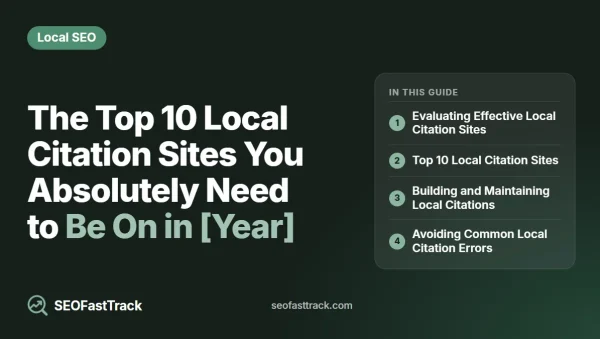
The Top 10 Local Citation Sites You Absolutely Need to Be On in [Year]
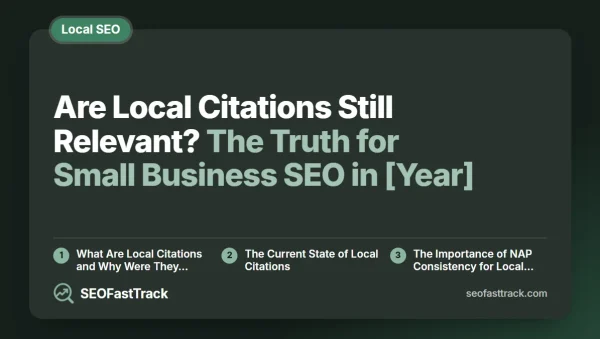
Are Local Citations Still Relevant? The Truth for Small Business SEO in [Year]
Master Local Citation Management for Higher Local Search Rankings
Local Citation Management is the backbone of any successful Local SEO strategy. For small business owners, bloggers, and digital marketers, ensuring your business name, address, and phone number (NAP) are consistent across the web builds trust with search engines like Google and boosts your visibility in map packs and local search results. This subcategory within SEOFastTrack dives deep into actionable tactics to audit, build, and monitor citations, helping you outrank competitors and attract nearby customers. Whether you’re a local brick-and-mortar or a multi-location service provider, mastering citations is non-negotiable for sustainable organic growth.
📋 Why Consistent NAP Data is Your #1 Local SEO Asset
Search engines rely on your NAP information to verify legitimacy and determine relevance for local queries. If your business appears with different phone numbers or street abbreviations across directories, Google’s algorithm loses confidence in your accuracy, causing your rankings to plummet. A consistent NAP signal acts like a digital fingerprint, telling Google that you’re a real, trustworthy entity. Spend time auditing every existing citation—from Yelp to Facebook—to ensure exact matches, including suite numbers and zip code formats. Even one mismatched citation can derail your local pack presence.
Beyond search engines, inconsistent NAP data confuses potential customers, leading to missed calls and lost foot traffic. Use tools like Moz Local or WhiteSpark to scan for duplicates and errors across the web. Fixing these misalignments not only improves crawlability but also enhances user experience, as customers find the right address every time. Prioritize schema markup for local business to further reinforce structured data. Remember, citation consistency is a continuous process—schedule quarterly audits to stay ahead of new directory listings and automated aggregator updates that can introduce errors.
🔍 Top Citation Sources: Where to Get Listed First
Not all citations carry equal weight. High-authority platforms like Google Business Profile, Apple Maps, Bing Places, Yelp, and Facebook are critical starting points, as they feed data to hundreds of secondary directories. Beyond these, niche sites relevant to your industry—such as TripAdvisor for hospitality or Zillow for real estate—boost local relevance and category authority. Prioritize platforms that are prominent in your geographic area and have strong domain authority. Quality trumps quantity; ten well-placed citations outperform fifty spammy ones.
For local pack dominance, focus on aggregators like DataAxle, Factual, and Neustar that distribute your NAP to a network of smaller websites. Claim your profiles on industry-specific associations and local chambers of commerce, as these are often trusted by search engines. Don’t ignore review platforms like Angie’s List or HomeAdvisor for service businesses. As you build your list, keep a spreadsheet tracking the URL, login, and last audit date. This systematic approach prevents oversight and helps you spot new opportunities. Aim for at least 20 high-quality citations for a solid baseline, expanding as you add new locations.
🛠️ Automate Citation Audits with the Right Tools
Manually checking dozens of directories is time-consuming and error-prone. Leverage citation management software to scan the web for all instances of your NAP, flag inconsistencies, and track changes over time. Tools like Yext, BrightLocal, and SEMrush’s Listing Management offer centralized dashboards where you can update your information across all linked platforms with a single click. Automation not only saves hours weekly but also ensures rapid propagation of changes.
When selecting a tool, evaluate features like duplicate detection, removal services, and reporting on search visibility. Free options like Moz Local’s basic tier or Google’s Business Profile insights suffice for small operations, but paid tools provide deeper analytics and bulk management for multi-location businesses. Set up automated alerts to notify you when new citations appear (so you can verify accuracy) or when existing ones go offline. Integrating your tool with Google Analytics helps you measure the traffic each citation sends your way. Remember that tools are only as good as your inputs—always start with a clean, consistent NAP dataset before syncing.
📈 Measuring the ROI of Citations on Local Rankings
To justify your citation efforts, track how changes correlate with rankings in local search results. Monitor your Google Business Profile insights for views, clicks, and direction requests, and compare them to citation count changes. Use rank tracking software to log your position for target keywords like “plumber near me” or “coffee shop Austin.” Jump in rankings often follows a robust citation build and consistency fix within 2-4 weeks.
Create a monthly report linking citation activity to organic traffic, phone calls, and form submissions. Use unique tracking phone numbers for different directories to attribute inbound calls precisely. Also, monitor your conversion rate from map pack clicks to on-site actions—if citations bring impressions but not conversions, your listing quality or offers may need improvement. As you scale, weight citations that generate leads higher than passive ones. Finally, benchmark against top competitors to see how many citations they hold and where you have gaps. This data-driven approach turns citation management from routine housekeeping into a measurable growth channel.
🚫 Avoiding Common Citation Pitfalls and Penalties
Many businesses unintentionally hurt their local SEO by creating duplicate listings or using keyword-stuffed business names. Never trade accuracy for keyword inclusion, as Google’s quality guidelines penalize misleading NAP data. Avoid listing your address as a PO Box unless you truly serve customers at a physical storefront. Also, watch out for “citation spam” from low-quality directories—Google may view links from those sites as unnatural, hurting your overall link profile. Focus on authoritative, editorially-reviewed platforms only.
Another frequent mistake is neglecting mobile consistency. Ensure your NAP displays exactly the same way in your footer, contact page, and structured data as it does on directories. Use same postal abbreviations and avoid alternating between “Street” and “St.” If you move locations, update all citations immediately to prevent customer frustration and ranking drops. Finally, don’t ignore disgraced or expired domains—use tools to find and remove outdated listings that could mislead users. Regularly re-check your citations after algorithm updates, as Google’s definition of trust evolves. Staying clean is easier than recovering from a penalty.
Frequently Asked Questions
What is the difference between a citation and a backlink?
A citation is any mention of your business’s NAP data on an external website, even without a hyperlink. A backlink is a clickable link that leads to your site. While both can boost SEO, citations primarily build local relevance and trust, while backlinks improve domain authority. High-quality citations often include a backlink, but directory listings without links still help your local pack rankings.
How long does it take for citations to affect my local rankings?
Usually, you’ll see initial movement within 2 to 4 weeks after consistent citations are live. However, full impact depends on the authority of the directories and how many errors you fixed. For new businesses, building a solid base of 20-30 citations can take 1-3 months. Patience is key—Google crawls at its own schedule, so monitor progress month-by-month.
Should I use the same NAP format on Google Business Profile and directories?
Absolutely. Your NAP must be identical on every platform, including Google Business Profile, Bing Places, Yelp, and your website footer. That includes using “Street” vs. “St.”, comma placement, and zip+4 codes. Even minor variations confuse search engines. Consistency is the golden rule of local citation management.
Can I remove a duplicate citation that I don’t own?
Yes, you can request removal of fake or duplicate listings on most major platforms like Yelp or Google Maps. For aggregators, use your citation management tool to submit a removal request. If that fails, contact the platform’s support with proof of your business (e.g., utility bill or business license). Be persistent—duplicates dilute your authority.
How often should I audit my local citations?
Ideally, audit quarterly, especially if you move locations, change phone numbers, or rebrand. Automated tools can run weekly scans for new errors. Even without changes, directory owners may occasionally alter data. A scheduled audit every 90 days ensures your NAP remains pristine and that no spammy listings appear that could harm your reputation.
Related topics