Advanced SEO
Read more about this topic
Master advanced SEO to outrank competitors with semantic search, entity optimization, and programmatic techniques. This section of SEOFastTrack delivers cutting-edge strategies for search intent, knowledge graph visibility, and scalable content automation—perfect for digital marketers ready to move beyond basics and dominate niche rankings in 2024.
7 articles
3 subtopics

Articles in Advanced SEO
Improve User Engagement with Semantic SEO: Satisfy Searcher Intent
The Impact of Algorithm Updates on Entity SEO: Staying Ahead of the Curve
Entity SEO Explained: Optimizing for Things, Not Just Strings
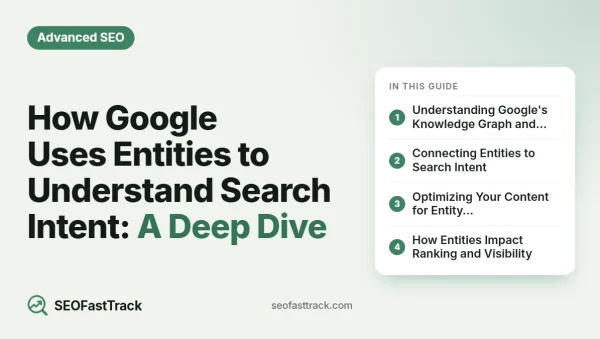
How Google Uses Entities to Understand Search Intent: A Deep Dive
Measure SEO Success at Scale: Programmatic SEO Tracking and Analytics
The Power of Context: Optimizing Content for Entity Understanding
Advanced SEO: Unlock Next-Level Search Performance
Welcome to the Advanced SEO hub on SEOFastTrack. If you’ve mastered the basics of keyword stuffing and meta tags, this is your playground for dominating search results through deeper intent, structured data, and automation. Here, we move beyond surface tactics to explore how search engines truly understand context, entities, and scale. Expect actionable frameworks for semantic relevance, entity authority, and automated content architecture—all tailored for small businesses, bloggers, and digital marketers who want sustainable, compounding growth.
🔥 Semantic SEO Strategies
Semantic SEO shifts focus from individual keywords to topical clusters and user intent. Here, you’ll learn to map out concept networks, use latent semantic indexing (LSI) naturally, and answer “people also ask” questions to build topical authority. Expect practical methods for crafting content that satisfies search engines’ understanding of meaning, not just string matching. You’ll discover how to use schema markup like FAQPage and HowTo to enhance rich snippets, and how to analyze competitor content gaps using TF-IDF tools. This subcategory is your key to ranking for long-tail, conversational queries that convert higher.
🧠 Entity SEO and Knowledge Graph Optimization
Entity SEO is about making your brand or topic a recognized “thing” in Google’s Knowledge Graph. We delve into how to build consistent NAP citations, leverage Wikipedia and Wikidata, and create strong internal linking to establish entity relationships. You’ll learn to position your website as the authoritative source for your niche by using sameAs schema, optimizing your Google Business Profile, and earning mentions from high-authority domains. This strategy reduces reliance on exact-match keywords and builds durable ranking power that survives algorithm updates. Expect advanced techniques for auditing your current entity presence and actionable steps to increase your digital footprint.
⚙️ Programmatic SEO for Scalability
Programmatic SEO is the ultimate lever for scaling content without multiplying manual effort. This section teaches you how to create data-driven page templates that generate hundreds of keyword-targeted pages from structured data sources—think city pages, product variations, or glossary terms. You’ll learn to design URL structures, metadata, and internal linking rules that avoid thin content penalties. We cover tools like Python, Google Sheets, and static site generators, plus real-world examples of low-competition, high-volume keywords ideal for automation. The goal is to help you release a content engine that grows your organic traffic exponentially while maintaining quality standards.
Frequently Asked Questions
What is the difference between semantic SEO and traditional keyword SEO?
Traditional SEO focuses on specific terms and phrases, optimizing each page for one or two keywords. Semantic SEO looks at the broader meaning and context behind a search query, covering related concepts, synonyms, and user intent. It builds topical authority by creating comprehensive content clusters, which helps search engines understand your expertise. This approach improves rankings for multiple variations without keyword stuffing, making your content more resilient to algorithm updates.
How long does it take to see results from entity SEO?
Entity SEO is a long-term strategy, typically showing noticeable impact within 3–6 months of consistent effort. It depends on your current brand awareness, competition, and the quality of your structured data. Start by cleaning up your NAP citations and adding sameAs schema to every page. Once Google recognizes your entity, you’ll see improved rankings for branded and non-branded queries. Continue building authoritative mentions and updating your Knowledge Graph panels for compounding benefits.
What are the risks of programmatic SEO?
The biggest risk is creating thin or duplicate content that Google penalizes. To avoid this, ensure each programmatic page has unique data and at least one paragraph of valuable, manually written or contextually varied copy. Use canonical tags and structured data to differentiate pages. Also, monitor performance regularly—if pages show high bounce rates or low engagement, refine your templates. Start small with a pilot program of 50–100 pages, then scale after validating quality and search engine acceptance.
Can small businesses benefit from advanced SEO techniques?
Absolutely. Small businesses often have the advantage of niche focus, allowing them to dominate specific entities or semantic topics that larger competitors ignore. For example, a local bakery can use semantic SEO to target gluten-free recipes, entity SEO to become recognized in local search, and programmatic SEO to create location-specific landing pages. These techniques are cost-effective and scalable, making them ideal for low-budget teams that want to compete with bigger players through smarter, not just harder, optimization.
Do I need to learn coding for programmatic SEO?
No, but basic familiarity with HTML and data handling helps. Many programmatic SEO setups use platforms like WordPress with custom post types and ACF fields, or simple spreadsheet-to-HTML generators. You can also use no-code tools like Glide or Zapier to automate page creation. However, knowing a bit of Python or JavaScript allows for more complex logic, such as auto-generating internal links based on data values. Start with tutorials on our site, and you’ll be launching your first programmatic campaign within a week.
Related topics