
How Google Uses Entities to Understand Search Intent: A Deep Dive

Ready to unlock the secrets behind Google's search algorithm and dramatically improve your website's ranking? At SEOFastTrack, we demystify SEO for small businesses, bloggers, and digital marketers. This isn't your average SEO guide; we're diving deep into Advanced SEO concepts. Discover how understanding Google entities and search intent is crucial for dominating search results. Prepare to uncover the strategies that transform clicks into conversions—let's explore how to leverage this powerful knowledge today!
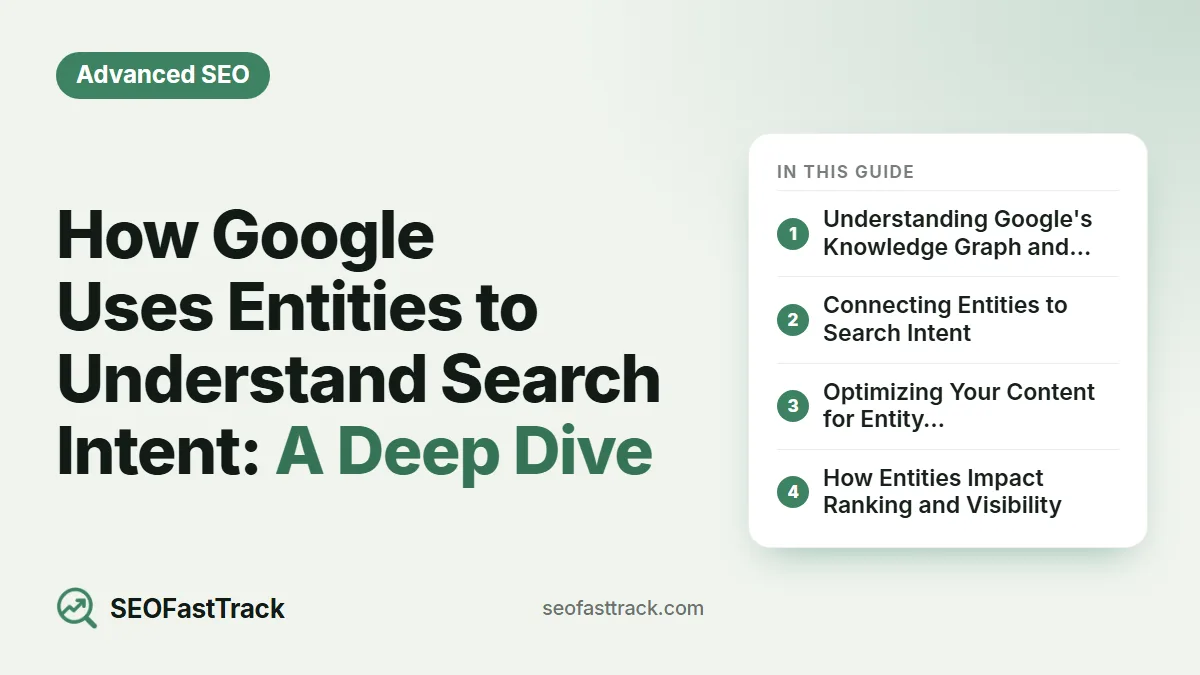
- Understanding Google's Knowledge Graph and Entity Recognition
- Connecting Entities to Search Intent: A Deeper Look
- Optimizing Your Content for Entity Recognition and Search Intent
- Case Studies: How Entities Impact Ranking and Visibility
- Measuring the Success of Your Entity Optimization Strategy
- Advanced Techniques for Entity SEO and Knowledge Graph Optimization
- Frequently Asked Questions
- Final Reflection: Unraveling the Intent Behind the Search
- Unlock Your Search Optimization Potential
Understanding Google's Knowledge Graph and Entity Recognition
What are Google Entities and How Does Google Identify Them?
Google entities are essentially "things" in the real world that Google's search engine can identify and understand. These entities can be people, places, organizations, concepts, or even abstract ideas. Think of them as nodes in a vast network of knowledge, where each node represents a distinct entity with its own unique identity and attributes. For example, "Albert Einstein," "Paris," "World Wildlife Fund," "Quantum Physics," and "Love" are all considered entities by Google. Google's ability to recognize and understand these entities is fundamental to its capacity to process and respond to search queries effectively.
Google identifies entities through a complex process involving natural language processing (NLP), machine learning, and its vast Knowledge Graph. The Knowledge Graph is a massive database containing information about billions of entities and their relationships. When Google crawls and indexes web pages, it uses NLP algorithms to identify potential entities within the text.
Factors like context, surrounding words, and existing knowledge within the Knowledge Graph help Google disambiguate and confirm the entity being referenced. For instance, if a text mentions "Apple" in the context of smartphones and technology, Google can confidently identify it as the "Apple Inc." entity, rather than the fruit. This identification process often involves analyzing structured data on websites, mentions across the web, and even user interactions to refine its understanding of each entity and its connections.
The Role of Schema Markup in Entity Recognition
Schema markup plays a crucial role in enhancing Google's entity recognition capabilities. Schema.org is a collaborative, community-driven vocabulary of structured data markups that webmasters can add to their HTML to help search engines better understand the content on their pages. By implementing schema markup, you are essentially providing Google with explicit clues about the entities mentioned on your website and their attributes. This structured data acts as a direct line of communication, making it significantly easier for Google to identify entities accurately and efficiently.
For example, if you have a webpage about a local restaurant, using schema markup like LocalBusiness and Restaurant clearly signals to Google that the page is about a specific business entity of the "restaurant" type. Furthermore, you can use schema to specify attributes of this entity, such as its name, address, cuisine, opening hours, and even menu items. This rich, structured information helps Google not only identify the restaurant as an entity but also understand its key characteristics. According to a study by Schema.org, websites using schema markup experience a 30% increase in click-through rates, suggesting that enhanced entity recognition, facilitated by schema, leads to better search visibility and user engagement.
Identifying Key Entities Relevant to Your Content
Identifying key entities relevant to your content is a critical step in optimizing for entity-based SEO. This process begins with a thorough understanding of your content's topic and the search intent behind it. Think about the core concepts, people, places, and organizations that are central to your subject matter.
These are likely to be the most important entities. For example, if you are writing a blog post about "The History of Coffee," key entities might include "Coffee," "Ethiopia" (the origin of coffee), "Brazil" (a major coffee producer), "Starbucks" (a prominent coffee company), and historical figures associated with coffee cultivation or trade.
Tools like Google's Natural Language API and various entity recognition tools can assist in identifying entities within your text automatically. These tools analyze your content and highlight potential entities, often categorizing them by type (person, location, organization, etc.). However, manual review is still essential to ensure accuracy and relevance. Consider the search queries users might employ to find your content.
What entities are implicitly or explicitly present in those queries? Aligning your content's entities with user search intent is crucial for attracting the right audience and improving your search ranking for relevant terms. By focusing on entities that are both semantically related to your topic and relevant to user search behavior, you can create content that resonates with Google's entity-aware search algorithms.
Connecting Entities to Search Intent: A Deeper Look
How Google Uses Entities to Interpret User Queries
Google's shift towards entity-based search is fundamentally driven by its desire to understand search intent more accurately. When a user enters a query, Google doesn't just look for keywords; it strives to understand the underlying meaning and the user's goal behind the search. Entities are the key to unlocking this deeper understanding. By recognizing entities within a query, Google can move beyond simple keyword matching and delve into the semantic context of the search.
For example, consider the query "best movies directed by Christopher Nolan". Instead of merely searching for pages containing these keywords, Google's entity recognition system identifies "Christopher Nolan" as a person entity and "movies" as a concept entity. It then leverages its Knowledge Graph to access information about Christopher Nolan and his filmography.
This allows Google to understand the user's intent is to find a curated list of highly-rated movies directed by this specific person. Consequently, the search results are tailored to provide lists, reviews, and information related to Christopher Nolan's best films, rather than just any page mentioning "Christopher Nolan" and "movies." This entity-driven approach leads to far more relevant and satisfying search results for the user.
Matching Entities to Search Terms and Contextual Clues
Matching entities to search terms and contextual clues is a sophisticated process that allows Google to bridge the gap between user language and its understanding of the world. It involves analyzing not just the keywords in a query but also the surrounding words, the user's search history (when available and permitted), location, and other contextual signals. This holistic approach enables Google to accurately identify the intended entity even when search terms are ambiguous or incomplete.
For instance, if a user searches for "jaguar," Google needs to determine whether they are interested in the animal, the car brand, or perhaps the operating system. Contextual clues are crucial here. If the search history includes previous searches for "wildlife documentaries" or "national geographic," Google might infer that the user is likely interested in the animal entity "Jaguar (Panthera onca)".
Conversely, if the user recently searched for "luxury cars" or "electric vehicles," the "Jaguar Cars" entity becomes more probable. Furthermore, geographic location plays a role; a search for "jaguar dealership" in London strongly suggests the car brand, while a search for "jaguar sightings" in Brazil points towards the animal. By combining search terms with these contextual layers, Google refines its entity identification and delivers search results that are highly relevant to the user's specific intent.
The Impact of Entity Relationships on Search Results
The relationships between entities significantly impact how Google ranks and presents search results. Google’s Knowledge Graph is not just a collection of entities; it's a network of interconnected entities, where relationships define how these entities interact and relate to each other. These relationships are crucial for understanding the nuances of search intent and providing comprehensive and contextually relevant search results. Google uses these relationships to determine the semantic relevance of content and to surface information that answers the user's query in a holistic manner.
Consider a search for "Italian restaurants near Central Park." Google identifies "Italian restaurants" and "Central Park" as entities. The relationship between these entities is "located near." Google then leverages its Knowledge Graph to identify restaurants classified as "Italian cuisine" and located geographically close to the "Central Park" entity.
It further considers relationships like "serves cuisine," "located in," "has reviews," and "price range" to rank and present the restaurants in search results. This focus on entity relationships allows Google to provide not just a list of restaurants, but a ranked list of Italian restaurants that are actually near Central Park and potentially relevant based on user preferences like ratings and price. This demonstrates how understanding entity relationships allows Google to go beyond keyword matching to deliver semantically rich and user-centric search experiences.
Optimizing Your Content for Entity Recognition and Search Intent
Keyword Research Focused on Relevant Entities
Traditional keyword research remains valuable, but optimizing for entity recognition necessitates a shift towards entity-focused keyword research. This involves identifying not just keywords, but the underlying entities associated with those keywords and the search intent they represent. Instead of solely targeting keywords like "best running shoes," entity-focused research would delve into the entities associated with running shoes, such as "Nike," "Adidas," "Brooks," "marathon running," "pronation," "cushioning," and specific shoe models like "Nike Air Zoom Pegasus."
Tools like Google's Keyword Planner can still be used to identify relevant keywords, but the focus shifts to understanding the entity landscape around those keywords. Explore "People Also Ask" and "Related Searches" sections in Google Search Results Pages (SERPs) to uncover entities frequently associated with your target keywords. Use entity recognition tools to analyze top-ranking content for your target keywords and identify the prominent entities being discussed.
For example, analyzing top results for "best running shoes" might reveal entities like "Road Runner Sports," "Saucony Kinvara," "New Balance Fresh Foam," and concepts like "neutral runners" and "stability shoes." By identifying these related entities, you can expand your keyword strategy to encompass a broader semantic space and target search intent more comprehensively. This entity-driven approach to keyword research ensures your content aligns with how Google understands and indexes information in the context of entities.
Incorporating Schema Markup for Enhanced Entity Recognition
Incorporating schema markup is a direct and effective way to enhance Google's entity recognition for your content. By adding structured data to your website, you provide explicit signals about the entities you are discussing and their attributes, making it easier for search engines to understand the semantic meaning of your pages. This is particularly crucial for disambiguating entities and ensuring Google correctly identifies the entities you intend to reference.
Start by identifying the primary entities on each page of your website. Use schema.org's vocabulary to find the most relevant schema types for these entities. For example, for a blog post about a famous author, you would use Person schema and specify properties like name, description, image, birthDate, deathDate, and works. For a product page, use Product schema, including properties like name, description, image, brand, offers (price, availability), and aggregateRating. Tools like Google's Structured Data Markup Helper can assist in generating schema markup code. Implement schema markup in JSON-LD format, as recommended by Google, for cleaner and easier implementation. Regularly test your schema markup using Google's Rich Results Test to ensure it is valid and correctly implemented. Consistent and accurate schema markup across your website significantly improves entity recognition and can contribute to richer search results and improved visibility.
Creating High-Quality Content that Contextualizes Entities
Creating high-quality content that contextualizes entities is paramount for ranking in an entity-driven search environment. Google prioritizes content that not only mentions relevant entities but also provides context, depth, and valuable information about them. Simply mentioning entities is not enough; you need to demonstrate your understanding of their significance, attributes, and relationships. This means moving beyond keyword stuffing and focusing on creating comprehensive, informative, and engaging content that revolves around your target entities.
Develop content that explores different facets of your key entities. For example, if your entity is "Electric Vehicles," don't just list electric car models. Discuss the history of electric vehicles, the technology behind them, the environmental benefits, charging infrastructure, government incentives, and future trends. Use diverse content formats like articles, blog posts, videos, infographics, and interactive tools to cater to different learning styles and provide a comprehensive understanding of the entities.
Incorporate real-world examples, case studies, statistics, and expert opinions to add credibility and depth to your content. Focus on answering user questions comprehensively and addressing various aspects of search intent related to your target entities. Content that provides rich context around entities is more likely to be perceived as valuable and authoritative by both users and Google, leading to improved rankings and visibility.
Building topical authority through entity linking is a powerful strategy for enhancing your website's entity recognition and overall SEO performance. Entity linking involves strategically linking between pages on your website, and even to reputable external resources, to establish clear relationships between entities and demonstrate your expertise within a specific topic area. This internal and external linking helps Google understand the semantic connections between your content and strengthens your website's authority around specific entities and topics.
Internally, link related entities within your website's content. If you have multiple articles discussing different aspects of "Sustainable Energy," ensure they are interlinked using relevant anchor text that highlights the entity being linked. For example, link from an article about "Solar Panels" to an article about "Wind Turbines" using anchor text like "wind energy" or "wind power." Externally, link to authoritative and reputable sources that provide further information about the entities you are discussing. Linking to Wikipedia pages, official organization websites, or reputable news sources can reinforce the credibility of your content and help Google contextualize the entities you are referencing. Use anchor text that is descriptive and entity-focused when linking both internally and externally. By strategically building a network of interconnected content focused on relevant entities, you signal to Google that your website is a comprehensive and authoritative resource on those topics, boosting your topical authority and search visibility.
Case Studies: How Entities Impact Ranking and Visibility
Case Study 1: Impact of Entity Optimization on a Recipe Website
Consider a recipe website, "Delicious Dishes," that initially focused solely on keyword-based SEO. They targeted keywords like "easy chicken recipes," "chocolate cake recipe," and "vegetarian pasta recipes." While they achieved some traffic, their rankings were inconsistent and often outranked by larger, more established websites. Recognizing the shift towards entity-based search, "Delicious Dishes" decided to optimize their content around entities.
They started by identifying key entities within their recipes. For a "Chicken Stir-Fry" recipe, entities included "Chicken Stir-Fry" (recipe entity), "Chicken Breast" (ingredient entity), "Soy Sauce" (ingredient entity), "Ginger" (ingredient entity), "Chinese Cuisine" (cuisine entity), and "Stir-frying" (cooking method entity). They implemented schema markup using Recipe schema, meticulously detailing these entities and their properties. They also enriched their recipe descriptions to contextually mention these entities and their relationships. For instance, instead of just saying "add soy sauce," they wrote "Enhance the umami flavor with high-quality soy sauce, a staple in Chinese cuisine." Furthermore, they internally linked related recipes based on shared entities like ingredients or cuisines.
Within three months of implementing entity optimization, "Delicious Dishes" saw a significant improvement in their search rankings for target recipes. For "chicken stir-fry recipe," they moved from position 8 to position 3 in Google search results. Organic traffic to their recipe pages increased by 45%. This case study demonstrates how focusing on entity recognition and semantic context, through schema markup and content enrichment, can significantly boost the search visibility of a recipe website, even in a competitive niche.
Case Study 2: Improving Search Visibility for a Local Business Through Entity Optimization
"Green Valley Family Dentistry," a local dental practice, struggled to rank for local search terms like "dentist near me" and "family dentist [city name]". They had a basic website with standard SEO practices, but their visibility in local search results and Google Maps was limited. To improve their local SEO, they adopted an entity-focused approach.
They identified key entities related to their business: "Green Valley Family Dentistry" (organization entity), their physical address (place entity), "Dentist" (profession entity), "Family Dentistry" (service entity), "Teeth Whitening" (service entity), "Dental Implants" (service entity), and the names of their dentists (person entities). They implemented LocalBusiness schema, providing detailed information about these entities, including their NAP (Name, Address, Phone Number) data, services offered, operating hours, and dentist profiles. They also optimized their Google My Business profile to align with these entities, ensuring consistent entity representation across their online presence. On their website, they created service pages that contextually discussed these entities, for example, detailing the benefits of "teeth whitening" and the process of "dental implants," linking these services back to their practice entity.
Within two months, "Green Valley Family Dentistry" saw a noticeable improvement in their local search rankings. They started appearing in the top 3 results for "dentist near me" and "family dentist [city name]" searches within their service area. Google Maps visibility also increased significantly, leading to a 30% rise in appointment bookings through online channels. This case study illustrates how entity optimization, particularly through schema markup and consistent entity representation across online platforms, can dramatically improve local search visibility and drive business growth for local businesses.
Key Takeaways from the Case Studies
These case studies highlight several key takeaways regarding the impact of entity optimization on ranking and visibility:
- Schema Markup is Crucial: Both case studies demonstrate the effectiveness of schema markup in enhancing entity recognition and improving search visibility. Implementing schema provides explicit signals to Google about the entities on your website.
- Contextual Content Matters: Simply mentioning entities is not enough. Creating content that provides context, depth, and valuable information about entities is essential for ranking in an entity-driven search environment.
- Entity Relationships are Important: Linking related entities internally and externally helps Google understand the semantic connections within your content and strengthens your topical authority.
- Entity Optimization Drives Tangible Results: Both "Delicious Dishes" and "Green Valley Family Dentistry" experienced significant improvements in search rankings and traffic after implementing entity optimization strategies, demonstrating the real-world impact of this approach.
- Entity SEO Benefits Various Niches: These case studies represent different types of websites – a recipe website and a local business – showcasing that entity SEO is beneficial across various industries and niches.
Measuring the Success of Your Entity Optimization Strategy
While entity optimization is about more than just keywords, tracking keyword rankings related to your target entities remains a valuable metric for measuring success. Monitor the search engine ranking positions (SERPs) for keywords that are directly associated with your primary entities and the search intent you are targeting. For example, if you are optimizing for the entity "Electric Vehicles," track rankings for keywords like "best electric cars," "electric vehicle charging stations," "benefits of electric cars," and specific electric car models.
Use SEO ranking tracking tools like SEMrush, Ahrefs, or Moz to monitor your keyword rankings over time. Segment your keyword tracking to focus on entity-related keywords and compare your rankings before and after implementing entity optimization strategies. Pay attention to ranking improvements for long-tail keywords that incorporate entity names and attributes.
For instance, instead of just "electric cars," track rankings for "best electric cars for city driving" or "most affordable electric cars with long range." While keyword rankings are not the sole indicator of success, significant improvements in rankings for entity-related keywords suggest that your entity optimization efforts are contributing to better search visibility.
Monitoring organic traffic from entity-related searches provides a more direct measure of the impact of your entity optimization efforts on attracting relevant users. Analyze your website's organic traffic in Google Analytics or Google Search Console, focusing on traffic originating from search queries that contain your target entities or related concepts.
Segment your organic traffic data to identify traffic from keywords that include entity names, categories, or attributes. For example, if you are targeting the entity "Sustainable Fashion," analyze traffic from queries like "sustainable clothing brands," "eco-friendly fashion trends," "organic cotton clothing," and "recycled polyester fabrics." Track the growth in organic traffic from these entity-related search queries over time.
Also, monitor the landing pages that are receiving this entity-related traffic. Are they the pages you optimized for specific entities? Increased organic traffic from entity-related searches indicates that your content is effectively attracting users who are searching for information related to your target entities, demonstrating the success of your entity optimization strategy in reaching the intended audience.
Analyzing user behavior on your website, particularly for pages optimized for specific entities, provides valuable insights into user engagement and the effectiveness of your entity optimization strategy in satisfying search intent. Metrics like bounce rate, time on page, pages per session, and conversion rates on entity-focused pages can reveal how users are interacting with your content and whether it is meeting their needs.
In Google Analytics, analyze the user behavior metrics for landing pages that are optimized for specific entities and are receiving entity-related organic traffic. A low bounce rate and high time on page on these pages suggest that users are finding the content relevant and engaging. A high pages per session indicates that users are exploring more content on your website after landing on entity-focused pages, demonstrating that your content is providing a comprehensive and valuable experience.
Track conversion rates, such as contact form submissions, product purchases, or newsletter sign-ups, on entity-optimized pages. Improved user behavior metrics and higher conversion rates on entity-focused pages indicate that your entity optimization strategy is not only driving traffic but also delivering a positive user experience and achieving your business goals.
Advanced Techniques for Entity SEO and Knowledge Graph Optimization
Leveraging Entity Linking Tools and Platforms
Leveraging entity linking tools and platforms can significantly streamline and enhance your entity SEO efforts. These tools automate and simplify the process of identifying, annotating, and linking entities within your content, saving time and improving accuracy. Several tools and platforms are available, each offering different features and functionalities.
Entity Linking APIs: Services like Google Cloud Natural Language API, Amazon Comprehend, and Microsoft Text Analytics offer APIs that can automatically identify entities within text and link them to knowledge bases like Wikidata or DBpedia. These APIs can be integrated into your content management system (CMS) or used for batch processing of content to identify and annotate entities at scale.
Entity Linking Plugins and Extensions: Plugins for WordPress and browser extensions are available that can help identify and link entities directly within your content creation workflow. These tools often provide suggestions for relevant entities and facilitate the process of adding schema markup and internal links.
Knowledge Graph Platforms: Platforms like Neo4j and GraphDB allow you to build and manage your own knowledge graphs, enabling you to model entity relationships and leverage graph databases for content organization and SEO optimization. These platforms are particularly useful for websites with large amounts of interconnected content and complex entity relationships.
By leveraging these entity linking tools and platforms, you can automate entity identification, improve the accuracy of entity annotation, and streamline the process of building a semantically rich and entity-optimized website.
Understanding the Importance of Co-citation and Co-occurrence
Understanding the concepts of co-citation and co-occurrence is crucial for advanced entity SEO and Knowledge Graph optimization. These concepts describe how entities are related based on how they are mentioned together across the web, providing valuable signals to search engines about semantic relationships and topical relevance.
Co-citation: Co-citation refers to the frequency with which two entities are cited together in academic papers, research articles, or web pages. If entity A and entity B are frequently co-cited, it suggests a strong semantic relationship between them. In SEO, co-citation can be understood as when multiple websites mention two or more entities together in their content, without explicitly linking to each other.
Google uses co-citation as a signal to understand entity relationships and topical associations. To leverage co-citation, ensure your content comprehensively covers related entities within your topic area, increasing the likelihood of other websites mentioning your entities alongside related entities when discussing the same topics.
Co-occurrence: Co-occurrence refers to the frequency with which two entities appear together within the same document or context. If entity A and entity B frequently co-occur within web pages, it indicates a semantic relationship between them. Google analyzes co-occurrence patterns to understand how entities are related within content and to determine topical relevance.
To optimize for co-occurrence, ensure your content comprehensively covers related entities and concepts within the same page or article. For example, if your target entity is "Electric Cars," include co-occurring entities like "Lithium-ion Batteries," "Charging Infrastructure," "Renewable Energy," and "Tesla" within your content to reinforce the semantic context and topical relevance.
By understanding and leveraging co-citation and co-occurrence, you can create content that signals strong semantic relationships between entities, enhancing Google's understanding of your content's topic and improving your website's topical authority.
Future Trends in Entity SEO and Knowledge Graph Optimization
The field of Entity SEO and Knowledge Graph Optimization is constantly evolving, driven by advancements in artificial intelligence, natural language processing, and search engine algorithms. Several future trends are likely to shape the landscape of Entity SEO in the coming years.
Increased Reliance on Knowledge Graphs: Google and other search engines are expected to increasingly rely on Knowledge Graphs to understand and organize information. Optimizing for entities and knowledge graph inclusion will become even more critical for SEO success.
Semantic Search Dominance: Search engines will continue to move towards semantic search, focusing on understanding user intent and the meaning behind queries rather than just keyword matching. Entity optimization will be central to achieving high rankings in semantic search.
AI-Powered Content Creation and Optimization: AI tools will play a growing role in content creation and SEO optimization, including entity identification, content generation, and schema markup implementation. SEO professionals will need to leverage AI to enhance their entity SEO strategies.
Voice Search and Conversational Search: The rise of voice search and conversational search will further emphasize the importance of entities. Search queries will become more conversational and entity-focused, requiring content optimized for natural language understanding and entity recognition.
Personalized and Contextualized Search Experiences: Search results will become increasingly personalized and contextualized based on user location, search history, and preferences. Entity optimization will be crucial for delivering relevant and personalized search experiences.
Staying informed about these future trends and adapting your Entity SEO strategies accordingly will be essential for maintaining and improving your search visibility in the evolving search landscape.
Frequently Asked Questions
What are Google entities, and why are they important for SEO?
Google entities are real-world concepts like people, places, things, and events. Understanding and using them in your content helps Google better understand your page's topic, improving your chances of ranking for relevant searches. This directly impacts search intent fulfillment.
How does Google use entities to determine search intent?
Google uses entities to contextualize search queries. By identifying the entities mentioned in a query and on your webpage, Google determines if your content aligns with the user's intended purpose for the search. Accurate entity usage improves relevance.
What is the relationship between entities and keyword research?
Effective keyword research should identify relevant entities related to your target keywords. Incorporating these entities into your content helps Google understand the context and scope of your page, leading to better rankings for more specific search terms.
How can I optimize my website to incorporate Google entities?
Use schema markup to explicitly tell Google about the entities on your page. Also, naturally incorporate relevant entity names within your content, ensuring they're contextually appropriate and not keyword-stuffed. High-quality content is key.
Are there any tools to help with entity optimization?
While no single tool directly optimizes for entities, tools like Google Search Console and SEMrush can help you identify relevant keywords and topics, which in turn inform your entity usage. Analyzing your competitors' content can also reveal relevant entities.
Final Reflection: Unraveling the Intent Behind the Search
Understanding how Google uses entities to interpret search intent is no longer a niche technicality; it's the bedrock of effective SEO in the modern digital landscape. The sheer volume of information online necessitates sophisticated algorithms, and Google's reliance on entities provides a crucial framework for delivering relevant results amidst the chaos. This understanding is not just about technical optimization; it's about connecting with users on a deeper level.
The evolution of search, driven by advancements in entity recognition and natural language processing, has profoundly impacted how we interact with information. This shift from keyword-focused strategies to a more nuanced understanding of user intent has forced a necessary adaptation in the way we approach content creation and digital marketing. As the famous quote by Peter Drucker states: The best way to predict the future is to create it.
By understanding and leveraging Google's entity-based approach, we actively participate in shaping the future of search and information retrieval.
The journey into the world of Google entities and search intent doesn't end here. This exploration should inspire you to critically examine your own content strategy. Ask yourself: How well does your content reflect a deep understanding of user needs and intent?
Are you structuring your content in a way that allows Google's algorithms to easily understand the entities and relationships within your work? By embracing this knowledge and continuously adapting your approach, you can not only improve your search rankings but also create more meaningful and engaging experiences for your audience. The future of search is semantic, and your understanding of entities is your key to unlocking its potential.
Unlock Your Search Optimization Potential
Thanks for diving deep into the world of Google entities and search intent with us! You've now gained valuable insights into how understanding entities can supercharge your SEO strategy. Ready to put this knowledge into action?
- Craft a killer entity-focused content plan: Identify key entities relevant to your niche and create content specifically designed to target them. This is your primary action step to directly apply what you've learned.
- Share your newfound knowledge: Discuss this article with fellow SEO professionals on social media – let's spark a conversation!
- Explore Google's Knowledge Graph: Take some time to investigate specific entities within your industry – you might be surprised by what you discover.
What surprising entity connections will you uncover in your next SEO campaign?