Entity SEO and Knowledge Graph Optimization
Read more about this topic
Entity SEO and Knowledge Graph optimization are the next frontier in search—moving beyond keywords to help Google understand your brand as a distinct, credible thing. By structuring your content around entities (people, places, products, and concepts) and their relationships, you can earn rich results, brand panels, and featured snippets that boost visibility. This advanced approach builds topical authority, improves voice-search relevance, and future-proofs your site against AI-driven updates. Start mapping your entity ecosystem, leverage schema markup, and align your digital footprint to get discovered not just for queries, but for knowledge-based answers.
3 articles

Articles in Entity SEO and Knowledge Graph Optimization

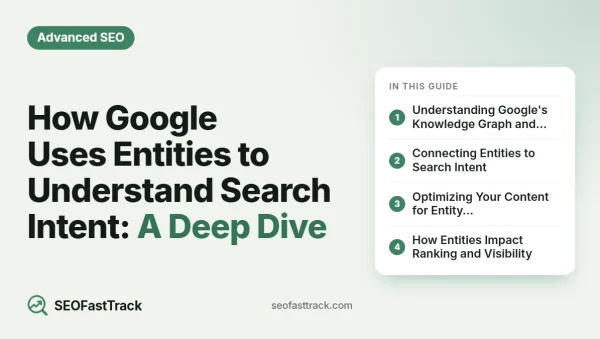
How Google Uses Entities to Understand Search Intent: A Deep Dive
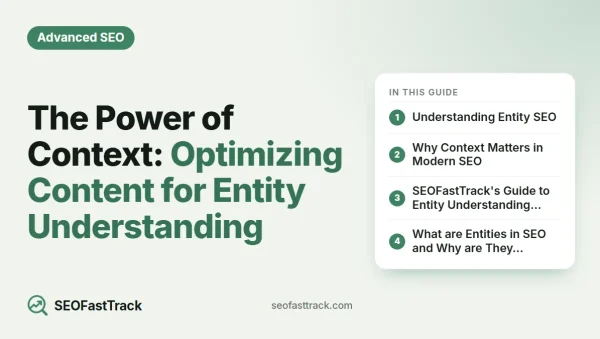
The Power of Context: Optimizing Content for Entity Understanding
Master Entity SEO and Knowledge Graph Optimization for Higher Rankings
Welcome to the Entity SEO and Knowledge Graph Optimization subcategory at SEOFastTrack. Here, we focus on shifting your SEO strategy from keyword-centric to entity-centric, helping search engines understand the who, what, and how of your brand. By optimizing for entities, you can secure rich results, improve brand visibility, and dominate niche queries. This guide offers practical steps to build your digital footprint as a recognized entity in Google’s Knowledge Graph—a competitive edge every modern business needs.
🔍 What Is Entity SEO and Why Does It Matter?
Entity SEO refers to optimizing your online presence so search engines can identify your brand, person, or product as a distinct, trusted entity with defined attributes. Unlike traditional keyword targeting, entity SEO leverages relationships between concepts, people, and places. Google’s Knowledge Graph uses this data to provide factual answers, featured snippets, and panel results, which dramatically increase click-through rates. For small businesses and bloggers, becoming an entity means you’re not just a web page but a reliable source.
When you master entity SEO, you future-proof your site against algorithm updates that prioritize meaning over strings. You’ll see better performance on voice search, conversational queries, and zero-click searches. Moreover, a strong entity profile helps you earn backlinks and citations naturally, as others reference your established authority. Start by creating consistent NAP (Name, Address, Phone) data across platforms, then build out your website with clear schema markup to signal your identity to crawlers.
🧠 Building Your Knowledge Graph Profile: Schema Markup Essentials
To get into Google’s Knowledge Graph, you need structured data that explicitly defines your entity. Use schema.org vocabulary with types like Organization, Person, or LocalBusiness. Add properties such as logo, founding date, social profiles, and contact points. For content creators, use Author and Article types to link your byline to your entity. Implement JSON-LD format as it’s easiest for search engines to parse. Validate your markup using Google’s Rich Results Test to ensure no errors.
Beyond basic markup, use SameAs properties to connect your website to your Wikipedia page, LinkedIn, Twitter, and other authoritative profiles. This explicitly tells Google that all these pages refer to the same entity. Also, create a dedicated “About Us” or “About Me” page that answers fundamental questions (who, what, when) about your brand. Regularly update your schema as your business evolves—adding new products, locations, or team members—to keep your Knowledge Panel fresh and accurate.
📈 Topical Authority and Content Clustering for Entity Recognition
Search engines assign entity status to those who demonstrate deep expertise in a niche. Build topical authority by publishing comprehensive cluster content around one core entity topic. For example, if you’re a digital marketer, your hub page could be “Digital Marketing Guide,” with cluster posts on SEO, PPC, and email marketing. Each cluster should link back to the hub and to each other, creating an interconnected web of meaning. This approach signals to Google that your site is a one-stop resource, reinforcing your entity’s relevance.
Use entity-related keywords naturally within your content—not just primary keywords but also synonyms, related concepts, and entities like tools, competitors, or influencers. For instance, mention industry standards, certifications, and partner brands to build semantic context. Additionally, earn mentions from credible sources (press releases, guest posts) using your brand name and logo consistently. The more co-occurrences of your entity with respected terms, the faster Google will trust and rank you higher for broader queries.
🔗 Leveraging Wikipedia and Wikidata for Authority Signals
One of the quickest ways to accelerate Knowledge Graph inclusion is to secure a Wikipedia page or improve an existing one. Wikipedia’s credibility is recognized by Google as a trustworthy entity source. If you qualify (notability criteria), create a neutral, well-cited article about your business or personal brand. Ensure your official website is listed in the references section. Then, link your Wikipedia page to your Wikidata item, which acts as the central repository for entity data across all languages and platforms.
If Wikipedia isn’t feasible, use Wikidata directly by creating a concise entry for your entity (if one doesn’t exist). Add aliases, descriptions, and statements (e.g., industry, country, official website). This alternative still helps Google understand your entity’s core attributes. Additionally, get listed on industry-specific directories, professional associations, and review sites with consistent formatting. Each structured mention adds a data point that strengthens your entity graph, making it easier for search engines to resolve queries about you.
⚙️ Optimizing for Voice Search and AI Overviews with Entities
Voice search and AI-generated overviews rely heavily on entity relationships. When users ask “What is the best SEO tool for small businesses?” Google answers based on entity benefits, user reviews, and authoritative comparisons—not just keyword density. To optimize, create content that directly answers who, what, when, where, and why questions about your entity. Use FAQ schema to mark up these Q&A sections, giving search engines clear, extractable answers. Also, write in a conversational tone that mirrors spoken queries.
Structure your data using HowTo or FAQPage schemas to increase your chances of appearing in voice results. Additionally, ensure your website loads fast and is mobile-friendly since voice searches usually happen on mobile devices. Monitor your performance in AI overviews by searching for your brand plus common queries. If you find inaccuracies, adjust your public data and schema. Over time, a robust entity profile leads to higher visibility across all modern search interfaces, positioning you as the default answer.
📊 Measuring Entity SEO Success and Adjusting Strategy
Unlike traditional SEO metrics, entity SEO success is measured through brand mentions, Knowledge Panel updates, and rich result impressions. Use Google Search Console to track impressions for your brand name plus product-related keywords. Monitor your Knowledge Panel for accuracy—if it incorrectly identifies you, report it via the feedback link. Also, use tools like Brand24 or Mention to track how often others reference you with your entity attributes. Increased co-occurrence with authoritative sites is a positive signal.
Track your performance in featured snippets and local pack results. If you see declining visibility, audit your schema markup and citation consistency. Consider running a competitor analysis to see which entities they are associated with and where you have gaps. Since entity recognition evolves, periodically review your Wikidata and Wikipedia entries for outdated data. Remember: entity SEO is a long-term investment. Consistency in your digital identity across all channels is the primary driver of sustained Knowledge Graph presence.
Frequently Asked Questions
How long does it take to appear in Google’s Knowledge Graph?
There’s no fixed timeline, but with consistent schema markup, high-authority backlinks, and a Wikipedia entry, you may see a Knowledge Panel within 3 to 6 months. Without Wikipedia, it can take longer. Focus on building real-world recognition and credible citations to speed up the process.
Can small businesses benefit from entity SEO without a Wikipedia page?
Yes, absolutely. You can use Wikidata, schema.org, and consistent NAP data to build an entity. Google also recognizes entities through local business databases, review sites, and social profiles. Even a local bakery can gain rich results by optimizing their Google Business Profile and linking related entities.
What is the difference between schema markup and entity SEO?
Schema markup is a tool that helps search engines parse your data, while entity SEO is the broader strategy of establishing your identity and relevance. You can have schema without entity SEO, but effective entity SEO uses schema along with citations, content hierarchy, and authoritative mentions to create a complete entity profile.
How do I find out if Google has already created a Knowledge Panel for my brand?
Simply search for your exact brand name in an incognito browser. If a Knowledge Panel appears on the right side, Google has recognized you as an entity. Check whether the information is accurate, and use the “Suggest edits” or “Feedback” link to correct any mistakes. If no panel exists, look for your brand in search results to identify what entities are being confused with.
Does entity SEO affect local search rankings?
Yes, entity optimization heavily impacts local SEO. When your business is recognized as a distinct entity, Google can associate your listings with your physical location, reviews, and services. You’ll see improvements in the local pack, Google Maps rankings, and voice queries like “near me,” provided your citations and schema are consistent across all platforms.
Related topics