
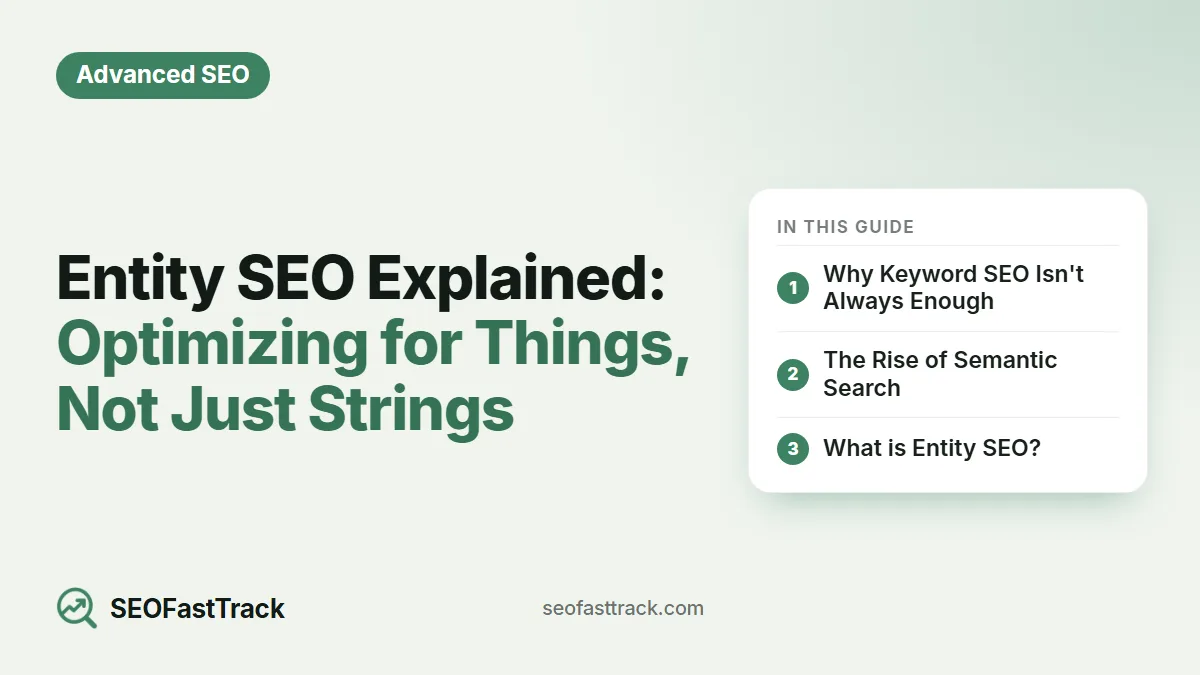
Entity SEO Explained: Optimizing for Things, Not Just Strings

Welcome to SEOFastTrack, your ultimate resource for mastering search engine optimization!
Are you ready to move beyond simple keyword stuffing and unlock the true potential of your online presence? In today's dynamic search landscape, it's no longer enough to just target keywords. Dive into the world of Entity SEO for small businesses and discover how optimizing for things, not just strings, can dramatically improve your search rankings. Curious how understanding entities can give your business a competitive edge? Let's explore this advanced SEO strategy and transform the way search engines understand your brand.
- Introduction to Entity SEO
-
Frequently Asked Questions
- ### What is Entity SEO and how does it differ from traditional keyword-based SEO?
- ### Why is Entity SEO important for small businesses?
- ### How can a small business identify its key entities?
- ### What are some practical steps small businesses can take to implement Entity SEO?
- ### How can small businesses measure the success of their Entity SEO efforts?
- Final Reflection: Embracing the Semantic Web
Introduction to Entity SEO
Why Keyword SEO Isn't Always Enough
For years, keyword SEO reigned supreme. The strategy was straightforward: identify the keywords your target audience uses, sprinkle them strategically throughout your website content, and climb the search engine rankings. This approach, while effective in its early days, focused primarily on matching strings of text to search queries. However, search engines, particularly Google, have evolved significantly.
They are no longer just string-matching machines; they aim to understand the meaning behind search queries and website content. Relying solely on keywords today can be limiting because it often misses the nuanced understanding of user intent and the broader context surrounding a topic. Imagine searching for "best Italian restaurants near me". A keyword-focused approach might only target pages with those exact words, potentially overlooking excellent Italian eateries described with slightly different phrasing, or those not heavily optimizing for that specific keyword string but still highly relevant to the user's need.
The limitations of keyword-centric SEO become even more apparent with the increasing complexity of search queries. Users are now using longer, more conversational search phrases, reflecting a desire for specific and nuanced information. Simply optimizing for broad keywords like "Italian restaurant" is no longer sufficient.
Search engines need to understand the user's underlying intent – are they looking for a romantic dinner spot, a family-friendly pizzeria, or a place with outdoor seating? Keyword SEO, in isolation, struggles to capture this depth of meaning. Furthermore, keyword stuffing and unnatural keyword usage, once common tactics, are now penalized by search engine algorithms, highlighting the need for a more sophisticated and context-aware approach to SEO.
The Rise of Semantic Search
The evolution beyond keyword-based search led to the rise of semantic search. Semantic search is about understanding the meaning and context of words, rather than just the words themselves. It's about deciphering the intent behind a user's query and delivering results that are not only relevant in terms of keywords but also conceptually aligned with the user's needs.
This shift was significantly propelled by Google's introduction of the Hummingbird algorithm update in 2013 and further enhanced by subsequent updates like RankBrain and BERT. These updates signaled a fundamental change in how Google processes and understands information, moving away from a purely lexical approach to a semantic one.
Semantic search leverages technologies like Natural Language Processing (NLP) and machine learning to analyze the relationships between words, concepts, and entities. Instead of just counting keyword occurrences, search engines now analyze the overall topic of a page, the entities it discusses, and the relationships between those entities. For example, if you search for "restaurants owned by famous chefs", semantic search understands that you are interested in restaurants, chefs, and the ownership relationship between them.
It can then identify pages that discuss celebrity chefs and their restaurants, even if those pages don't explicitly use the exact phrase "restaurants owned by famous chefs." This deeper understanding allows search engines to provide more accurate, relevant, and comprehensive search results, leading to a better user experience and necessitating a more sophisticated approach to SEO.
What is Entity SEO?
Entity SEO is a strategic approach to search engine optimization that focuses on optimizing for entities rather than just keywords. Entities are "things" – people, places, organizations, concepts, events, products, and more – that search engines can identify and understand. Entity SEO recognizes that search engines like Google are increasingly focused on understanding the world in terms of these entities and their relationships.
It’s about ensuring that search engines can clearly identify and understand the entities relevant to your business and content, and recognize you as an authority within your niche or industry concerning these entities. This involves not just mentioning keywords, but providing rich, contextual information around the entities you want to be associated with.
Essentially, Entity SEO shifts the focus from optimizing for strings of text to optimizing for real-world concepts and things. It's about building a strong online presence centered around your core entities, demonstrating expertise, authority, and trustworthiness (E-A-T) in relation to these entities.
Instead of just targeting the keyword "coffee shop," entity SEO would aim to establish your business as an entity that is clearly understood by search engines as a "coffee shop" located at a specific place, serving specific types of coffee, perhaps owned by a particular person, and associated with positive attributes like "best coffee," "friendly service," or "cozy atmosphere." By optimizing for entities, you're aligning your SEO strategy with the way modern search engines are designed to understand and index the web, leading to more sustainable and effective long-term results.
Frequently Asked Questions
### What is Entity SEO and how does it differ from traditional keyword-based SEO?
Entity SEO focuses on understanding and optimizing for things, not just strings of text. It goes beyond keywords to understand the relationships and context surrounding a topic, while traditional SEO often prioritizes matching specific keywords.
### Why is Entity SEO important for small businesses?
Entity SEO helps small businesses establish authority and relevance in their niche. By clearly defining their business as a distinct entity, they can improve their visibility in search results and attract a more targeted audience.
### How can a small business identify its key entities?
Start by identifying your core business offerings, products, and services. Then, consider related entities like your industry, target audience, and competitors. Use tools like Google's Knowledge Graph API to further refine your entity identification.
### What are some practical steps small businesses can take to implement Entity SEO?
Implement structured data markup (Schema.org) on your website to define your entities. Create high-quality content that thoroughly covers your chosen entities and their relationships. Build out a Google Business Profile, this is crucial for local entity association.
### How can small businesses measure the success of their Entity SEO efforts?
Track metrics like branded search volume, knowledge panel visibility, and improved ranking for relevant keywords. Monitor your website's overall organic traffic and engagement to assess the impact of your entity-focused optimization.
Final Reflection: Embracing the Semantic Web
The shift from keyword-centric SEO to Entity SEO represents a fundamental evolution in how we understand and engage with search engines. No longer can small businesses rely solely on stuffing keywords into content; they must now focus on establishing themselves as credible entities within the vast network of knowledge that defines the semantic web. This transition is not just a technical adjustment, but a philosophical one, demanding a deeper understanding of context, relationships, and the very essence of what a business represents.
This focus on entities has profoundly influenced the digital landscape, pushing businesses to cultivate genuine authority and build meaningful connections with their audience. The journey towards Entity SEO is a continuous process of refinement and adaptation, requiring a commitment to providing valuable information and establishing trust. The goal is no longer to rank for keywords; it's to be the best answer, regardless of the query.
This quote encapsulates the essence of Entity SEO, highlighting the importance of providing comprehensive and authoritative information that resonates with users and search engines alike.
As you navigate the complexities of the digital world, remember that Entity SEO is not just about algorithms; it's about building a lasting legacy for your business. Embrace the power of knowledge graphs, cultivate your brand's identity, and strive to become a trusted source of information within your niche. Reflect on how you can contribute to the semantic web, not just by optimizing for search engines, but by enriching the online experience for your customers and the wider community.
Learn how to boost your website's search ranking with entity SEO. Stop focusing solely on keywords; understand how to optimize for the things your audience searches for. Discover strategies to improve your site's visibility and attract more organic traffic. Get started today and unlock the power of entity SEO!