
Amazon SEO Optimization
Read more about this topic
Unlock the full potential of your online storefront with Amazon SEO Optimization — the strategic art of making your products impossible to ignore in the world’s largest marketplace. In the crowded aisles of Amazon, where millions of listings compete for a click, simply having a great product isn’t enough. Our tailored strategies focus on keyword research, backend search terms, title optimization, and bullet point refinement, ensuring your listing aligns precisely with what your ideal customers are typing into that search bar. By mastering Amazon’s A9 algorithm, you’ll boost your organic rankings, increase your click-through rate, and convert more browsers into loyal buyers. Whether you’re a small seller or scaling an established brand, our proven tactics help you dominate niche searches, reduce ad spend, and maximize every product page’s visibility. Ready to turn search queries into sales? Dive into our expert, actionable insights and watch your listing climb the ranks — your competition won’t know what hit them.
3 articles

Articles in Amazon SEO Optimization
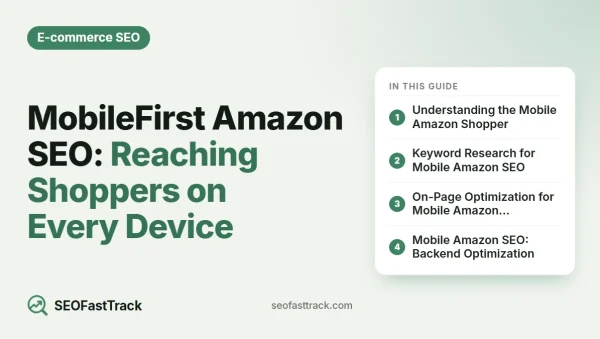
MobileFirst Amazon SEO: Reaching Shoppers on Every Device
Amazon Product Title Secrets: Write Titles That Convert & Rank Higher
Amazon SEO Optimization: Dominate Product Search Rankings
Amazon SEO Optimization is the targeted practice of improving your product listings to rank higher in Amazon’s search engine and, ultimately, boost conversion rates. For sellers on the world’s largest e-commerce marketplace, this means moving beyond basic keyword stuffing. It’s about understanding A9 and A10 algorithms, aligning with buyer intent, and crafting listings that both robots and humans love. On SEOFastTrack, we break down the tactical elements to help small businesses and digital marketers turn product pages into high-velocity sales assets. This subcategory is your blueprint for organic visibility on Amazon, covering everything from backend search terms to strategic review generation.
🔍 Mastering Amazon Keyword Research for Higher Rankings
Effective Amazon SEO begins with discovering the exact phrases shoppers type into the search bar. Unlike Google, Amazon’s algorithm prioritizes purchase intent, meaning your focus should be on long-tail keywords with commercial value. We guide you through using tools like Helium 10, Jungle Scout, and Amazon’s own autocomplete to identify high-volume, low-competition terms. You’ll learn to analyze competitor listings and extract keywords that drive sales, not just traffic.
Moreover, you’ll discover the critical difference between front-end and backend keywords. Front-end keywords appear naturally in your title, bullets, and description, while backend search terms (invisible to shoppers) can be used to include synonyms and misspellings. This dual-layer strategy ensures you capture every possible entry point. By optimizing for relevance and conversion, you not only improve placement but also enhance click-through rates, which Amazon rewards with even higher visibility.
📝 Crafting High-Converting Product Titles and Bullet Points
Your product title is the single most powerful SEO element on Amazon. It must serve two masters: the algorithm and the human buyer. We teach you how to structure titles that place the most critical keywords first, include brand, product type, material, and size, while remaining readable. Avoid keyword stuffing; instead, use natural language that communicates value. A well-optimized title can increase click-through rates by over 40%, directly impacting your organic ranking.
Beyond the title, bullet points should expand on benefits and features while reinforcing secondary keywords. Each bullet should answer a buyer question or solve a pain point, incorporating terms like “easy to clean,” “durable,” or “gift ready.” We demonstrate how to format bullets for mobile readability, as most Amazon traffic is mobile. By weaving SEO keywords into persuasive, benefit-driven copy, you create a listing that converts visitors into customers, signaling to Amazon that your product deserves top placement.
🖼️ Optimizing Product Images and A+ Content for SEO
Amazon’s algorithm uses image quality as a proxy for customer satisfaction, but images also impact SEO through load time and alt-text relevance. We guide you on using high-resolution images (at least 1000×1000 pixels) to enable zoom, and how to name image files with descriptive, keyword-rich filenames. Additionally, infographics that highlight features support keyword usage in the alt-text field, giving search engines more context.
A+ Content (or Enhanced Brand Content) is a game-changer for both Shopify and Amazon SEO. While it primarily improves conversion, it also provides additional text fields where you can incorporate keywords naturally. We show you how to build modular A+ pages with comparison charts, lifestyle imagery, and storytelling copy. This increases time on page and purchase confidence, both positive signals to Amazon. For brands, investing in A+ content can lift conversion rates by up to 8%, making it a core SEO strategy.
📦 Leveraging Backend Search Terms and Indexing
The backend search terms field is your secret weapon, offering 250 bytes of exploitable space (or 1000 characters for newer sellers) to include keywords not visible in your listing. We explain how to fill this field with synonyms, misspellings, abbreviations, and related terms that shoppers might use. You’ll learn to avoid repeating words already in the title and bullets to maximize your character allowance. Correct backend optimization ensures your product is indexed for every relevant query.
Indexing is the foundational step; if your product lacks the keyword index, it won’t rank at all. We cover troubleshooting techniques to verify indexing using URLs and the search bar. Additionally, we discuss the importance of avoiding prohibited terms and keeping the field clean. By mastering backend search terms, you expand your reach without cluttering the visible listing, giving you a competitive edge in niche searches.
⭐ The Role of Reviews and Sales Velocity in Amazon SEO
Amazon’s A9/A10 algorithm views reviews not just as social proof but as a critical ranking factor. Products with higher review counts and better ratings consistently outrank competitors. We show ethical strategies to generate reviews, including request buttons, automated follow-up emails, and Amazon Vine enrollment for new products. You’ll also learn how to respond to negative reviews constructively, as this engagement signals vendor health to the algorithm.
Sales velocity—the rate at which you sell items—is the strongest ranking signal. We explain how pricing, promotions, and PPC (Pay-Per-Click) ads can temporarily boost velocity, which then breaks the organic ranking barrier. By pairing your SEO optimization with a solid advertising strategy, you can push products into the “best seller” tier. This H3 section provides actionable tactics to sustainably increase velocity without violating Amazon’s terms of service.
Frequently Asked Questions
How quickly can I see results from Amazon SEO Optimization?
Most sellers notice improved rankings within 2-4 weeks after optimizing titles, backend keywords, and fixing indexing issues. However, significant jumps in sales rankings often take 3-6 months because Amazon’s algorithm requires sustained sales velocity. Consistency in optimization and content updates will accelerate progress, but patience is essential.
What is the difference between Amazon SEO and Google SEO?
Amazon SEO focuses on conversion signals and purchase intent, while Google SEO prioritizes informational queries and backlinks. Amazon uses a product-search algorithm (A9/A10) that weighs reviews, price, sales history, and click-through rates more heavily. Google uses over 200 ranking factors including domain authority. So, strategies must be tailored to each platform.
Do I need to use an external keyword tool for Amazon SEO?
Not strictly, but it is highly recommended. Amazon’s autocomplete and its own brand analytics provide free data. Paid tools like Helium 10 or Jungle Scout offer reverse-looking up, search volume, and trend analysis that accelerate research. For serious sellers, they pay for themselves through improved ad targeting and organic positioning.
Can I reuse my Shopify product descriptions for Amazon listings?
You can, but it’s not optimal. Amazon federates concise, benefit-led copy with a maximum character length for bullets and descriptions. Google SEO often favors longer, more descriptive content with internal links. Rewriting for Amazon, focusing on bullet points and quick-read value, is better for conversions and ranking.
What is the impact of suppressed listings on Amazon SEO?
Suppressed listings—due to missing principal image, title character counts, or invalid back-end terms—stop indexing entirely, killing your SEO. Fixing suppression issues restores visibility quickly. Regular dashboard checks to maintain metadata integrity are thus critical for sustained ranking performance.
Related topics