
Content Repurposing Goldmine: Find Untapped Potential with Ahrefs

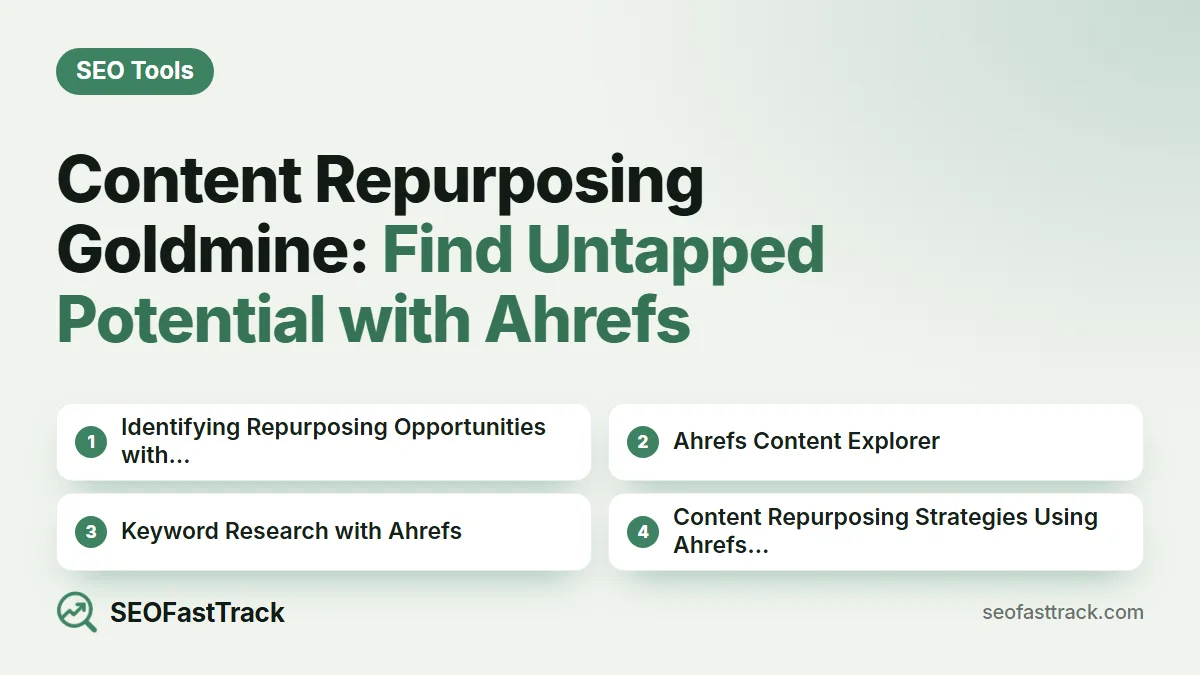
Welcome to SEOFastTrack, your go-to resource for mastering the art of search engine optimization. Are you ready to unlock a content repurposing goldmine and dramatically amplify your reach? In this article, we'll dive deep into Ahrefs content repurposing strategies, revealing how to leverage this powerful tool to breathe new life into your existing content and attract a flood of targeted traffic. Curious to discover how you can transform old blog posts into engaging videos or podcasts? Let's get started and unearth those hidden SEO opportunities!
- Introduction: Unlocking Content Repurposing Success with Ahrefs
- Identifying Repurposing Opportunities with Ahrefs Site Explorer
- Ahrefs Content Explorer: Your Secret Weapon for Repurposing Ideas
- Keyword Research with Ahrefs: Fueling Your Repurposed Content
- Content Repurposing Strategies Using Ahrefs Data: Practical Examples
- Repurposing for Different Platforms: Leveraging Ahrefs for Targeted Reach
- Measuring the Impact of Your Repurposing Efforts with Ahrefs
- Advanced Ahrefs Techniques for Content Repurposing
- Avoiding Common Content Repurposing Mistakes
- Conclusion: Mastering Ahrefs for Long-Term Content Success
-
Frequently Asked Questions
- What is content repurposing, and why is it beneficial for SEO?
- How can Ahrefs help identify content that is ripe for repurposing?
- What are some examples of content repurposing strategies that can be implemented using Ahrefs data?
- How does using Ahrefs for content repurposing contribute to link building efforts?
- What are the key metrics within Ahrefs that I should focus on when identifying content for repurposing?
- Final Reflection: Unearthing Enduring Value
- Unearth Hidden Gems: Repurpose & Rise!
Introduction: Unlocking Content Repurposing Success with Ahrefs
Why Content Repurposing Matters for SEO and Growth
Content repurposing is the strategic practice of reusing existing content in new formats or across different platforms. In today's fast-paced digital landscape, creating high-quality content is a significant investment of time and resources. Content repurposing allows you to maximize the return on that investment by extending the lifespan and reach of your best-performing pieces.
Instead of constantly churning out new content from scratch, you can leverage your existing assets to target new audiences, explore different content formats, and reinforce your core message. This approach is particularly beneficial for SEO because it allows you to target a wider range of keywords and build a more comprehensive content ecosystem around your chosen topics.
From a growth perspective, content repurposing significantly contributes to efficiency. Imagine you've invested heavily in a detailed whitepaper. Instead of letting it sit as a single downloadable PDF, you can break it down into multiple blog posts, social media updates, and even a short video series.
This not only expands the reach of the whitepaper's core message but also caters to different learning preferences and content consumption habits of your audience. By strategically repurposing content, you can achieve more with less, amplifying your message and driving sustainable growth without constantly reinventing the wheel. Studies show that businesses that actively repurpose content see a significant increase in organic traffic and lead generation compared to those that rely solely on new content creation.
How Ahrefs Can Revolutionize Your Content Strategy
Ahrefs, a leading SEO tool suite, provides a wealth of data and features that are invaluable for effective content repurposing strategies. It moves beyond simple keyword research and offers in-depth content analysis, competitor insights, and performance tracking, all crucial elements for identifying and executing successful repurposing opportunities. With Ahrefs, you can pinpoint your top-performing content, understand what resonates with your audience, and uncover content gaps that can be filled by repurposing existing material. This data-driven approach ensures that your repurposing efforts are not based on guesswork but on solid insights, maximizing your chances of success.
Ahrefs empowers you to understand not only what content to repurpose but also how to repurpose it effectively. For instance, its Content Explorer tool can help you discover trending topics and identify formats that are currently performing well in your niche. Site Explorer allows you to analyze competitor content strategies, revealing successful content types and platforms they are leveraging.
Furthermore, Ahrefs' keyword research tools are essential for optimizing repurposed content for different platforms and formats, ensuring that it continues to attract organic traffic and contribute to your overall SEO goals. By integrating Ahrefs into your content strategy, you can transform content repurposing from a reactive tactic into a proactive, data-informed process that drives significant results.
Identifying Repurposing Opportunities with Ahrefs Site Explorer
Digging Deep: Analyzing Your Best-Performing Content in Ahrefs
Ahrefs Site Explorer is your starting point for identifying content repurposing goldmines within your own website. By inputting your domain into Site Explorer, you gain access to a comprehensive overview of your website's performance, including organic traffic, backlinks, and top-performing pages. To pinpoint your best content for repurposing, navigate to the "Pages" report in Site Explorer and sort by "Traffic" or "Referring domains."
This will reveal the pages that are already attracting significant organic traffic and backlinks, indicating strong audience interest and SEO value. These high-performing pages are prime candidates for repurposing as they have already proven their ability to resonate with your target audience.
Once you've identified your top pages, delve deeper into their performance metrics within Ahrefs. Examine the keywords they are ranking for using the "Organic Keywords" report. Analyze the backlinks they have acquired using the "Backlinks" report to understand what kind of websites are linking to them.
This detailed analysis provides valuable insights into the topics that are most engaging for your audience and the formats that have been most successful in attracting attention. For example, if a blog post about "SEO for E-commerce" is generating substantial traffic and backlinks, it signals a strong interest in this topic and suggests opportunities to repurpose this content into formats like webinars, infographics, or downloadable guides tailored specifically for e-commerce businesses.
Finding Content Gaps: Identifying Missed Opportunities
Beyond analyzing your best-performing content, Ahrefs Site Explorer can also help you uncover content gaps and missed opportunities for repurposing. One effective technique is to use the "Content Gap" tool within Site Explorer. This tool allows you to compare your website's content against the content of your competitors, revealing keywords and topics that your competitors are ranking for but you are not. By identifying these content gaps, you can pinpoint areas where your existing content might be lacking or where new content, repurposed from existing assets, could fill a void and attract more traffic.
Furthermore, explore the "Top Content" report in Site Explorer for your competitors' domains. Analyze their most popular pages and content formats. Are they excelling with video content, infographics, or interactive tools?
This competitive analysis can inspire repurposing ideas and highlight content formats that are performing well within your industry but that you may not be fully leveraging. For example, if a competitor's infographic on "Content Marketing Trends" is generating significant social shares and backlinks, consider repurposing your own blog post on content marketing into a visually engaging infographic to tap into this popular format and reach a wider audience. Ahrefs provides the data to move beyond simply replicating competitor content and instead, intelligently repurpose your own expertise in formats that are proven to resonate within your niche.
Ahrefs Content Explorer: Your Secret Weapon for Repurposing Ideas
Discovering Trending Topics and Untapped Niches
Ahrefs Content Explorer is a powerful search engine specifically designed for content. It allows you to search billions of web pages using keywords and filters, making it an invaluable tool for discovering trending topics and untapped niches ripe for content repurposing.
By entering broad keywords related to your industry or target audience into Content Explorer, you can identify articles, blog posts, and other content pieces that are currently generating high levels of social shares, backlinks, and traffic. This real-time data helps you understand what topics are resonating most with audiences right now, providing crucial insights for timely and relevant content repurposing.
To further refine your search and uncover untapped niches, utilize Content Explorer's advanced filters. For example, you can filter results by "Content type" (e.g., articles, blog posts, videos), "Language," and "Publish date." You can also sort results by "Social shares," "Referring domains," or "Traffic" to prioritize content that is already proven to be engaging and authoritative.
By combining keyword searches with these filters, you can drill down into specific subtopics and niches that are gaining traction but may be underserved by existing content. This allows you to identify opportunities to repurpose your existing expertise into content that addresses emerging trends and caters to specific niche audiences, maximizing the impact of your repurposing efforts.
Analyzing Competitor Content for Repurposing Inspiration
Ahrefs Content Explorer is not only useful for identifying trending topics but also for deeply analyzing your competitor's content strategy and gleaning repurposing inspiration. By entering a competitor's domain into Content Explorer, you can see a comprehensive list of their most shared, linked to, and trafficked content. Analyze the formats and topics of their top-performing pieces. Are they consistently successful with listicles, in-depth guides, or video tutorials? Understanding their content strengths can provide valuable clues about what resonates with your shared target audience and inspire similar repurposing strategies for your own content.
Go beyond simply identifying popular formats. Use Content Explorer to analyze the specific topics and angles that your competitors are covering. Are they focusing on beginner-friendly guides, advanced strategies, or case studies?
Identify gaps in their coverage or areas where you can offer a unique perspective or more in-depth analysis. For example, if a competitor has a popular blog post on "Keyword Research Basics," you could repurpose your own advanced keyword research guide into a series of social media posts or a downloadable checklist for experienced marketers. By leveraging Ahrefs Content Explorer to understand your competitive landscape, you can strategically repurpose your content to differentiate yourself, fill content gaps, and capture a larger share of your target audience's attention.
Keyword Research with Ahrefs: Fueling Your Repurposed Content
Finding New Keyword Opportunities for Existing Content
Ahrefs Keyword Explorer is an indispensable tool for optimizing your content repurposing efforts for SEO. One of its key applications is identifying new keyword opportunities for your existing content. Start by inputting the URL of your existing content into Ahrefs Site Explorer and navigate to the "Organic Keywords" report.
This report shows you all the keywords that your content is currently ranking for. However, it also reveals keywords for which you are ranking on pages 2 or 3 of search results, indicating potential for improvement with targeted optimization. These "low-hanging fruit" keywords are excellent opportunities to repurpose your content to specifically target these terms and climb higher in search rankings.
To further expand your keyword research, use Ahrefs Keyword Explorer directly. Enter the main topic of your existing content and explore the "Keyword ideas" reports, such as "Phrase match," "Having same terms," and "Also rank for." These reports will uncover a wealth of related keywords, including long-tail variations and semantic keywords that you may not have considered initially.
For example, if your original blog post focused on "Content Marketing Strategy," you might discover related keywords like "content marketing strategy for startups," "content marketing strategy examples," or "measuring content marketing ROI." These newly discovered keywords can inform your content repurposing strategy, guiding you to create spin-off content pieces that target these specific search queries and expand your reach within your niche.
Targeting Long-Tail Keywords for Repurposed Content
Repurposing content provides an excellent opportunity to target long-tail keywords, which are longer, more specific search queries that often have lower search volume but higher conversion rates. Ahrefs Keyword Explorer is crucial for identifying relevant long-tail keywords that align with your existing content. When researching keywords related to your content topic, pay close attention to the "Questions" report in Keyword Explorer.
This report specifically surfaces question-based keywords that people are actively searching for online. These question keywords often represent long-tail opportunities that are perfect for repurposing content into formats like FAQs, Q&A videos, or social media posts answering specific audience questions.
Furthermore, explore the "Traffic share by domains" report in Keyword Explorer for your main topic keywords. This report shows you the top-ranking pages for those keywords and the estimated traffic they receive. Analyze the content of these top-ranking pages. Are they addressing specific long-tail variations of the main keyword?
Are they using particular formats or angles that are resonating with searchers? By understanding how top-ranking content targets long-tail keywords, you can gain insights into how to repurpose your own content to capture similar long-tail traffic. For instance, if your original guide covered "SEO for Beginners," you could repurpose sections of it into shorter, more focused blog posts or social media series targeting long-tail keywords like "SEO tips for small businesses," "SEO checklist for startups," or "free SEO tools for beginners."
Content Repurposing Strategies Using Ahrefs Data: Practical Examples
Turning Blog Posts into Engaging Infographics: A Step-by-Step Guide
Infographics are highly shareable and visually appealing, making them a powerful format for repurposing blog posts. Using Ahrefs data, identify your top-performing blog posts based on organic traffic and backlinks, as analyzed in Site Explorer. Choose a blog post that presents data, statistics, or a step-by-step process, as these elements translate well into a visual format. For example, if your blog post "10 SEO Mistakes to Avoid" is performing well, this is a perfect candidate for an infographic.
Step-by-step guide:
- Extract key data points and takeaways: Reread your chosen blog post and identify the core arguments, statistics, and actionable steps. For "10 SEO Mistakes to Avoid," these would be the 10 mistakes themselves and brief explanations of each.
- Structure the infographic: Outline the infographic's flow. A common structure is a numbered list, a comparison, or a process flow. For our example, a numbered list of the 10 mistakes is ideal.
- Design the infographic: Utilize design tools like Canva or Piktochart (many offer free versions) to create a visually appealing infographic. Focus on clear visuals, concise text, and a consistent color scheme. Incorporate data visualizations like charts or graphs where relevant.
- Promote your infographic: Embed the infographic within the original blog post and create a dedicated landing page for it. Share it on social media platforms like Pinterest, Twitter, and LinkedIn, using relevant hashtags. Submit it to infographic directories. Use Ahrefs Site Explorer to identify websites that linked to your original blog post and reach out to them to share the infographic.
Transforming Webinars into Lead Magnets: Maximizing Value
Webinars are rich in content and expertise but are often consumed only once live. Repurposing webinars into lead magnets extends their lifespan and helps generate leads. Identify webinars that had high attendance and positive feedback. Ahrefs can indirectly help here by analyzing blog posts or pages promoting past webinars. If these pages attract traffic and backlinks, it suggests the webinar topic was of interest.
Step-by-step guide:
- Transcribe the webinar: Use a transcription service or software to convert the webinar's audio into text.
- Edit and refine the transcript: Clean up the transcript, removing filler words and editing for clarity and readability. Structure it into chapters or sections for easy navigation.
- Design a lead magnet: Turn the refined transcript into a downloadable PDF e-book, guide, or checklist. Add a professional cover page and branding elements. Include a call to action to encourage further engagement, such as signing up for your newsletter or requesting a demo.
- Promote your lead magnet: Create landing pages to gate the lead magnet download, requiring email signup. Promote the lead magnet on your blog, social media, and email newsletters. Use Ahrefs Keyword Explorer to find relevant keywords to optimize the landing page for SEO and attract organic traffic. You can also repurpose snippets of the webinar content as social media teasers driving traffic to the lead magnet landing page.
Repurposing Case Studies into Compelling Testimonials
Case studies are powerful social proof, showcasing the value of your products or services. However, they can be lengthy and less digestible in their original format. Repurposing case studies into testimonials makes them more accessible and impactful across various platforms. Identify case studies that highlight significant results and positive client experiences. Ahrefs isn't directly involved here, but consider case studies related to topics that are performing well organically according to Site Explorer.
Step-by-step guide:
- Extract key quotes and results: Review your case studies and identify the most impactful quotes from clients and the most impressive quantifiable results achieved.
- Create short testimonial snippets: Condense these quotes and results into concise, impactful testimonials. Focus on the most compelling aspects of the case study. Aim for testimonials that are easily digestible in social media posts or website sidebars.
- Design visual testimonials: Create visually appealing testimonial graphics using tools like Canva. Combine client photos with short, impactful quotes. Use consistent branding and design elements.
- Integrate testimonials across platforms: Incorporate these testimonials on your website's homepage, service pages, and landing pages. Share them on social media platforms, tagging the client if appropriate. Use them in email marketing campaigns and sales presentations. For video testimonials, you can extract short video clips from longer case study videos.
Data-heavy reports, like industry research or survey findings, often contain valuable insights but can be overwhelming in their entirety. Repurposing key data points from these reports into social media snippets makes the information more digestible and shareable. Identify reports that have garnered significant downloads or media mentions. Ahrefs can help by analyzing backlinks to pages hosting these reports, indicating their authority and interest.
Step-by-step guide:
- Identify key data points and statistics: Review your data reports and extract the most compelling statistics, charts, and graphs. Focus on data points that are surprising, insightful, or relevant to current industry trends.
- Create social media visuals: Design visually engaging social media graphics for each key data point. Use tools like Canva to create eye-catching visuals with clear text and data visualizations. Adapt the visuals for different platforms (e.g., square for Instagram, landscape for Twitter).
- Craft concise social media copy: Write short, engaging captions for each social media snippet. Highlight the key takeaway from the data point and encourage engagement by asking questions or prompting discussion. Use relevant hashtags to increase discoverability.
- Schedule social media posts: Schedule these snippets across your social media channels over time, rather than posting them all at once. Use a social media scheduling tool to plan your posts and optimize posting times for maximum reach. Link back to the full report for those who want to delve deeper.
Repurposing for Different Platforms: Leveraging Ahrefs for Targeted Reach
Optimizing Content for YouTube using Ahrefs Keyword Data
YouTube is a powerful search engine in its own right, and repurposing content for this platform can significantly expand your reach. Ahrefs Keyword Explorer is invaluable for YouTube SEO. When researching keywords for your video content, switch the search engine dropdown in Keyword Explorer to "YouTube." This will provide YouTube-specific keyword data, including search volume, keyword difficulty (specifically for YouTube), and keyword ideas tailored to video content.
Use Ahrefs to identify keywords with a good balance of search volume and low keyword difficulty on YouTube. These are keywords where there is audience interest but less competition, making it easier to rank your videos. For example, if you have a blog post on "SEO Audit," research "SEO audit" in Ahrefs Keyword Explorer with YouTube selected.
Explore keyword ideas like "SEO audit tutorial," "SEO audit tools," or "free SEO audit." These long-tail keywords can guide your video content creation, ensuring you target search terms that people are actively using on YouTube. Optimize your video titles, descriptions, and tags with these targeted keywords to improve YouTube search visibility.
LinkedIn is a professional networking platform ideal for reaching a business-oriented audience. Repurposing content for LinkedIn requires a different approach than other social media platforms. Focus on long-form content, professional insights, and thought leadership. Ahrefs Content Explorer can help you understand what type of content performs well on LinkedIn within your industry. Search for industry-relevant keywords in Content Explorer and filter by "Social shares" and "Referring domains." Analyze the top-performing articles and posts on LinkedIn to understand content formats and topics that resonate with professionals.
Repurpose blog posts or reports into LinkedIn articles, expanding on key points and adding professional context. Share data-driven insights and industry trends relevant to your LinkedIn audience. Create short video summaries of your blog posts or webinars specifically for LinkedIn, focusing on professional takeaways and actionable advice. Engage in LinkedIn groups related to your industry and share repurposed content that provides value and positions you as a thought leader. Use Ahrefs Site Explorer to analyze backlinks to your LinkedIn articles and identify potential outreach opportunities to further amplify your content within professional networks.
Creating Twitter Threads from Existing Articles: Driving Traffic
Twitter is a fast-paced platform where concise, engaging content thrives. Repurposing blog posts or articles into Twitter threads is an effective way to drive traffic back to your website and engage with your audience in real-time. Use Ahrefs Site Explorer to identify key takeaways and statistics from your top-performing articles. Break down these key points into individual tweets, creating a thread that tells a story or provides a step-by-step guide.
Each tweet in your thread should be concise, engaging, and provide value independently, while also contributing to the overall narrative. Use strong visuals, like images or GIFs, to make your thread more visually appealing. Include a clear call to action in the final tweet, linking back to the original article for readers who want to learn more.
Use relevant hashtags to increase the discoverability of your thread. Schedule your thread strategically to reach your target audience during peak Twitter usage times. Monitor engagement and respond to comments and questions to further amplify the reach of your repurposed content on Twitter.
Measuring the Impact of Your Repurposing Efforts with Ahrefs
Tracking Keyword Rankings for Repurposed Content
Measuring the success of your content repurposing strategies is crucial for understanding ROI and optimizing future efforts. Ahrefs Rank Tracker is essential for monitoring the keyword rankings of your repurposed content. After repurposing content and optimizing it for specific keywords (identified using Ahrefs Keyword Explorer), add those target keywords to Ahrefs Rank Tracker. This tool will track your content's ranking progress over time for those keywords, allowing you to see if your repurposing efforts are improving your search visibility.
Set up Rank Tracker to monitor keywords related to both your original content and the newly repurposed versions. For example, if you repurposed a blog post into an infographic and optimized both for the keyword "SEO checklist," track this keyword for both the blog post URL and the infographic landing page URL. Regularly monitor the ranking reports in Ahrefs Rank Tracker to identify improvements, plateaus, or declines in keyword rankings. Use this data to refine your optimization strategies, identify underperforming repurposed content, and make data-driven decisions about future repurposing efforts.
Monitoring Backlinks to Repurposed Assets
Backlinks are a crucial ranking factor, and monitoring backlinks to your repurposed content is essential for measuring its authority and SEO impact. Ahrefs Site Explorer is the ideal tool for this. Input the URL of your repurposed content (e.g., infographic landing page, YouTube video page, LinkedIn article) into Site Explorer and navigate to the "Backlinks" report. This report shows you all the websites that are linking to your repurposed asset.
Monitor the number and quality of backlinks over time. An increase in backlinks, especially from authoritative websites, indicates that your repurposed content is gaining traction and authority. Analyze the referring domains and anchor text of the backlinks to understand who is linking to your content and why.
Use this backlink data to identify potential outreach opportunities for further promotion. For example, if you created an infographic and notice that relevant industry blogs are linking to similar infographics but not yours, reach out to them and suggest your infographic as a valuable resource. Backlink monitoring in Ahrefs provides valuable insights into the reach and authority of your repurposed content and guides your ongoing promotion efforts.
Analyzing Traffic and Engagement: Measuring ROI
Ultimately, the success of content repurposing is measured by its impact on traffic, engagement, and ultimately, your business goals. Ahrefs Site Explorer and Google Analytics (or your website analytics platform) are used in conjunction to measure the ROI of your repurposing efforts. In Ahrefs Site Explorer, use the "Organic traffic" report for your repurposed content URLs to track changes in organic traffic over time. Compare traffic before and after repurposing to assess the impact of your efforts.
In Google Analytics, set up tracking for specific repurposed content assets, such as landing pages for lead magnets or embedded YouTube videos. Monitor key engagement metrics like page views, bounce rate, time on page, and conversions (e.g., lead form submissions, webinar registrations).
Analyze traffic sources to understand where traffic to your repurposed content is coming from (e.g., organic search, social media, referral). By combining traffic and engagement data from Google Analytics with keyword ranking and backlink data from Ahrefs, you gain a comprehensive understanding of the ROI of your content repurposing strategies and can make data-driven decisions to optimize future efforts and maximize impact.
Advanced Ahrefs Techniques for Content Repurposing
Using Ahrefs to Identify Broken Links for Content Updates
Broken links negatively impact user experience and SEO. Ahrefs Site Audit tool can be leveraged to identify broken links on your website, presenting a valuable opportunity for content updates and repurposing. Run a Site Audit for your domain in Ahrefs. Navigate to the "Links" section of the Site Audit report and look for the "Broken outgoing links" and "Broken incoming links" reports. These reports list pages on your website that have broken links pointing to external resources or pages that are linked to from external websites but are now broken.
For broken outgoing links, review the context of the link. Was it pointing to a valuable resource that is no longer available? This is an opportunity to update your content by finding a replacement resource or creating your own updated content to fill the gap. For broken incoming links, identify the pages on your website that are receiving broken links from external sites.
This indicates that your content was once considered valuable enough to link to. Revitalize and update this content, addressing the reasons why it might be outdated. Reach out to websites that were previously linking to your broken page and inform them about your updated content, providing a new, working link. This proactive approach not only fixes broken links but also re-engages audiences who were previously interested in your content and can lead to new backlinks.
Leveraging Ahrefs Alerts to Monitor Content Performance
Staying on top of content performance is crucial for timely repurposing opportunities. Ahrefs Alerts feature allows you to set up alerts for various content-related events, enabling you to proactively monitor your content and your competitors' content. Set up alerts for "New backlinks" to your website or specific content pages. This alert notifies you whenever new websites link to your content, allowing you to identify content that is gaining traction and potentially ripe for repurposing into other formats to capitalize on its popularity.
Set up alerts for "New keywords" that your website or specific content pages are ranking for. This helps you discover new keyword opportunities related to your existing content. If you see your content ranking for unexpected or high-volume keywords, consider repurposing it to more explicitly target these new keywords and capture additional traffic.
You can also set up alerts for "Mentions" of your brand or keywords related to your industry. This allows you to track industry trends and conversations, identifying topics that are gaining momentum and presenting repurposing opportunities to contribute to those conversations and establish thought leadership. Ahrefs Alerts provide real-time insights into content performance and industry trends, empowering you to make timely and data-driven repurposing decisions.
Identifying Content Clusters for Strategic Repurposing
Content clusters, also known as topic clusters, are a strategic SEO approach involving a central "pillar page" that covers a broad topic and several "cluster content" pieces that delve into related subtopics and link back to the pillar page. Ahrefs can help you identify and build content clusters, enhancing your content repurposing strategy. Use Ahrefs Site Explorer to analyze your website's content structure and identify potential pillar pages and cluster content opportunities.
Look for broad, comprehensive blog posts or guides that could serve as pillar pages. Then, identify related but more narrowly focused blog posts or articles that could function as cluster content, linking back to the pillar page.
Use Ahrefs Keyword Explorer to research keywords related to your pillar page topic. Identify both broad, high-volume keywords for the pillar page and more specific, long-tail keywords for the cluster content pieces. Repurpose existing content to create or strengthen your content clusters.
For example, if you have a pillar page on "Content Marketing," you can repurpose sections of it into individual cluster content pieces focusing on subtopics like "Content Promotion," "Content Measurement," or "Content Strategy." Ensure that all cluster content pieces link back to the pillar page and that the pillar page comprehensively covers the main topic and links out to all relevant cluster content. Building content clusters with Ahrefs data improves your website's topical authority, internal linking structure, and overall SEO performance, maximizing the impact of your content repurposing efforts.
Avoiding Common Content Repurposing Mistakes
Ensuring Content Relevance and Accuracy
One of the most critical aspects of content repurposing is ensuring that the repurposed content remains relevant and accurate. Content, especially in fast-paced industries, can quickly become outdated. Before repurposing any piece of content, thoroughly review it to ensure that the information, statistics, and advice are still current and accurate. Ahrefs can indirectly assist here by showing you the original publication date of your content in Site Explorer and Content Explorer, reminding you to check for timeliness.
Update any outdated information, statistics, or examples. If the original content references specific dates or events that are no longer relevant, adjust the content to reflect the current context. For example, if a blog post from 2020 discusses social media trends, ensure that the repurposed content reflects the current social media landscape in 2024. Consider adding new information, examples, or perspectives to enhance the repurposed content and make it even more valuable. Always prioritize relevance and accuracy to maintain your credibility and provide value to your audience. Repurposing should enhance, not dilute, the quality of your content.
Duplicate content can negatively impact SEO, so it's crucial to avoid creating duplicate content when repurposing. If you are repurposing content by publishing it on different URLs on your own website, or on external platforms where you have control over technical SEO, implement canonical tags. Canonical tags tell search engines which version of a piece of content is the original or "master" version. For example, if you repurpose a blog post into a PDF guide hosted on a separate URL, use a canonical tag on the PDF guide pointing back to the original blog post URL.
If you are significantly altering or updating existing content and want to replace the old version with the new repurposed version, use 301 redirects. A 301 redirect permanently redirects users and search engines from the old URL to the new URL, ensuring that you don't lose any SEO equity accumulated by the original content. For example, if you are completely rewriting and repurposing an outdated blog post, redirect the old URL to the new URL of the repurposed content.
Carefully consider whether to use canonical tags or 301 redirects based on the extent of content duplication and your SEO goals. When repurposing for platforms where you have limited technical SEO control (like social media), focus on creating unique content variations adapted for each platform to minimize any potential duplicate content concerns.
Maintaining Brand Voice and Consistency
Consistency in brand voice is essential for building brand recognition and trust. When repurposing content across different formats and platforms, ensure that you maintain a consistent brand voice and tone. Your brand voice should be recognizable regardless of the content format or platform. Adapt the tone and style of your repurposed content to suit the specific platform and audience, but always stay true to your core brand voice and values.
Develop brand voice guidelines that outline your brand's personality, tone, and style. Share these guidelines with your content team to ensure consistency across all content creation and repurposing efforts. Review repurposed content before publication to ensure that it aligns with your brand voice and messaging. Pay attention to word choice, sentence structure, and overall tone. Consistency in brand voice reinforces your brand identity, builds trust with your audience, and creates a cohesive brand experience across all touchpoints.
Conclusion: Mastering Ahrefs for Long-Term Content Success
The Power of Data-Driven Content Repurposing
Content repurposing, when driven by data and insights from tools like Ahrefs, transforms from a simple content recycling tactic into a powerful, strategic approach for long-term content success. Ahrefs provides the data to identify your best-performing content, uncover content gaps, understand competitor strategies, and optimize repurposed content for maximum SEO impact. By leveraging Ahrefs Site Explorer, Content Explorer, and Keyword Explorer, you can move beyond guesswork and make informed decisions about what content to repurpose, how to repurpose it effectively, and where to distribute it for optimal reach and engagement.
Data-driven content repurposing ensures that your efforts are focused on content that is proven to resonate with your audience and has the highest potential for driving results. It allows you to maximize the ROI of your content investment, extend the lifespan of your valuable assets, and build a more comprehensive and impactful content ecosystem. By embracing a data-driven approach to content repurposing, you can achieve sustainable content success, improve your SEO performance, and drive long-term growth for your business.
Embracing Ahrefs as Your Go-To Content Repurposing Tool
Ahrefs is more than just an SEO tool; it's a comprehensive content intelligence platform that empowers you to master content repurposing and achieve lasting content success. Its suite of tools, from Site Explorer for content performance analysis to Keyword Explorer for optimization and Content Explorer for idea generation, provides everything you need to develop and execute effective content repurposing strategies. By integrating Ahrefs into your content workflow, you can transform content repurposing from an ad-hoc activity into a systematic, data-driven process.
Embrace Ahrefs as your go-to tool for content repurposing. Continuously leverage its data and insights to identify opportunities, optimize your efforts, and measure your results. By mastering Ahrefs and adopting a data-driven approach to content repurposing, you can unlock untapped potential in your existing content, amplify your message, and achieve sustained content success in today's competitive digital landscape. Ahrefs empowers you to work smarter, not harder, in your content creation and repurposing efforts, driving significant results and establishing a strong online presence.
Frequently Asked Questions
What is content repurposing, and why is it beneficial for SEO?
Content repurposing involves transforming existing content into new formats. This is beneficial for SEO because it extends the reach and lifespan of valuable content, improving rankings and driving more traffic.
How can Ahrefs help identify content that is ripe for repurposing?
Ahrefs can help by identifying high-performing content with strong backlinks and keyword rankings. You can also use it to find content with untapped potential that could benefit from updates or a new format.
What are some examples of content repurposing strategies that can be implemented using Ahrefs data?
You can repurpose a blog post into an infographic, a webinar, or a series of social media posts. Ahrefs can help you identify the most engaging sections of the original content to focus on.
How does using Ahrefs for content repurposing contribute to link building efforts?
By creating new, valuable content from existing assets, you can attract new backlinks. Ahrefs helps you identify link opportunities and create content that other websites will want to link to.
What are the key metrics within Ahrefs that I should focus on when identifying content for repurposing?
Focus on metrics such as organic traffic, backlinks, and keyword rankings. These indicate which content is already performing well and has the potential to reach an even wider audience with repurposing.
Final Reflection: Unearthing Enduring Value
The strategies outlined in this article demonstrate that content repurposing, especially when powered by Ahrefs, is far more than a mere efficiency tactic; it's a strategic imperative for sustained online growth. In today's saturated digital landscape, simply creating new content isn't enough. We must actively cultivate and amplify the value of what we already possess, ensuring it reaches a wider audience and continues to resonate over time.
This exploration of Ahrefs content repurposing strategies highlights the enduring power of adaptability and resourcefulness in the digital age. The ability to breathe new life into existing content, to tailor it for different platforms and audiences, is a skill that will only become more valuable as the online world continues to evolve. The best marketing doesn't feel like marketing.
- Tom Fishburne. This quote perfectly encapsulates the goal of effective content repurposing: to provide genuine value to the audience in a way that feels natural and engaging, not forced or repetitive.
Now, consider the wealth of information you already possess. What dormant potential lies within your existing content? What opportunities are waiting to be unearthed with the help of tools like Ahrefs? Take the time to analyze your past efforts, identify areas for improvement, and embrace the art of repurposing. By doing so, you can unlock a treasure trove of untapped potential and build a more resilient and impactful online presence.
Okay, I'm ready to craft a Call to Action (CTA) for the end of a web article titled "Content Repurposing Goldmine: Find Untapped Potential with Ahrefs," targeting readers of SEOFastTrack.com. Here's my attempt:
Thank you for diving into the world of content repurposing and unlocking the power of Ahrefs with us. You've now got the keys to transforming your existing content into a constant stream of fresh opportunities. Let's put that knowledge into action!
- Immediately identify at least three existing blog posts ripe for repurposing using Ahrefs' Content Gap tool. Don't just think about new formats; think about targeting new audiences.
- Share your favorite content repurposing tactic (or a question!) in the comments below. Let's learn from each other and build a stronger SEO community.
- Challenge yourself: Create one repurposed piece of content this week. Even a small tweak can yield big results.
What overlooked piece of content holds the most potential for a quick repurposing win in your arsenal?