
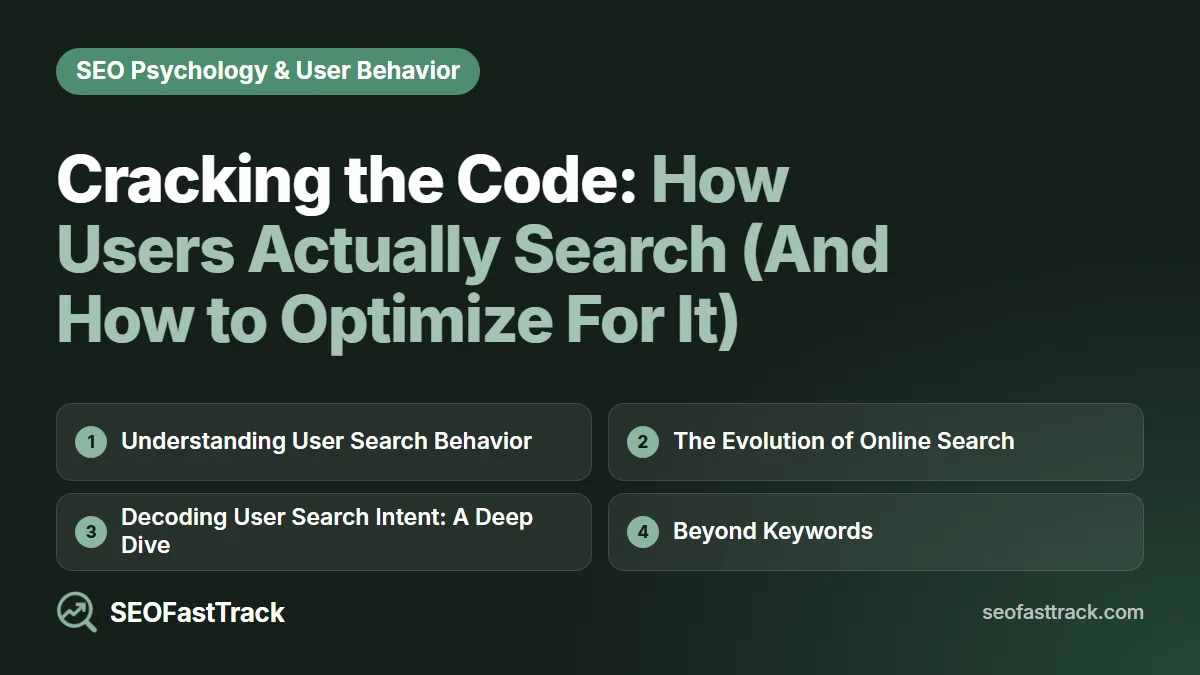
Cracking the Code: How Users Actually Search (And How to Optimize For It)

Welcome to SEOFastTrack, your comprehensive guide to conquering the world of Search Engine Optimization. Ever wondered how users search online and if your current SEO strategy truly aligns with their behavior? Unlocking this secret is the key to skyrocketing your visibility. Dive in to discover the surprising truths about user search patterns and learn actionable strategies to optimize your website for maximum impact. What if everything you thought you knew about SEO was only half the story?
- Understanding User Search Behavior: An SEO Guide
- The Evolution of Online Search: From Keywords to Context
- Decoding User Search Intent: A Deep Dive
- Beyond Keywords: The Power of Long-Tail Search Terms
- Analyzing Search Queries: Tools and Techniques
- Optimizing Your Website for How Users Actually Search: Practical Strategies
- Voice Search Optimization: Adapting to the Conversational Era
- Measuring and Adapting Your SEO Strategy Based on User Search Data
- Case Studies: Real-World Examples of Optimizing for User Search Behavior
- Conclusion: Embracing User-Centric SEO for Long-Term Success
-
Frequently Asked Questions
- How has the way users search online evolved in recent years?
- What role does keyword research play in understanding how users search?
- What are some effective on-page SEO techniques for optimizing for user search behavior?
- How important is mobile-friendliness in optimizing for how users search online?
- How do search engine algorithm updates impact my SEO strategy for user search?
- Final Reflection: Decoding the Digital Quest
- Unveil Your Search Potential!
Understanding User Search Behavior: An SEO Guide
In the dynamic realm of Search Engine Optimization (SEO), understanding how users search online is not just beneficial—it's paramount. Gone are the days when simply stuffing keywords into content guaranteed top rankings. Today, search engines like Google are far more sophisticated, prioritizing user experience and relevance above all else.
This evolution necessitates a deep dive into user search behavior, exploring the nuances of how individuals formulate queries, what they expect to find, and how their intent shapes the entire search landscape. By truly grasping these dynamics, SEO professionals, small business owners, and bloggers can craft strategies that resonate with their target audience, leading to enhanced visibility, engagement, and ultimately, conversions. This guide will serve as your compass, navigating the intricacies of user search behavior and illuminating the path to effective optimization.
The Evolution of Online Search: From Keywords to Context
The journey of online search has been a remarkable transformation from rudimentary keyword matching to an intricate dance of context and meaning. In the early days of search engines, algorithms were relatively simple, primarily focused on identifying the presence of specific keywords on web pages. If your content liberally used the keywords someone searched for, you had a decent chance of ranking well. This era, however, was rife with manipulation, leading to keyword stuffing and low-quality content dominating search results.
As technology advanced, so did search engine algorithms. The introduction of updates like Google's Panda, Penguin, and Hummingbird marked a significant shift towards understanding the context behind search queries. Hummingbird, in particular, was a pivotal update, emphasizing semantic search and the ability to interpret the meaning of entire phrases and sentences, rather than just individual keywords.
This evolution signifies a move away from a purely keyword-centric approach to one that prioritizes user intent and the overall quality and relevance of content. Now, understanding how users actually search means deciphering their underlying needs and motivations, not just mirroring the words they type.
How User Intent Shapes Modern Search Queries
User intent, often referred to as search intent or keyword intent, represents the primary goal a user has when conducting a search. It's the 'why' behind the query. Understanding this intent is crucial because modern search engines are designed to deliver results that directly satisfy this underlying need. A user searching "weather in London" is clearly looking for a quick weather forecast, not a history of London's climate. Conversely, someone searching "best restaurants in London" is likely seeking recommendations for dining options, perhaps with reviews and menus.
The way users formulate their queries is heavily influenced by their intent. For example, someone with informational intent might use question-based queries like "what is SEO?" or "how to bake a cake?".
Those with transactional intent, ready to make a purchase, might use more direct and commercially focused terms such as "buy iPhone 15 pro max" or "discount running shoes". Recognizing these patterns allows SEO strategists to anticipate the types of content and formats that will best resonate with users at different stages of their journey. By aligning content with user intent, businesses can significantly improve their search engine rankings and attract the right kind of traffic – users who are genuinely interested in what they offer.
The Rise of Semantic Search and Natural Language Processing (NLP)
Semantic search represents a paradigm shift in how search engines interpret and process information. Instead of merely focusing on keywords, semantic search aims to understand the meaning and context behind words, phrases, and even entire sentences. This is largely powered by Natural Language Processing (NLP), a branch of Artificial Intelligence that enables computers to understand, interpret, and generate human language. Through NLP, search engines can dissect the grammatical structure, identify entities, and discern the relationships between words in a query, allowing them to grasp the user's true intention with greater accuracy.
The impact of semantic search and NLP on SEO is profound. It necessitates a move beyond keyword optimization to a more holistic content strategy focused on topical authority and comprehensive coverage.
For instance, instead of creating multiple pages targeting variations of a keyword like "dog training tips," a semantic SEO approach would focus on creating a single, in-depth resource that comprehensively covers various aspects of dog training, addressing a wide range of user questions and intents related to the topic. This shift encourages content creators to think thematically, building content clusters around core topics and demonstrating expertise and authority in a subject area, which aligns perfectly with how modern search engines evaluate and rank content.
Decoding User Search Intent: A Deep Dive
Understanding the nuances of user search intent is akin to possessing a key that unlocks effective SEO strategies. While the spectrum of user intentions is broad, they can generally be categorized into four primary types: informational, navigational, transactional, and commercial investigation. Recognizing these distinct categories allows for a more targeted approach to content creation and optimization, ensuring that you're meeting user needs at every stage of their online journey. Each intent category dictates not only the type of query users employ but also the kind of content they expect to find in the search results.
Informational Intent: Seeking Knowledge and Answers
Users with informational intent are essentially in learning mode. They are seeking knowledge, answers to questions, or explanations on a particular topic. Their queries often begin with question words like "what," "how," "why," "where," or "when," or they might use phrases indicating a desire to learn, such as "explain," "define," or "tutorial." Examples of informational queries include "what is blockchain technology?
", "how to change a tire? ", "why is the sky blue? ", or "history of the internet." These users are not necessarily looking to buy something immediately; they are at the research stage, gathering information to expand their understanding.
To effectively target users with informational intent, content should be educational, comprehensive, and easily digestible. Blog posts, articles, guides, tutorials, and FAQs are ideal formats. Optimizing for informational intent involves identifying the questions your target audience is asking and providing clear, concise, and authoritative answers. Keyword research should focus on question-based keywords and long-tail phrases that reflect common informational needs within your niche. By providing valuable and insightful content that directly addresses these queries, you can attract users at the top of the marketing funnel and establish your website as a trusted resource.
Navigational intent is characterized by users who are trying to locate a specific website or webpage. They already know where they want to go, but they are using a search engine as a shortcut, perhaps because they don't remember the exact URL or it's simply faster than typing it into the address bar. Typical navigational queries include brand names like "YouTube," "Amazon," "Facebook login," or specific page names such as "Apple iPhone 15 Pro page" or "SEOFastTrack blog." These users are not broadly exploring a topic; they have a destination in mind.
Optimizing for navigational intent primarily revolves around brand SEO. Ensuring your website ranks prominently for your brand name and related branded keywords is crucial. This includes optimizing your homepage, contact page, and other key landing pages for brand terms.
Local businesses should also focus on local SEO to ensure they appear prominently when users search for their business name in their area. Consistent branding across all online platforms and accurate business listings are also vital for navigational searches. The goal is to ensure that when users search for your brand or website, they are quickly and easily directed to the intended destination.
Transactional Intent: Ready to Make a Purchase
Users exhibiting transactional intent are ready to make a purchase or complete a specific action. They are at the bottom of the marketing funnel, actively seeking to buy a product or service. Their queries often include keywords indicating a desire to transact, such as "buy," "purchase," "order," "discount," "sale," or "coupon." Examples of transactional queries include "buy Nike Air Max online," "cheap flights to Paris," "order pizza delivery near me," or "download Photoshop free trial." These users are looking for product pages, e-commerce sites, and online stores where they can complete their desired transaction.
To capture users with transactional intent, focus on optimizing product pages, category pages, and landing pages designed for conversions. Use transactional keywords in page titles, descriptions, and throughout the content. Ensure a clear call to action and a seamless purchasing process. For e-commerce businesses, optimizing product listings on marketplaces like Amazon and Google Shopping is also critical for transactional searches. Paid advertising, particularly search engine marketing (SEM), can be highly effective in targeting transactional queries, allowing you to directly reach users who are actively looking to buy what you offer.
Commercial Investigation: Research Before Buying
Commercial investigation intent lies in the space between informational and transactional intent. Users with this intent are considering a purchase but are not yet ready to transact. They are in the research phase, comparing options, reading reviews, and seeking recommendations before making a final decision. Their queries often include keywords like "best," "top," "review," "compare," "vs," "alternatives," or "pros and cons." Examples include "best laptops for students 2024," "iPhone 15 Pro vs Samsung Galaxy S24," "Dyson vacuum cleaner reviews," or "top digital marketing agencies in New York."
Content that caters to commercial investigation intent includes product reviews, comparison articles, "best of" lists, case studies, and testimonials. Optimizing for this intent involves targeting keywords that reflect the user's research process. Provide in-depth, unbiased information that helps users evaluate different options and make informed decisions. By offering valuable resources that aid in their research, you can position your brand as a trusted advisor and guide users towards choosing your products or services when they are ready to make a purchase. This intent is particularly important for high-value or considered purchases where users typically undertake significant research before committing.
Beyond Keywords: The Power of Long-Tail Search Terms
While broad, high-volume keywords may initially seem appealing, the real power in understanding how users search often lies in long-tail keywords. These are longer, more specific keyword phrases that users employ when they have a clearer idea of what they are looking for. Think of a short-tail keyword like "shoes" versus a long-tail keyword like "women's waterproof trail running shoes size 7". The latter, while lower in search volume, reflects a much more specific user need and intent. Ignoring long-tail keywords is akin to leaving a significant portion of your potential audience unaddressed.
Identifying Long-Tail Keywords for Your Niche
Identifying effective long-tail keywords for your niche requires a shift in perspective from broad topics to specific user needs and questions. Begin by brainstorming common questions your target audience might ask related to your products, services, or industry. Tools like AnswerThePublic can be invaluable for uncovering question-based keywords.
Examine your customer service inquiries and FAQs – these often reveal real questions users are asking. Use keyword research tools like Semrush, Ahrefs, and Google Keyword Planner to explore keyword variations and identify longer, more specific phrases with lower competition. Analyze the "People Also Ask" and "Related Searches" sections in Google search results pages (SERPs) for your target keywords – these often reveal valuable long-tail keyword opportunities.
Another effective strategy is to think about the different stages of the buyer's journey. Users at the informational stage will use different long-tail keywords than those at the transactional stage. For example, someone researching "how to make cold brew coffee at home" is in the informational stage, while someone searching "best affordable cold brew coffee maker under $50" is closer to a purchase decision. By mapping long-tail keywords to different stages of the customer journey, you can create content that resonates with users at each point and guides them towards conversion.
Why Long-Tail Keywords Convert Better
Long-tail keywords often exhibit significantly higher conversion rates compared to their shorter, more generic counterparts. This is primarily because they are inherently more specific and targeted, reflecting a clearer user intent. When someone searches for "best noise-canceling headphones for studying under $100," they are not casually browsing; they are actively seeking a specific type of product within a defined budget and for a particular use case (studying). Users employing long-tail keywords are typically further down the sales funnel and closer to making a purchase decision.
Because long-tail keywords are more specific, they also tend to have lower search volume and less competition. This means it's often easier to rank higher for long-tail keywords, allowing you to capture a more qualified audience. While the traffic volume may be lower compared to broad keywords, the quality of traffic is often much higher, leading to a better return on investment (ROI) for your SEO efforts. By focusing on long-tail keywords, you can attract users who are precisely looking for what you offer, resulting in improved conversion rates and a more efficient SEO strategy.
Optimizing Content for Specific User Questions
Optimizing content for specific user questions is a cornerstone of effective long-tail keyword strategy and aligns perfectly with how users search online today, particularly with the rise of voice search. The key is to create content that directly answers the questions your target audience is asking. This often involves using a question-and-answer format, incorporating FAQs, and structuring content around specific user queries. Think about creating dedicated pages or sections within your content that address common questions related to your products, services, or industry.
Use question-based keywords naturally within your content, particularly in headings (H2, H3, etc.) and subheadings. Consider using schema markup, specifically FAQPage schema, to explicitly identify question-and-answer content for search engines, which can enhance visibility in search results and even lead to rich snippets. When crafting content to answer user questions, prioritize clarity, conciseness, and accuracy. Provide comprehensive and helpful answers that genuinely address the user's need. By directly answering user questions, you not only improve your SEO but also establish your website as a valuable resource and build trust with your audience.
Analyzing Search Queries: Tools and Techniques
Understanding how users search goes hand-in-hand with analyzing the actual search queries they use. Fortunately, a variety of powerful tools and techniques are available to delve into this data and extract actionable insights. These tools allow you to see what keywords users are typing into search engines, how your website is performing for those queries, and how user behavior unfolds after they click on your search result. Effective analysis of search queries is crucial for refining your SEO strategy and continuously optimizing for user search behavior.
Google Search Console: Unveiling User Queries
Google Search Console (GSC) is an indispensable free tool provided by Google that offers a wealth of information about your website's performance in Google Search. One of its most valuable features for understanding user search behavior is the "Performance" report. This report reveals the actual search queries that users are typing into Google that trigger impressions and clicks for your website. You can see the keywords for which your pages are ranking, the average position, the number of clicks, and the click-through rate (CTR).
By analyzing the "Queries" section within the Performance report, you can identify both broad and long-tail keywords that are driving traffic to your site. This data provides real-world insights into how users are finding your content and can reveal keyword opportunities you might have overlooked during traditional keyword research.
You can filter the data by date range, page, country, and device to gain more granular insights into specific segments of your audience and their search behavior. GSC is a direct line to understanding how users are actually searching and finding your website, making it a cornerstone tool for SEO analysis.
Keyword Research Tools: Semrush, Ahrefs, and Google Keyword Planner
While Google Search Console reveals queries driving traffic to your existing website, keyword research tools like Semrush, Ahrefs, and Google Keyword Planner are essential for proactive keyword discovery and analysis. These tools offer a broader perspective on the search landscape and help you identify potential keywords to target. Semrush and Ahrefs are comprehensive SEO suites providing in-depth keyword research features, including keyword volume, keyword difficulty, related keywords, competitor analysis, and content ideas. They allow you to explore keyword trends, identify long-tail keyword opportunities, and analyze the search landscape for your niche.
Google Keyword Planner, while primarily designed for Google Ads, is also a valuable tool for organic keyword research. It provides keyword volume data, keyword suggestions, and competition levels. Although the volume data in Keyword Planner is often presented in ranges rather than precise figures, it can still be useful for gauging keyword popularity and identifying relevant terms. By using these keyword research tools in conjunction with Google Search Console, you can develop a comprehensive understanding of both current and potential search queries relevant to your website and target audience.
Using Analytics to Track User Behavior After the Search
Understanding how users behave after they click on your search result is just as important as understanding the initial search query. Analytics platforms like Google Analytics provide crucial data on user behavior once they land on your website. Key metrics to track include bounce rate, time on page, pages per session, and conversion rates.
A high bounce rate on a landing page might indicate that the content is not meeting user expectations or search intent, even if the page is ranking well for relevant keywords. Low time on page or pages per session could suggest that users are not finding the content engaging or valuable.
By analyzing these user behavior metrics in conjunction with keyword data, you can gain a holistic understanding of how well your website is satisfying user search intent. For example, if you notice a high bounce rate for users landing on a specific blog post from informational keywords, it might indicate that the content is not answering their questions effectively or is not formatted for easy readability. This data informs content optimization efforts, allowing you to refine your pages to better align with user expectations and improve engagement, ultimately leading to better search engine rankings and conversions.
Optimizing Your Website for How Users Actually Search: Practical Strategies
Translating the understanding of user search behavior into actionable website optimization strategies is the ultimate goal. This involves a multifaceted approach that encompasses content optimization, on-page SEO, technical SEO, and mobile optimization. By implementing these practical strategies, you can create a website that not only ranks well in search engines but also provides a seamless and satisfying user experience, effectively catering to how users actually search online.
Content Optimization: Creating User-Focused Content
Content optimization, in the context of user search behavior, goes far beyond simply using relevant keywords. It's about creating user-focused content that genuinely addresses user needs, answers their questions, and fulfills their search intent. This means prioritizing quality, depth, and relevance over keyword density or superficial content. Focus on creating content that is comprehensive, authoritative, and trustworthy (E-A-T), as these are key factors in modern search engine ranking algorithms.
Develop content that is structured logically and easy to read, using headings, subheadings, bullet points, and visuals to break up text and enhance readability. Ensure your content is accurate, up-to-date, and provides unique value to the user. Consider different content formats to cater to various user intents, such as blog posts for informational queries, product pages for transactional queries, and comparison guides for commercial investigation queries. By creating user-focused content that truly meets user needs, you not only improve your search engine rankings but also build a loyal audience and establish your website as a valuable resource.
On-Page SEO: Targeting Relevant Keywords and Search Intent
On-page SEO involves optimizing individual web pages to rank higher in search engines and attract more relevant traffic. A crucial aspect of on-page SEO is targeting relevant keywords and aligning them with user search intent. This means not just using keywords, but using them strategically in key on-page elements to signal relevance to search engines and users alike. Optimize your page titles, meta descriptions, headings (H1, H2, etc. ), URL slugs, and image alt text with relevant keywords that reflect the primary search intent of the page.
Ensure that your content body also naturally incorporates relevant keywords and related terms, but avoid keyword stuffing, which can harm your rankings. Focus on creating a semantic relationship between your keywords and the surrounding content. Internal linking is also a critical on-page SEO tactic; use relevant anchor text to link to other pages on your website that are topically related, helping search engines understand the context and hierarchy of your content. By meticulously optimizing on-page elements for relevant keywords and search intent, you can significantly improve your website's visibility in search results for targeted user queries.
Technical SEO: Ensuring Crawlability and Indexability
Technical SEO focuses on optimizing the technical aspects of your website to ensure search engines can easily crawl, index, and understand your content. While content and on-page SEO are crucial, technical SEO lays the foundation for search engine visibility. Key technical SEO elements include website speed, mobile-friendliness, site structure, XML sitemaps, robots.txt file, and HTTPS security. A slow-loading website can negatively impact user experience and search engine rankings, as users are likely to bounce if a page takes too long to load.
Mobile-friendliness is no longer optional; with mobile-first indexing, Google primarily uses the mobile version of your website for indexing and ranking. Ensure your website is responsive and provides a seamless user experience across all devices. A clear and logical site structure, along with XML sitemaps, helps search engines crawl and index your website efficiently.
The robots.txt file controls which parts of your website search engines can crawl, and HTTPS ensures secure communication between users and your website. By addressing these technical SEO elements, you create a website that is easily accessible and understandable to search engines, paving the way for better rankings and visibility for relevant user searches.
Mobile Optimization: Catering to Mobile Searchers
Mobile optimization is no longer a separate consideration but an integral part of SEO, especially given the prevalence of mobile search. A significant portion of online searches now originate from mobile devices, and Google's mobile-first indexing underscores the importance of prioritizing the mobile experience. Mobile optimization involves ensuring your website is responsive, loads quickly on mobile devices, and provides a user-friendly experience on smaller screens. This includes optimizing page speed for mobile, using mobile-friendly design principles, and ensuring content is easily readable and navigable on mobile devices.
Consider the specific needs of mobile searchers. Mobile searches are often location-based and immediate, such as "restaurants near me" or "coffee shops open now." Optimize for local SEO to capture mobile users searching for local businesses. Voice search is also heavily used on mobile devices, so optimizing for conversational queries and natural language processing is crucial for mobile SEO. By prioritizing mobile optimization, you cater to a large and growing segment of users who are searching online primarily through their mobile devices, ensuring you are visible and accessible to them.
Voice Search Optimization: Adapting to the Conversational Era
The rise of voice search through devices like smartphones, smart speakers, and virtual assistants has introduced a new dimension to how users search online. Voice search queries tend to be more conversational, natural language-based, and question-oriented compared to traditional text-based searches. Adapting your SEO strategy to accommodate voice search is essential for staying ahead in this evolving landscape. This requires understanding the nuances of voice search queries and optimizing your content and website to cater to this conversational search style.
Understanding Voice Search Queries
Voice search queries differ significantly from text-based searches in several key aspects. Firstly, they are typically longer and more conversational, reflecting natural language patterns. Instead of typing "weather London," a voice search query might be "what's the weather like in London today?". Secondly, voice search queries are often question-based, starting with "who," "what," "where," "when," "why," or "how." Users are literally asking questions to their devices. Thirdly, voice search is often location-based, with users frequently asking for "restaurants near me" or "directions to the nearest gas station."
Understanding these characteristics is crucial for voice search optimization. Keyword research for voice search should focus on long-tail, question-based keywords and conversational phrases. Think about how people naturally speak when asking questions related to your products, services, or industry. Tools like AnswerThePublic and keyword research tools with question filters can be helpful in identifying voice search keywords. By understanding the nuances of voice search queries, you can tailor your content and SEO strategy to effectively capture this growing segment of search traffic.
Optimizing for Natural Language and Question-Based Searches
Optimizing for natural language and question-based searches is at the heart of voice search SEO. This involves creating content that directly answers common user questions in a clear, concise, and conversational manner. Focus on using natural language in your content, mirroring the way people speak. Incorporate question-based keywords directly into your content, particularly in headings and subheadings. Create FAQ pages or sections within your content that address common user questions.
Structure your content in a way that is easily understood by voice assistants. Use short paragraphs, bullet points, and numbered lists to present information in a digestible format. Aim for featured snippets in search results, as voice assistants often read out featured snippets as answers to voice queries. Using schema markup, particularly FAQPage schema, can also help search engines understand question-and-answer content and potentially improve your chances of appearing in featured snippets for voice searches. By optimizing for natural language and question-based searches, you make your content more accessible and relevant to voice search users.
Local SEO for Voice Search
Local SEO plays a particularly crucial role in voice search optimization, especially for businesses with a physical location. Many voice searches are location-based, with users asking for "restaurants near me," "best coffee shops in my area," or "directions to the nearest pharmacy." Optimizing for local SEO ensures your business appears prominently in local voice search results. Claim and optimize your Google My Business (GMB) listing, ensuring all information is accurate and up-to-date, including your business name, address, phone number, hours of operation, and website.
Encourage customer reviews on your GMB listing and other relevant platforms, as reviews can influence local search rankings and voice search results. Use local keywords in your website content, particularly on your homepage, contact page, and location pages. Ensure your website is mobile-friendly and loads quickly, as mobile devices are the primary platform for local voice searches. By focusing on local SEO, you can enhance your visibility in local voice search results and attract nearby customers who are searching for businesses like yours using voice assistants.
Measuring and Adapting Your SEO Strategy Based on User Search Data
SEO is not a static, one-time effort; it's an ongoing process of measurement, analysis, and adaptation. Constantly monitoring your SEO performance, analyzing user search data, and adapting your strategies based on these insights is crucial for long-term success. This iterative approach ensures that your SEO efforts remain aligned with evolving user search behavior and algorithm updates, allowing you to maintain and improve your search engine rankings and organic traffic.
Tracking Key Performance Indicators (KPIs)
Tracking Key Performance Indicators (KPIs) is essential for measuring the effectiveness of your SEO strategy and understanding how well you are optimizing for user search behavior. Relevant KPIs for user-centric SEO include organic traffic, keyword rankings, click-through rate (CTR) from search results, bounce rate, time on page, pages per session, and conversion rates from organic traffic. Organic traffic provides a broad overview of how many users are finding your website through search engines. Keyword rankings track your website's position for target keywords, indicating your visibility for relevant searches.
CTR measures how often users click on your search result when it is displayed, reflecting the appeal of your page title and meta description. Bounce rate, time on page, and pages per session provide insights into user engagement and the quality of user experience on your website. Conversion rates track how effectively organic traffic translates into desired actions, such as leads, sales, or sign-ups. By regularly monitoring these KPIs, you can identify areas of success and areas for improvement in your SEO strategy and make data-driven decisions to optimize for user search behavior.
A/B Testing Different SEO Strategies
A/B testing, also known as split testing, is a powerful technique for optimizing your SEO strategy based on user search data. It involves comparing two versions of a webpage or SEO element to see which performs better in terms of user engagement and search engine rankings. You can A/B test different page titles, meta descriptions, headings, content layouts, calls to action, and even keyword targeting strategies. For example, you might test two different page titles for a blog post to see which one generates a higher CTR in search results.
Similarly, you can test different content formats or layouts to see which one results in lower bounce rates and higher time on page. A/B testing provides data-driven insights into what resonates best with users and search engines, allowing you to refine your SEO strategy based on empirical evidence rather than assumptions. By continuously A/B testing different SEO elements, you can incrementally improve your website's performance and optimize for user search behavior in a data-backed manner.
Staying Updated with Algorithm Updates and Search Trends
Search engine algorithms are constantly evolving, and user search behavior is also dynamic, influenced by technological advancements and changing user preferences. Staying updated with algorithm updates and search trends is crucial for maintaining a successful SEO strategy. Google and other search engines regularly announce algorithm updates that can impact website rankings. Monitoring industry blogs, SEO news sites, and official search engine communication channels is essential for staying informed about these updates.
Keep track of emerging search trends, such as the increasing prevalence of voice search, mobile search, and visual search. Adapt your SEO strategy to align with these trends and algorithm changes. For example, if Google announces an update emphasizing user experience, prioritize website speed, mobile-friendliness, and content quality. If voice search is on the rise, invest in voice search optimization strategies. Continuous learning, adaptation, and staying informed are key to navigating the ever-changing landscape of SEO and ensuring your website remains optimized for how users actually search online.
Case Studies: Real-World Examples of Optimizing for User Search Behavior
To further illustrate the practical application of optimizing for user search behavior, let's examine a couple of case studies showcasing real-world examples. These examples demonstrate how understanding user intent and tailoring SEO strategies accordingly can lead to significant improvements in search engine rankings and business outcomes.
Optimizing a Blog for Informational Queries on "Best Coffee Beans"
Imagine a coffee blog aiming to rank for informational queries related to "best coffee beans." Initially, they focused on broad keywords and product-focused content. However, analyzing user search data revealed that users searching "best coffee beans" often had informational intent, seeking guidance and recommendations rather than immediately buying. They adapted their strategy to create comprehensive blog posts targeting long-tail, question-based keywords like "what are the best coffee beans for French press? ", "best coffee beans for beginners? ", and "top-rated Arabica coffee beans? ".
They created in-depth articles answering these specific questions, providing detailed information about different types of coffee beans, brewing methods, and taste profiles. They optimized these blog posts for on-page SEO, using question-based keywords in headings and throughout the content. They also used FAQ schema markup to highlight question-and-answer sections.
As a result, their blog posts started ranking prominently for these long-tail informational queries, attracting a highly targeted audience of coffee enthusiasts. This user-centric approach not only improved their search engine rankings but also established their blog as a trusted resource for coffee information, driving organic traffic and building brand authority.
Optimizing an E-commerce Product Page for "Buy Espresso Machine"
Consider an e-commerce website selling espresso machines aiming to rank for transactional queries like "buy espresso machine." They optimized their product pages specifically for transactional intent. They used transactional keywords like "buy," "purchase," "order," and "shop now" in page titles, meta descriptions, and product descriptions. They included clear calls to action, such as "Add to Cart" and "Buy Now" buttons, prominently displayed on product pages. They also optimized product images and included customer reviews to enhance user confidence and conversion rates.
Furthermore, they implemented structured data markup for product listings, including price, availability, and ratings, to enhance their visibility in search results and shopping platforms. They focused on website speed and mobile-friendliness to ensure a seamless purchasing experience for users searching on all devices. By meticulously optimizing their product pages for transactional intent, they significantly improved their rankings for "buy espresso machine" and related transactional keywords. This targeted approach resulted in increased organic traffic to their product pages, higher conversion rates, and ultimately, increased sales of espresso machines.
Conclusion: Embracing User-Centric SEO for Long-Term Success
Cracking the code of how users actually search is not about deciphering a secret algorithm, but rather about deeply understanding human behavior and intent. The evolution of search has shifted the focus from keyword manipulation to user-centricity. Embracing this paradigm shift is not just a best practice; it's the foundation for long-term SEO success. By prioritizing user intent, creating valuable and relevant content, optimizing for natural language and voice search, and continuously analyzing user search data, you can build a website that not only ranks well in search engines but also genuinely resonates with your target audience.
User-centric SEO is about building relationships, providing value, and creating a seamless online experience that satisfies user needs at every stage of their journey. It's about moving beyond chasing rankings to building a sustainable online presence that attracts, engages, and converts your ideal audience. As search engines continue to evolve and prioritize user experience, adopting a user-centric SEO approach is not just a strategy—it's the future of effective search engine optimization. By truly understanding and optimizing for how users actually search, you unlock the key to sustainable organic growth and long-term online success.
Frequently Asked Questions
How has the way users search online evolved in recent years?
User search has moved beyond simple keywords to focus on natural language queries and voice search. Optimizing for longer-tail keywords and answering questions directly is crucial. Understanding user intent is now paramount.
What role does keyword research play in understanding how users search?
Keyword research helps uncover the specific words and phrases users employ when seeking information. It reveals search volume and competition, guiding content creation and optimization for relevant terms.
What are some effective on-page SEO techniques for optimizing for user search behavior?
On-page SEO involves optimizing website content and structure to match user search intent. This includes using relevant keywords in titles, headings, and body text, and creating high-quality, informative content.
How important is mobile-friendliness in optimizing for how users search online?
Mobile-friendliness is absolutely critical because a significant portion of searches now occur on mobile devices. Google prioritizes mobile-first indexing, meaning the mobile version of your site is used for ranking.
How do search engine algorithm updates impact my SEO strategy for user search?
Algorithm updates, like Google's, frequently change ranking factors. Staying informed about these updates and adapting your SEO strategy to prioritize user experience and high-quality content is essential to maintain search visibility.
Okay, here's a final reflection designed for your article "Cracking the Code: How Users Actually Search (And How to Optimize For It)," tailored to the structure you provided and optimized for emotional connection and lasting impact:
Final Reflection: Decoding the Digital Quest
The insights we've explored into how users search online are not just academic exercises; they are essential tools for navigating the ever-evolving digital landscape. Understanding the nuances of user intent, the power of long-tail keywords, and the importance of mobile optimization allows us to connect with audiences in meaningful ways, transforming search from a technical process into a human-centered interaction.
This exploration has profoundly shaped my perspective on the digital world, revealing the intricate dance between technology and human behavior. It's a constant reminder that behind every search query is a person with a question, a need, or a desire. The best marketing doesn't feel like marketing.
This quote underscores the importance of creating content that genuinely resonates with users, providing value and building trust, rather than simply chasing algorithms.
Now, armed with this knowledge, I invite you to reflect on your own online presence. How can you better anticipate the needs of your audience? How can you craft content that not only answers their questions but also inspires them? Embrace the challenge of truly understanding how users search, and you'll unlock the potential to connect, engage, and make a lasting impact in the digital realm.
Unveil Your Search Potential!
Thanks for exploring the world of user search with us! We hope you've gained valuable insights into connecting with your audience online and boosting your SEO knowledge. Now, let's put that knowledge into action!
Here are a few things you can do to improve your search optimization, starting right now:
- Immediately audit your top three performing pages to ensure your keywords align with user intent. Make at least one small change to each page based on what you've learned! This is your primary action to drive real results.
- Brainstorm three new keywords related to your core business that you haven't yet targeted. This could uncover entirely new audiences!
- Share this article with a fellow marketer who's struggling with their search strategy – help them succeed!
What surprising user search behavior did you discover during your initial audit? Share your findings in the comments below!