
From Zero to Local Hero: MultiLocation SEO for Beginners

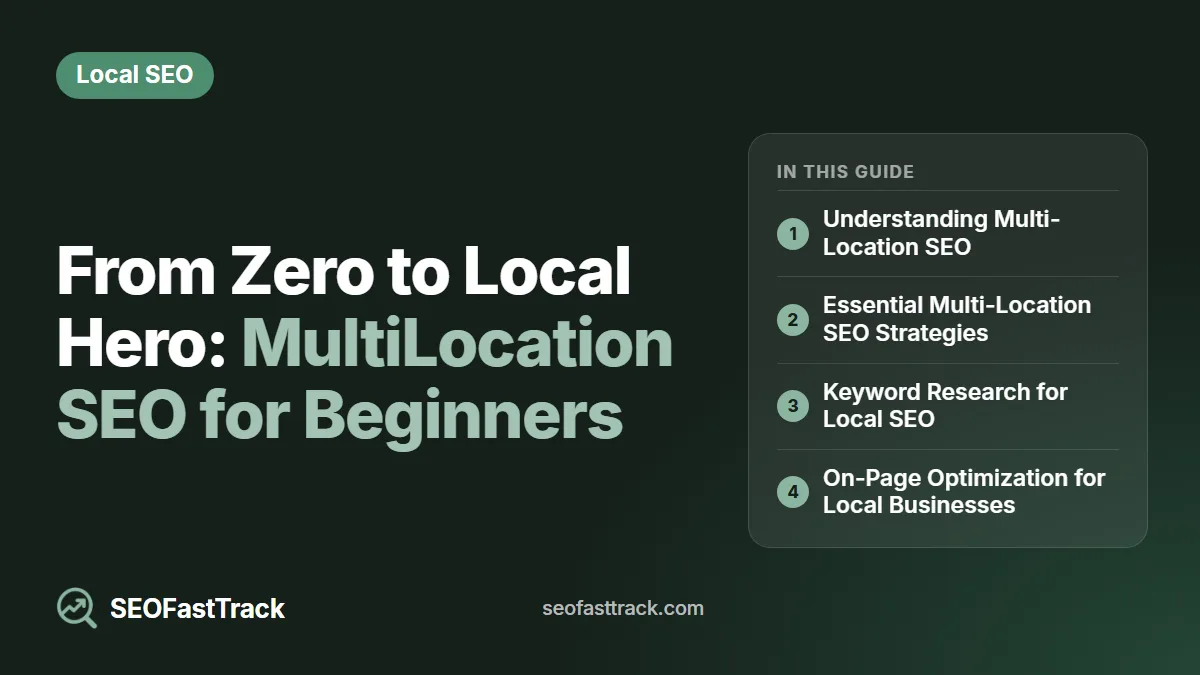
Welcome to SEOFastTrack, your comprehensive guide to conquering the SEO landscape!
Are you ready to transform your small business into a local powerhouse? This Multi-Location SEO Strategies Guide is your starting point. Discover the secrets to optimizing your online presence for multiple locations, attracting more customers, and dominating your local search results. Curious about how to become a local hero? Let's dive in and unlock the potential of multi-location SEO!
- Multi-Location SEO: A Comprehensive Guide
- Understanding Multi-Location SEO
- Essential Multi-Location SEO Strategies
- Keyword Research for Local SEO
- On-Page Optimization for Local Businesses
- Local Link Building Strategies
- Monitoring and Measuring Performance
- Multi-Location SEO Checklist
- Common Mistakes to Avoid
- Advanced Multi-Location SEO Tactics
- Next Steps for Continued Success
-
Frequently Asked Questions
- What is Multi-Location SEO and why is it important for businesses with multiple locations?
- What are the key components of a successful Multi-Location SEO strategy?
- How does keyword research differ for a multi-location business compared to a single-location business?
- What are some effective strategies for building local citations for multiple business locations?
- How can I track the success of my Multi-Location SEO efforts?
- Final Reflection: Building Bridges in the Digital Landscape
- Ignite Your Local Presence: Take the Next Leap!
Multi-Location SEO: A Comprehensive Guide
Understanding Multi-Location SEO
What is Multi-Location SEO?
Multi-location SEO is a specialized branch of search engine optimization focused on enhancing the online visibility of businesses with multiple physical locations. Unlike businesses serving a broad geographic area or operating solely online, multi-location businesses, such as franchises, chain stores, or companies with branches in different cities, require a distinct SEO approach.
This strategy aims to ensure that each business location appears prominently in local search results when potential customers nearby search for relevant products or services. It’s not just about ranking one website; it’s about managing and optimizing the online presence of numerous locations to capture local search traffic effectively.
The core of multi-location SEO lies in creating a cohesive yet locally relevant online footprint for each branch. Imagine a coffee shop chain with outlets across a state. A generic SEO strategy might bring traffic to the main website, but it wouldn't necessarily direct local customers to their nearest branch.
Multi-location SEO, in contrast, ensures that when someone searches for "coffee near me" in a specific city, the coffee shop's location in that city is highly visible in search results, including Google Maps and local business listings. This targeted approach is crucial for driving foot traffic and local sales for businesses operating across multiple locations.
Defining Target Audience and Geographic Areas
Before embarking on a multi-location SEO strategy, a crucial first step is to clearly define the target audience for each location and the specific geographic areas they serve. While a business might have a general target audience across all locations, nuances often exist based on local demographics, preferences, and competitive landscapes. For example, a restaurant chain might find that a location near a university attracts a younger demographic seeking budget-friendly options, while a downtown location might cater to professionals looking for upscale dining experiences. Understanding these local variations is essential for tailoring SEO efforts effectively.
Defining geographic areas involves pinpointing the precise locations and service areas for each business branch. This goes beyond simply listing city names. It requires considering the radius around each location from which you aim to attract customers.
For instance, a dental clinic in a suburban area might target residents within a 5-mile radius, while a car dealership in a more rural setting might need to target a broader 20-mile radius. Utilizing tools like Google Maps and demographic data can help visualize and define these service areas accurately. This geographic precision is vital for ensuring that your SEO efforts are focused on reaching the most relevant local customer base for each of your business locations.
Benefits of Multi-Location SEO
Implementing a robust multi-location SEO strategy offers a multitude of benefits, directly impacting a business's bottom line and overall growth. One of the most significant advantages is increased local visibility. By optimizing each location's online presence, businesses can significantly improve their rankings in local search results, making it easier for nearby customers to find them. This heightened visibility translates directly into increased website traffic, phone calls, and ultimately, foot traffic to physical locations. For example, a study by Google found that 76% of people who search on their smartphones for something nearby visit a related business within a day.
Beyond increased visibility, multi-location SEO fosters brand consistency and trust across all locations. By ensuring consistent branding, messaging, and information across all online platforms, businesses project a professional and reliable image. This consistency is crucial for building customer confidence, especially for businesses operating in multiple cities or regions.
Furthermore, effective multi-location SEO can lead to improved customer engagement through localized content and targeted promotions. By tailoring content to specific locations and engaging with local communities online, businesses can build stronger relationships with their customer base, fostering loyalty and repeat business. This localized approach makes customers feel valued and understood, strengthening the connection between the business and its local communities.
Essential Multi-Location SEO Strategies
Optimizing Google Business Profile (GBP)
Google Business Profile (GBP) is arguably the most critical element in any multi-location SEO strategy. It serves as the central hub for managing each location's online presence on Google Search and Maps. A fully optimized GBP profile significantly enhances local visibility, providing potential customers with essential information like location, hours, services, and customer reviews directly within search results. For multi-location businesses, it’s crucial to claim and optimize a separate GBP profile for each physical location. This ensures that each branch appears independently in local searches, maximizing reach and relevance.
Optimizing GBP involves a comprehensive approach, starting with verifying each location and ensuring all information is accurate and up-to-date. This includes selecting the correct primary and secondary categories that accurately reflect the business offerings at each location. Regularly updating the profile with fresh content, such as posts about promotions, events, or new products, keeps the profile active and engaging.
Responding promptly to customer reviews, both positive and negative, demonstrates attentiveness and builds trust. High-quality photos and videos showcasing the location, products, and team further enhance the profile's visual appeal and provide a richer user experience. A well-managed GBP profile acts as a powerful local marketing tool, driving traffic and conversions for each business location.
NAP (Name, Address, Phone Number) Consistency
NAP consistency – ensuring that the Name, Address, and Phone Number are identical across all online platforms – is a foundational element of multi-location SEO. Search engines like Google use NAP information to verify the legitimacy and location of businesses. Inconsistent NAP data can confuse search engines, leading to lower rankings and reduced visibility in local search results. For multi-location businesses, maintaining NAP consistency across numerous online directories, citations, social media profiles, and the website is paramount.
Achieving NAP consistency requires meticulous attention to detail. Businesses should create a standardized NAP format and diligently apply it across all online listings. This includes using the exact same business name, full physical address (including suite or unit numbers if applicable), and local phone number for each location. It’s crucial to avoid variations or abbreviations.
For example, "Street" should always be "Street," not "St." or "Str." Regularly auditing online listings and correcting any inconsistencies ensures that search engines have accurate and reliable information, boosting local search rankings and improving the overall online presence of each business location. Tools are available to help businesses manage and monitor NAP consistency across the web, simplifying this crucial aspect of multi-location SEO.
GBP Description, Categories, and Attributes
The description, categories, and attributes within a Google Business Profile are vital for accurately representing each business location and attracting the right local customers. The GBP description provides an opportunity to showcase the unique selling points and offerings of each location in a compelling and keyword-rich manner. This section should be carefully crafted to highlight what differentiates the business and appeal to the local target audience. It's not just about listing services; it's about telling a story that resonates with local searchers.
Selecting the correct primary and secondary categories is crucial for ensuring that the GBP profile appears in relevant local searches. Choosing highly specific categories that accurately reflect the core business offerings enhances relevance and improves search visibility. Beyond categories, GBP attributes allow businesses to further specify their offerings and amenities, such as "wheelchair accessible," "free Wi-Fi," "outdoor seating," or "curbside pickup."
Utilizing relevant attributes not only provides valuable information to potential customers but also improves search visibility for specific needs and preferences. Regularly reviewing and updating the description, categories, and attributes ensures that the GBP profile remains optimized and effectively attracts the desired local customer base for each business location.
Managing Customer Reviews
Customer reviews on Google Business Profile are a powerful ranking factor in local SEO and significantly influence potential customers' decisions. Positive reviews build trust, enhance credibility, and improve local search rankings. Conversely, negative reviews, if left unaddressed, can deter potential customers and negatively impact a business's online reputation. For multi-location businesses, proactively managing customer reviews for each location is essential for maintaining a positive online presence and maximizing local search performance.
Effective review management involves actively encouraging satisfied customers to leave reviews. This can be done through various methods, such as email follow-ups, in-store prompts, or links on receipts. Equally important is responding promptly and professionally to all reviews, both positive and negative.
Thanking customers for positive feedback reinforces their positive experience and encourages future patronage. Addressing negative reviews constructively, acknowledging concerns, and offering solutions demonstrates a commitment to customer satisfaction and can often turn a negative experience into a positive interaction. Regularly monitoring and engaging with reviews on GBP not only improves online reputation but also provides valuable insights into customer perceptions and areas for improvement across all business locations.
Localized Website Structure
A well-structured website optimized for local search is fundamental for multi-location SEO success. For businesses with multiple locations, a centralized website with a dedicated structure for each location is crucial. This approach ensures that each location can rank independently in local search results while maintaining a cohesive brand identity. Simply having a single website with a contact page listing all locations is insufficient for effective multi-location SEO. A localized website structure focuses on creating distinct, location-specific pages and content that cater to the unique search queries and needs of customers in each geographic area.
This localized structure typically involves creating a "location finder" or "locations" section on the main website. Within this section, each location should have its own dedicated page, often accessible through a unique URL. These location pages are not just simple contact pages; they are comprehensive resources designed to attract local customers.
They should include detailed information about the specific location, such as address, phone number, hours, directions, services offered at that location, staff profiles, local testimonials, and location-specific content. This structured approach allows search engines to understand the geographic relevance of each page and index them appropriately for local search queries, significantly boosting the visibility of each business location in its respective area.
Location-Specific Pages
Location-specific pages are the cornerstone of a localized website structure for multi-location businesses. These are dedicated webpages, distinct from the main homepage, that provide detailed information about each individual business location. They go beyond simply listing contact information; they are designed to act as mini-hubs for local customers, providing all the necessary details and content relevant to that specific branch. Each location page should be optimized to rank in local search results for relevant keywords within its geographic area.
A high-quality location page should include, at minimum, the full NAP information prominently displayed and schema markup implemented. It should also feature an embedded Google Map showcasing the location's precise address.
Beyond these essentials, effective location pages include unique, location-specific content, such as a detailed description of the services or products offered at that particular branch, staff biographies, photos of the location's interior and exterior, customer testimonials specific to that location, and even blog posts or news updates relevant to the local community. Providing this rich, location-specific content not only improves SEO but also enhances the user experience, making it easier for local customers to find the information they need and choose the most convenient location.
Optimizing Website Content with Local Keywords
Optimizing website content with local keywords is a crucial aspect of multi-location SEO, ensuring that each location page ranks for relevant local search queries. Local keywords are search terms that include geographic modifiers, such as city names, neighborhoods, or landmarks, indicating local intent. For example, instead of just targeting "pizza delivery," a pizza restaurant in Brooklyn should target keywords like "pizza delivery Brooklyn" or "best pizza in Park Slope." Incorporating these local keywords naturally into website content helps search engines understand the geographic relevance of each page and match it with local search queries.
Effective local keyword optimization involves strategic placement of these keywords throughout the location pages and other relevant website content. This includes incorporating local keywords into page titles, header tags (H1, H2, etc. ), meta descriptions, image alt text, and body copy. However, it's crucial to avoid keyword stuffing, which can harm search engine rankings. The keywords should be integrated naturally and contextually within high-quality, informative content that is valuable to local users. Furthermore, location-specific content, such as blog posts about local events or neighborhood guides, can provide opportunities to incorporate local keywords organically and further enhance local SEO efforts.
Schema Markup Implementation
Schema markup is a structured data vocabulary that helps search engines better understand the content on a webpage. Implementing schema markup on location pages is highly beneficial for multi-location SEO. It provides search engines with explicit signals about the business name, address, phone number, hours of operation, services, and other key details, enhancing their ability to index and display the information accurately in search results. For local businesses, specifically, LocalBusiness schema markup is crucial.
By implementing LocalBusiness schema on each location page, businesses can provide search engines with structured data that clearly identifies each location as a distinct entity. Within LocalBusiness schema, businesses can specify various properties, including name, address, telephone, openingHours, geo (geographic coordinates), image, priceRange, and servesCuisine (for restaurants), among others. This structured data not only improves search engine understanding but also enhances the appearance of search results, potentially leading to richer snippets and increased click-through rates. For multi-location businesses managing multiple locations, schema markup is a vital technical SEO element that significantly contributes to improved local search visibility and accuracy.
Keyword Research for Local SEO
Identifying Relevant Local Keywords
Identifying relevant local keywords is the foundation of a successful multi-location SEO strategy. These are the search terms that potential customers in specific geographic areas use when looking for products or services like yours. Effective keyword research goes beyond generic industry terms and focuses on uncovering the specific phrases and questions local searchers are using. This involves understanding local search intent and tailoring keyword targeting to reflect those local needs and queries.
The process of identifying local keywords starts with brainstorming a broad list of terms related to your business offerings. Then, refine this list by adding geographic modifiers, such as city names, neighborhoods, zip codes, or even landmarks. Consider variations in how people search locally, including phrases like "near me," "closest," "in [city]," or "[city] [service]."
Think about the different ways customers might describe your products or services locally and incorporate those variations into your keyword research. Analyzing competitor keywords and utilizing keyword research tools can further expand and refine your list of relevant local keywords, ensuring you are targeting the most effective terms for local search visibility.
Keyword Research Tools
Leveraging keyword research tools is essential for efficiently identifying and analyzing local keywords. Several tools are specifically designed to help uncover local search terms, analyze search volume, and assess keyword competition. These tools provide valuable data that informs keyword targeting and helps prioritize SEO efforts. While some tools are premium, offering comprehensive features, there are also free or freemium options that can be valuable for initial keyword research.
Popular keyword research tools for local SEO include Google Keyword Planner, Ahrefs Keywords Explorer, SEMrush, Moz Keyword Explorer, and Ubersuggest. Google Keyword Planner, while primarily designed for Google Ads, provides search volume data and keyword suggestions. Ahrefs, SEMrush, and Moz offer more in-depth keyword analysis, competitor research, and ranking tracking capabilities. Ubersuggest provides a user-friendly interface and a range of keyword research features, including content ideas. Utilizing these tools allows businesses to systematically discover relevant local keywords, understand their search volume and competition, and make data-driven decisions about keyword targeting for their multi-location SEO strategy.
Analyzing Competitor Keywords
Analyzing competitor keywords is a valuable tactic for uncovering relevant local keywords and gaining insights into successful SEO strategies within your industry and geographic areas. By examining the keywords that your local competitors are ranking for, you can identify opportunities to target similar terms or discover underserved keyword niches. Competitor keyword analysis provides a competitive edge and helps refine your own keyword strategy.
Tools like SEMrush, Ahrefs, and Moz allow you to analyze the keywords that your competitors are ranking for in organic search. These tools can reveal the specific local keywords driving traffic to competitor websites, the content they are creating to rank for those keywords, and their backlink profiles.
By studying this competitive landscape, you can identify keyword gaps, discover long-tail local keywords you might have missed, and understand the level of competition for different local search terms. This competitive intelligence informs your keyword targeting, content creation, and link building efforts, helping you develop a more effective and targeted multi-location SEO strategy.
Incorporating Local Keywords
Once relevant local keywords are identified, the next crucial step is to strategically incorporate them into your website content and online presence. Effective keyword integration is not about simply stuffing keywords into text; it’s about naturally and contextually weaving them into various elements of your online presence to signal local relevance to search engines and users. The goal is to make your content informative and valuable to local searchers while optimizing it for search engine visibility.
Key areas for incorporating local keywords include page titles, meta descriptions, header tags (H1, H2, etc. ), body copy, image alt text, and URL slugs. For location pages, ensure that the city and relevant local keywords are prominently featured in these elements. Create location-specific content, such as blog posts, local guides, or case studies, that naturally incorporate local keywords.
Use variations of your target keywords and related terms to broaden your reach and avoid keyword repetition. Remember that the primary focus should always be on creating high-quality, user-friendly content that addresses the needs and queries of local searchers. Natural and strategic keyword integration will enhance both user experience and search engine optimization.
On-Page Optimization for Local Businesses
Optimizing title tags and meta descriptions is crucial for on-page SEO and significantly impacts click-through rates from search engine results pages (SERPs). Title tags are the HTML elements that specify the title of a webpage and are displayed as the clickable headline in search results. Meta descriptions are short summaries of the webpage content that appear below the title tag in search results. For multi-location businesses, optimizing these elements with local keywords is essential for attracting local searchers.
Each location page should have a unique and compelling title tag that accurately reflects the location and services offered. Include relevant local keywords, such as the city and primary service, naturally within the title tag. For example, "[Business Name] - [Service] in [City]" or "[Service] in [City] - [Business Name]". Similarly, craft compelling meta descriptions that entice users to click through to your website.
Meta descriptions should be concise, informative, and include a call to action, highlighting the local relevance of the page. For instance, "Get the best [Service] in [City] at [Business Name]! Visit our [City] location for expert [Service] and exceptional customer service." Well-optimized title tags and meta descriptions improve both search engine rankings and user engagement, driving more local traffic to your website.
Header tags (H1, H2, H3, etc.) are HTML elements used to structure content and create a hierarchy of headings on a webpage. They are not only important for readability and user experience but also play a significant role in on-page SEO. Search engines use header tags to understand the topic and context of webpage content. For local businesses, strategically using header tags with local keywords helps to emphasize local relevance and improve search engine rankings for local queries.
The main heading of each location page should be an H1 tag and should clearly state the primary service and location, incorporating relevant local keywords. For example, "H1: [Service] in [City] at [Business Name]". Subsequent sections of the page can use H2, H3, and other header tags to further organize content and incorporate related local keywords naturally.
Use header tags to highlight key services offered at that location, specific neighborhoods served, or unique selling points relevant to the local area. Ensure that header tags are used logically and contribute to the overall readability and flow of the content. Proper use of header tags improves both SEO and user experience, making it easier for both search engines and users to understand the local relevance of your content.
Location-Specific Content Creation
Creating location-specific content is a highly effective strategy for multi-location SEO. Generic content duplicated across all location pages can dilute SEO efforts and fail to resonate with local audiences. Unique, location-relevant content, on the other hand, signals local expertise to search engines and provides valuable information to local customers. This approach not only improves search engine rankings but also enhances user engagement and builds stronger connections with local communities.
Location-specific content can take various forms, including blog posts about local events or news, neighborhood guides, case studies featuring local clients, testimonials from customers at that specific location, staff profiles highlighting local team members, or even local promotions and offers. Tailor content to address the unique characteristics, needs, and interests of the local community surrounding each business location.
For example, a restaurant chain could create blog posts about local farmers markets, nearby attractions, or local food festivals relevant to each restaurant location. This type of content not only incorporates local keywords naturally but also positions the business as a local expert and valuable resource within each community, fostering trust and attracting local customers.
Optimizing Images
Optimizing images is an often-overlooked aspect of on-page SEO that can significantly contribute to local search visibility. Images not only enhance the visual appeal of web pages but also provide opportunities to incorporate local keywords and improve accessibility. For multi-location businesses, optimizing images on location pages with location-specific details is a valuable SEO tactic.
Image optimization for local SEO involves several key steps. First, use high-quality, relevant images that showcase the physical location, products, services, or team at each branch. Filename images using descriptive keywords that include location names. For example, instead of "image1.jpg," use "front-entrance-brooklyn-restaurant.jpg". Secondly, add descriptive alt text to each image, providing context for search engines and users with visual impairments.
Incorporate local keywords naturally within the alt text. For instance, "Front entrance of our Brooklyn restaurant on Smith Street." Thirdly, compress images to reduce file size without sacrificing quality, improving page load speed, which is a ranking factor. Optimized images not only enhance user experience but also provide valuable SEO signals, contributing to improved local search rankings and visibility.
Local Link Building Strategies
Building Local Citations
Building local citations is a fundamental local link building strategy for multi-location SEO. Local citations are online mentions of your business's NAP (Name, Address, Phone Number) on websites and online directories. These citations act as digital references that help search engines verify your business's legitimacy, location, and online presence. Consistent and accurate citations across reputable local directories and websites are crucial for improving local search rankings and building online authority.
The process of building local citations involves identifying relevant online directories and websites that cater to local businesses within your industry and geographic areas. Major directories like Yelp, Foursquare, Bing Places for Business, and Apple Maps are essential. Industry-specific directories and local business directories relevant to each location should also be targeted. Ensure that your NAP information is consistent and accurate across all citation sources.
Use the standardized NAP format you established and diligently apply it to each listing. Regularly audit your citations to ensure accuracy and update any outdated information. Consistent and high-quality local citations strengthen your online presence and contribute significantly to local search ranking improvements.
Earning Local Backlinks
Earning local backlinks, or links from other websites to your website, is a powerful local link building strategy that enhances your website's authority and improves local search rankings. Backlinks from reputable local websites signal to search engines that your website is a trusted and valuable resource within the local community. These backlinks act as "votes of confidence" and are a significant ranking factor in local SEO.
Focus on earning backlinks from relevant local websites, such as local news outlets, community blogs, business associations, chambers of commerce, and other local organizations. Guest blogging on local websites, sponsoring local events and getting listed on event websites, participating in local business directories (beyond basic citations), and offering valuable local resources that other websites might link to are effective tactics for earning local backlinks. Prioritize quality over quantity when it comes to backlinks.
A few high-quality backlinks from authoritative local websites are more valuable than numerous low-quality or irrelevant backlinks. Building a strong portfolio of local backlinks strengthens your website's authority within your target geographic areas and significantly boosts local search visibility.
Community Engagement
Community engagement is a valuable, often overlooked, local link building strategy that also fosters brand loyalty and local recognition. Actively participating in and contributing to the local community can generate organic backlinks, citations, and positive brand mentions, all of which contribute to improved local SEO. Engaging with the local community demonstrates your business's commitment to the area and builds trust with local customers.
Community engagement can take various forms, such as sponsoring local events, participating in local charities or non-profit organizations, hosting local workshops or seminars, partnering with other local businesses, or actively participating in local online forums and social media groups. When you sponsor a local event, your business name and website may be listed on the event's website, providing a valuable backlink and citation.
Participating in local community initiatives builds brand awareness, generates positive PR, and can lead to organic mentions and links from local news outlets, blogs, and community websites. Authentic community engagement not only strengthens your local SEO but also builds stronger relationships with your customer base and fosters long-term brand loyalty.
Monitoring and Measuring Performance
Tracking Key Metrics
Monitoring and measuring performance is crucial for understanding the effectiveness of your multi-location SEO strategy and making data-driven adjustments. Tracking key metrics provides insights into what is working well, what needs improvement, and whether your SEO efforts are driving tangible results. Regularly monitoring these metrics allows you to optimize your strategy and maximize your return on investment.
Essential key metrics to track for multi-location SEO include local search rankings for target keywords, website traffic from local search, Google Business Profile performance (views, clicks, calls, direction requests), citation growth, backlink acquisition, and ultimately, conversions and sales attributed to local search efforts. Utilize tools like Google Analytics, Google Search Console, and GBP Insights to track these metrics. Set up dashboards to visualize performance trends and easily identify areas of improvement or decline. Regularly analyze these metrics to assess the overall health of your multi-location SEO strategy and identify opportunities for optimization.
Analyzing Local Search Rankings and Website Traffic
Analyzing local search rankings and website traffic is a core aspect of performance monitoring for multi-location SEO. Tracking your rankings for target local keywords provides a direct measure of your visibility in local search results. Analyzing website traffic from local search reveals how effectively your SEO efforts are driving relevant users to your website. These analyses help you understand the impact of your SEO strategies on local search performance.
Use rank tracking tools to monitor your position for target local keywords across different search engines and geographic areas. Track rankings over time to identify trends and assess the impact of SEO changes. In Google Analytics, segment website traffic to isolate organic traffic from local search.
Analyze landing page performance, bounce rates, and conversion rates for local search traffic to understand user engagement and identify areas for website optimization. Combine ranking data with website traffic analysis to gain a comprehensive understanding of your local search performance and identify opportunities to improve rankings, drive more relevant traffic, and enhance user experience.
Adjusting SEO Strategy
Regularly monitoring and analyzing performance data is not just about tracking metrics; it's about using those insights to inform strategic adjustments to your multi-location SEO strategy. SEO is not a set-it-and-forget-it activity; it's an ongoing process of optimization and adaptation. Performance data provides valuable feedback that guides strategic decisions and ensures your SEO efforts remain effective and aligned with your business goals.
Based on your performance analysis, identify areas where your SEO strategy is underperforming or where opportunities for improvement exist. For example, if you are not ranking well for certain target keywords, you might need to refine your keyword targeting, optimize your content further, or build more relevant backlinks. If website traffic from local search is low, you might need to improve your GBP optimization, enhance your website’s user experience, or adjust your meta descriptions to improve click-through rates.
Continuously test different SEO tactics, monitor their impact on key metrics, and refine your strategy based on data-driven insights. This iterative approach to SEO ensures that your strategy remains agile, effective, and responsive to changes in search engine algorithms and user behavior.
Multi-Location SEO Checklist
This checklist provides a structured approach to implementing and maintaining a robust multi-location SEO strategy.
Google Business Profile (GBP) Optimization:
- [ ] Claim and verify GBP profiles for each location.
- [ ] Ensure NAP consistency across all GBP profiles.
- [ ] Optimize GBP descriptions, categories, and attributes.
- [ ] Regularly manage and respond to customer reviews.
- [ ] Post regularly with updates, offers, and photos.
Localized Website Structure:
- [ ] Create dedicated location pages for each branch.
- [ ] Optimize location page content with local keywords.
- [ ] Implement schema markup (LocalBusiness) on location pages.
- [ ] Ensure mobile-friendliness of all location pages.
- [ ] Implement a clear location finder on the website.
Keyword Research and Targeting:
- [ ] Conduct thorough local keyword research for each location.
- [ ] Analyze competitor keywords for local insights.
- [ ] Incorporate local keywords into page titles, meta descriptions, headers, and content.
- [ ] Target long-tail local keywords.
- [ ] Use keyword research tools for ongoing keyword discovery.
On-Page Optimization:
- [ ] Optimize title tags and meta descriptions with local keywords.
- [ ] Utilize header tags effectively to structure content and incorporate keywords.
- [ ] Create unique, location-specific content.
- [ ] Optimize images with location-relevant filenames and alt text.
- [ ] Ensure fast page load speed for all location pages.
Local Link Building:
- [ ] Build consistent local citations in relevant directories.
- [ ] Earn local backlinks from reputable local websites.
- [ ] Engage with the local community for link building opportunities.
- [ ] Monitor citation and backlink profiles regularly.
- [ ] Address and correct any inconsistent NAP information across citations.
Monitoring and Measurement:
- [ ] Track local search rankings for target keywords.
- [ ] Analyze website traffic from local search.
- [ ] Monitor Google Business Profile performance metrics.
- [ ] Regularly review and analyze performance data.
- [ ] Adjust SEO strategy based on performance insights.
Common Mistakes to Avoid
Inconsistent NAP Information
Inconsistent NAP (Name, Address, Phone Number) information is a critical mistake that can severely hinder multi-location SEO efforts. Search engines rely on NAP data to verify business legitimacy and location. Inconsistencies across online platforms confuse search engines, leading to lower local search rankings and reduced visibility. For multi-location businesses, maintaining absolute NAP consistency across all listings is paramount.
Inconsistencies can arise from various sources, such as using slightly different business names, abbreviations in addresses, or variations in phone number formats. Even minor discrepancies can impact SEO. For example, using "Street" in one listing and "St." in another, or having different phone number formats across citations.
Regularly audit all online listings, including Google Business Profile, online directories, social media profiles, and the website, to identify and correct any NAP inconsistencies. Establish a standardized NAP format and ensure it is applied meticulously across all online platforms. Tools are available to help monitor and manage NAP consistency, simplifying this crucial aspect of multi-location SEO.
Neglecting Customer Reviews
Neglecting customer reviews is a significant oversight in multi-location SEO, as reviews directly impact both local search rankings and customer trust. Positive reviews enhance online reputation, improve search visibility, and influence potential customers' decisions. Conversely, ignored or unaddressed negative reviews can damage online reputation and deter potential customers. For multi-location businesses, actively managing reviews for each location is essential.
Ignoring reviews, both positive and negative, signals a lack of engagement and customer care. Failing to respond to negative reviews can exacerbate customer dissatisfaction and damage brand perception. Make it a priority to actively encourage customers to leave reviews on Google Business Profile and other relevant platforms.
Respond promptly and professionally to all reviews, thanking customers for positive feedback and addressing concerns raised in negative reviews constructively. Use customer feedback to identify areas for improvement across all locations and demonstrate a commitment to customer satisfaction. Proactive review management is crucial for building a positive online reputation and maximizing the benefits of customer feedback for multi-location SEO.
Ignoring Location-Specific Content
Ignoring location-specific content is a missed opportunity in multi-location SEO. Generic content duplicated across all location pages can dilute SEO efforts and fail to resonate with local audiences. Search engines favor unique, relevant content that addresses specific user queries and geographic contexts. For multi-location businesses, creating location-specific content is crucial for improving local search rankings and engaging local customers effectively.
Using the same content across all location pages signals a lack of local relevance to search engines and provides a poor user experience for local searchers seeking information about a specific branch. Instead, create unique content for each location page that highlights the specific services, features, staff, and community aspects of that branch. Develop location-specific blog posts, local guides, or case studies that cater to the interests and needs of the local audience.
Tailor content to reflect the unique characteristics of each location and incorporate local keywords naturally. Location-specific content not only improves SEO but also enhances user engagement and builds stronger connections with local communities.
Keyword Over-Optimization
Keyword over-optimization, or keyword stuffing, is a detrimental practice that can harm multi-location SEO efforts. While incorporating relevant keywords is essential, excessively and unnaturally using keywords in website content and metadata can trigger search engine penalties and negatively impact rankings. Search engines prioritize user experience and penalize websites that appear to be manipulating search results through keyword stuffing.
Keyword stuffing manifests as unnaturally repeating keywords, using excessive keyword variations, or placing keywords in irrelevant contexts. This practice makes content difficult to read and provides a poor user experience. Instead of focusing on keyword density, prioritize creating high-quality, informative, and user-friendly content that naturally incorporates relevant keywords.
Use keywords strategically in page titles, meta descriptions, header tags, and body copy, but ensure they are integrated smoothly and contextually. Focus on providing valuable content that addresses user queries and meets their needs, rather than solely focusing on keyword manipulation. A natural and user-centric approach to keyword integration is far more effective and sustainable for long-term multi-location SEO success.
Advanced Multi-Location SEO Tactics
Leveraging Local Influencers
Leveraging local influencers is an advanced multi-location SEO tactic that can significantly amplify local reach and brand awareness. Local influencers are individuals with a strong online presence and engaged following within a specific geographic area. Collaborating with local influencers can expose your business to a wider local audience, generate valuable backlinks, and build social proof within the community.
Identifying relevant local influencers involves researching individuals with a strong local presence and audience alignment with your target demographic. This could include local bloggers, social media personalities, community leaders, or industry experts with a local following. Collaborate with influencers on various initiatives, such as sponsored posts, social media shout-outs, content collaborations, event partnerships, or product reviews.
Influencer collaborations can generate high-quality backlinks to your website, drive local traffic, and enhance your brand's credibility within the local community. Choose influencers whose audience and values align with your brand to ensure authentic and effective collaborations that resonate with your target local customer base.
Using Location-Based Landing Pages
Using location-based landing pages is an advanced multi-location SEO tactic that enhances targeting and conversion rates for specific local audiences. While location pages within the main website are essential, dedicated location-based landing pages can be created for specific marketing campaigns, promotions, or targeted keyword phrases. These landing pages are designed to be highly focused and optimized for specific local search queries and conversion goals.
Location-based landing pages are separate from the main location pages and are typically used for targeted advertising campaigns, email marketing, or specific promotional offers in a particular geographic area. For example, a multi-location business might create a landing page specifically for a "summer sale in Brooklyn" campaign.
These landing pages are highly optimized for relevant local keywords, feature compelling calls to action, and are designed to drive specific conversions, such as appointment bookings, lead generation, or online purchases. Location-based landing pages provide a more targeted and conversion-focused approach to multi-location SEO, complementing the broader SEO efforts for main location pages.
Optimizing for Voice Search
Optimizing for voice search is becoming increasingly crucial in local SEO as voice search adoption grows. Voice search queries often differ from text-based searches, typically being longer, more conversational, and location-focused. Adapting your multi-location SEO strategy to accommodate voice search trends is essential for capturing this growing segment of local search traffic.
Voice search queries are often phrased as questions and frequently include location modifiers, such as "where is the best pizza near me?" or "what are the opening hours of [business name] in [city]?". Optimize your website content to answer common voice search queries related to your business and locations. Incorporate long-tail keywords and conversational phrases into your content.
Ensure that your GBP profiles are fully optimized with accurate NAP information, hours of operation, and frequently asked questions. Improve website speed and mobile-friendliness, as voice search is predominantly performed on mobile devices. Optimizing for voice search ensures that your multi-location business is discoverable by users utilizing voice assistants like Siri, Google Assistant, and Alexa, capturing a significant and growing segment of local search traffic.
Next Steps for Continued Success
Staying Up-to-Date
Staying up-to-date with the ever-evolving landscape of SEO is crucial for continued success in multi-location SEO. Search engine algorithms, best practices, and user behaviors are constantly changing. What works effectively today might become outdated or less effective tomorrow. Continuous learning and adaptation are essential for maintaining and improving your multi-location SEO performance over time.
SEO is a dynamic field, with search engine algorithms like Google's undergoing frequent updates that can impact rankings and visibility. New SEO trends and technologies emerge regularly, requiring businesses to adapt their strategies to remain competitive. Algorithm updates, changes in local search ranking factors, and the rise of new search technologies like voice search necessitate ongoing learning and adaptation.
Follow reputable SEO blogs, industry publications, attend webinars and conferences, and engage with the SEO community to stay informed about the latest trends and best practices. Continuously monitor your SEO performance, analyze data, and adapt your strategy proactively to maintain a competitive edge in the ever-changing world of search engine optimization.
Investing in Ongoing SEO Efforts
Investing in ongoing SEO efforts is not just an option but a necessity for sustained success in multi-location SEO. SEO is not a one-time project; it's an ongoing process that requires continuous effort, monitoring, and optimization. Consistent SEO investment is crucial for maintaining and improving local search rankings, driving traffic, and achieving long-term business growth.
SEO is a marathon, not a sprint. Initial SEO efforts can yield significant improvements, but maintaining those results and continuing to grow requires sustained investment. Competitors are also actively engaged in SEO, and search engine algorithms are constantly evolving, necessitating ongoing optimization to stay ahead.
Allocate resources for ongoing keyword research, content creation, link building, GBP management, performance monitoring, and technical SEO maintenance. Consider partnering with SEO professionals or agencies to augment your in-house capabilities and ensure consistent, expert-level SEO management. Consistent investment in SEO is a strategic imperative for long-term online visibility, customer acquisition, and sustained success in the competitive landscape of multi-location businesses.
Frequently Asked Questions
What is Multi-Location SEO and why is it important for businesses with multiple locations?
Multi-Location SEO is the practice of optimizing your online presence to attract customers from different geographical areas. It's important because it helps businesses with multiple locations increase visibility in local search results and drive more foot traffic to each location.
What are the key components of a successful Multi-Location SEO strategy?
The key components include optimizing Google Business Profile (GBP) listings for each location, building local citations, and creating location-specific content on your website. These efforts help search engines understand your business's local relevance.
How does keyword research differ for a multi-location business compared to a single-location business?
For multi-location businesses, keyword research needs to be location-specific. You should identify keywords that include geographical terms relevant to each location, such as "[service] in [city]" or "[product] near [neighborhood]".
What are some effective strategies for building local citations for multiple business locations?
Effective strategies include submitting your business information to major online directories like Yelp and Yellow Pages, as well as industry-specific directories. Consistency in your NAP (Name, Address, Phone number) information is crucial.
How can I track the success of my Multi-Location SEO efforts?
You can track success by monitoring website traffic to location-specific pages, keyword rankings for local search terms, and engagement metrics on your Google Business Profile listings, such as calls and direction requests.
Okay, here's a final reflection you can use for your article, "From Zero to Local Hero: MultiLocation SEO for Beginners," aiming to rank for the keyword "Multi-Location SEO Strategies Guide."
Final Reflection: Building Bridges in the Digital Landscape
The journey from digital obscurity to local prominence, as outlined in this guide, highlights the enduring power of strategic visibility in the multi-location SEO landscape. In today's interconnected world, where consumers increasingly rely on local search to discover businesses, mastering these strategies is not just an advantage, but a necessity for survival and growth.
The impact of effective multi-location SEO extends far beyond mere rankings; it shapes the very fabric of local economies and community connections. Witnessing businesses thrive by connecting with their local customers through optimized online presence is a testament to the transformative power of these strategies. The future of search is all about context. Understanding the user's intent, location, and the world around them.
- Gary Illyes, Google Webmaster Trends Analyst. This quote encapsulates the essence of multi-location SEO: understanding and catering to the specific needs of local communities.
As you embark on your own journey to becoming a local hero, remember that the strategies outlined here are not just about algorithms and keywords; they are about building genuine connections with your customers and contributing to the vibrancy of your local community. Embrace the power of multi-location SEO, and let it be the bridge that connects your business with the people who need you most.
Ignite Your Local Presence: Take the Next Leap!
Thanks for exploring multi-location SEO with SEOFastTrack! We hope this guide provided actionable strategies to boost your local visibility. Now, it's time to put that knowledge into practice.
To get started, immediately focus on these key steps:
- Claim and optimize your Google Business Profile listings for each location. This is fundamental to local SEO success.
- Analyze your competitors' local SEO strategies using tools like Semrush or Ahrefs to identify opportunities for improvement.
- Join the SEOFastTrack community forum to share your progress, ask questions, and connect with other local SEO professionals.
Ready to elevate your business to a local SEO leader? Let us know in the comments which location you'll optimize first and the keywords you'll target.