
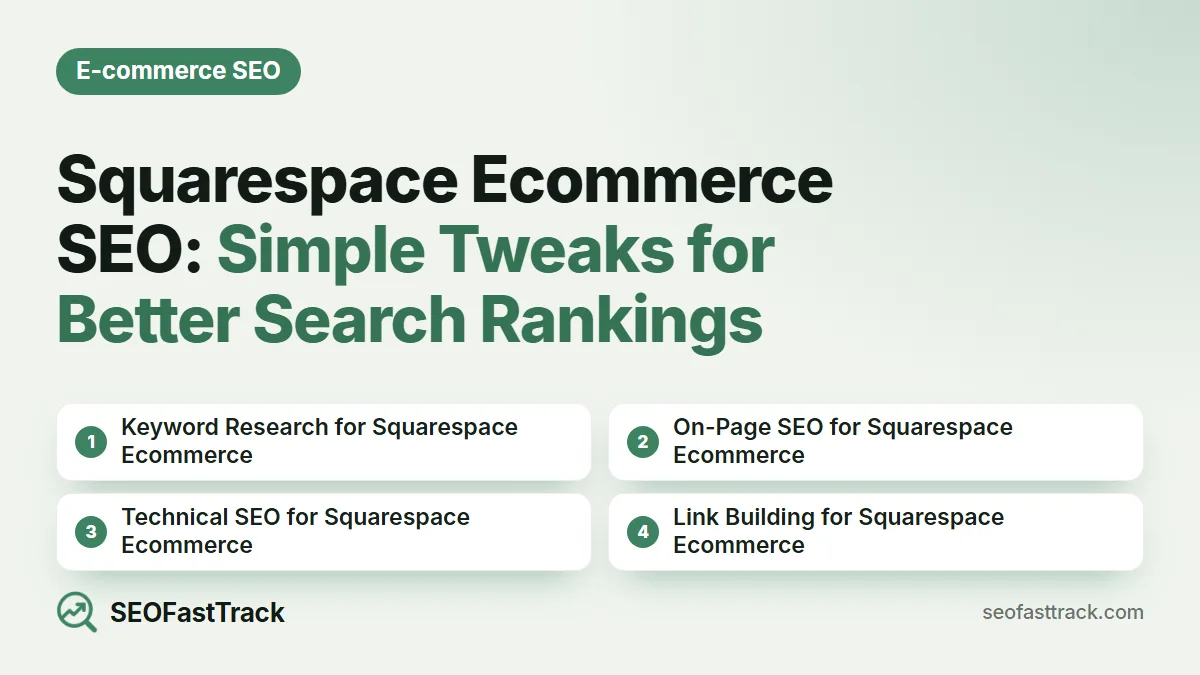
Squarespace Ecommerce SEO: Simple Tweaks for Better Search Rankings

Welcome to SEOFastTrack, your comprehensive resource for mastering search engine optimization!
Are you ready to unlock the untapped potential of your Squarespace e-commerce store? This guide delves deep into Squarespace SEO for Ecommerce Stores, revealing simple yet powerful tweaks that can dramatically improve your search rankings. Discover the secrets to attracting more organic traffic and boosting your sales. Let's get started and watch your business thrive!
- Squarespace Ecommerce SEO: Simple Tweaks for Better Search Rankings | SEOFastTrack
- Introduction: Boosting Your Ecommerce Store with Squarespace SEO
- Keyword Research for Squarespace Ecommerce: Finding Your Niche
-
On-Page SEO for Squarespace Ecommerce: Optimizing Your Product Pages
- Title Tags and Meta Descriptions: Click-Worthy Optimization for Squarespace
- Headline Optimization (H1, H2, H3) for Squarespace Product Pages
- Image Optimization for Squarespace Ecommerce: Alt Text and File Names
- Content Optimization: Writing Compelling Product Descriptions for Squarespace SEO
- Internal Linking for Squarespace Ecommerce: Guiding Customers and Search Engines
- Technical SEO for Squarespace Ecommerce: Ensuring a Smooth User Experience
- Link Building for Squarespace Ecommerce: Earning Authority and Trust
- Squarespace SEO Settings: Configuring Your Store for Search Engines
- Advanced Squarespace Ecommerce SEO Strategies
- Measuring Your Squarespace Ecommerce SEO Success
- Conclusion: Mastering Squarespace SEO for Ecommerce Growth
-
Frequently Asked Questions
- How important is keyword research when optimizing a Squarespace ecommerce store for SEO?
- What are some essential on-page SEO elements to focus on within Squarespace for ecommerce?
- How can I effectively build high-quality backlinks to my Squarespace ecommerce store?
- What are some common technical SEO issues that might hinder a Squarespace ecommerce store's ranking?
- How can I stay updated with the latest Google algorithm updates and adapt my Squarespace SEO strategy?
- Final Reflection: Elevating Ecommerce Through Squarespace SEO
- Unleash Your Squarespace Store's Potential!
Squarespace Ecommerce SEO: Simple Tweaks for Better Search Rankings | SEOFastTrack
Introduction: Boosting Your Ecommerce Store with Squarespace SEO
Why Squarespace SEO Matters for Online Sales
For ecommerce businesses using Squarespace, search engine optimization (SEO) is not just an option; it's a necessity for sustainable growth and profitability. Consider this: millions of online searches are conducted daily by potential customers actively seeking products like yours. Without a solid Squarespace SEO strategy, your online store risks becoming invisible to these potential buyers, effectively limiting your sales potential.
Imagine a physical store located in a bustling city center versus one tucked away on a deserted side street. Squarespace SEO acts as your storefront's location in the digital world, ensuring you are prominently positioned where your target audience is actively looking.
Furthermore, organic traffic derived from search engines like Google often boasts a higher conversion rate compared to paid advertising or social media. This is because users searching for specific products or solutions are typically further down the purchasing funnel, demonstrating a stronger intent to buy.
Investing in Squarespace SEO allows you to tap into this highly qualified traffic, driving not just visitors, but customers actively seeking your offerings. By optimizing your Squarespace store for relevant keywords, you are essentially placing your products in front of the right people at the right time, maximizing your chances of converting them into paying customers and building a thriving online business.
This Guide: Simple SEO Tweaks for Squarespace Ecommerce Success
This guide is designed to demystify Squarespace ecommerce SEO and provide actionable, easy-to-implement tweaks that can significantly improve your search engine rankings and, consequently, your online sales. We understand that as a Squarespace store owner, you might be juggling multiple responsibilities, from product sourcing to customer service. Therefore, we've focused on practical SEO strategies that don't require extensive technical expertise or a massive time investment. Instead, we'll highlight simple yet powerful adjustments you can make within your Squarespace platform to boost your store's visibility in search results.
Think of these tweaks as fine-tuning your Squarespace store's engine for optimal performance in the search engine race. We'll cover essential aspects of ecommerce SEO, including keyword research tailored for Squarespace, on-page optimization for product pages, technical SEO considerations specific to the platform, and effective link building strategies. Whether you're just starting your Squarespace ecommerce journey or looking to enhance your existing SEO efforts, this guide will equip you with the knowledge and practical steps to achieve better search rankings and unlock the full potential of your online store within the competitive ecommerce landscape.
Keyword Research for Squarespace Ecommerce: Finding Your Niche
Identifying Profitable Keywords for Your Squarespace Store
Keyword research is the cornerstone of any successful SEO strategy, and it's especially critical for Squarespace ecommerce stores aiming to attract the right customers. The goal is to identify keywords that are not only relevant to your products but also have a reasonable search volume and, crucially, indicate buyer intent. Imagine you sell handmade jewelry on Squarespace.
Generic keywords like "jewelry" are highly competitive and might attract a broad audience, many of whom are just browsing. However, focusing on more specific, buyer-intent keywords like "handmade silver necklaces for women" or "unique artisan earrings online" will target customers who are actively looking to purchase jewelry similar to yours.
To identify profitable keywords for your Squarespace store, start by brainstorming terms related to your product categories, specific product names, and the problems your products solve. Put yourself in your customer's shoes: what would they type into Google to find what you sell? Consider factors like product type, style, material, target audience, and occasion.
For example, if you sell organic baby clothes, relevant keywords could include "organic cotton baby onesies," "eco-friendly baby pajamas," or "best non-toxic baby clothing brands." Prioritize keywords with a balance of search volume and low-to-medium competition, allowing your Squarespace store to rank effectively and attract qualified traffic that converts into sales.
Using Keyword Research Tools for Ecommerce SEO on Squarespace
Leveraging keyword research tools is essential for efficiently identifying and analyzing profitable keywords for your Squarespace ecommerce store. While several paid tools offer advanced features, numerous free or freemium options are readily available and perfectly suitable for small businesses. Consider tools like Google Keyword Planner (free with a Google Ads account), which provides search volume data and keyword suggestions. Ubersuggest (freemium) offers keyword ideas, content suggestions, and competitor analysis, providing valuable insights into what keywords your rivals are targeting. AnswerThePublic (freemium) visualizes questions people ask around your keywords, helping you understand customer intent and uncover long-tail keyword opportunities.
When using these tools for Squarespace ecommerce SEO, focus on finding keywords with a decent monthly search volume that aligns with your niche and target audience. Pay attention to keyword difficulty or competition metrics, aiming for keywords that are not overly competitive, especially if you are just starting. For example, using Ubersuggest, you might search for "handmade soaps."
The tool will reveal related keywords like "natural soaps for sensitive skin," "best smelling soaps," or "organic soap gift sets," along with their search volume and keyword difficulty. Analyze these results to pinpoint keywords that are both relevant to your Squarespace store and attainable in terms of ranking, allowing you to optimize your product pages and content effectively for targeted search traffic.
Long-Tail Keywords: Targeting Specific Customer Searches on Squarespace
Long-tail keywords are longer, more specific keyword phrases that cater to niche searches and often demonstrate higher buyer intent. For Squarespace ecommerce stores, focusing on long-tail keywords can be a highly effective strategy to attract qualified traffic and reduce competition. Instead of broadly targeting "coffee mugs," consider long-tail variations like "personalized ceramic coffee mugs with dog photo," "large insulated travel mugs for commuters," or "funny coffee mugs for office gifts." These longer phrases reflect more specific customer needs and searches, increasing the likelihood of attracting visitors who are actively looking for exactly what you offer.
The advantage of long-tail keywords is that they are typically less competitive than broad, generic keywords. While "coffee mugs" might be a highly competitive keyword, ranking for "personalized ceramic coffee mugs with dog photo" is often more achievable, especially for smaller Squarespace stores. By optimizing your Squarespace product pages and content for long-tail keywords, you can capture niche traffic that is highly targeted and more likely to convert into sales.
For instance, a customer searching for "best vegan protein powder for muscle gain" is clearly further down the buying funnel than someone searching for just "protein powder." Tailoring your Squarespace store to these specific long-tail searches ensures you are attracting customers with a clear purchase intent, maximizing your SEO efforts and driving relevant traffic to your products.
On-Page SEO for Squarespace Ecommerce: Optimizing Your Product Pages
Title tags and meta descriptions are crucial on-page SEO elements that significantly influence click-through rates (CTR) from search engine results pages (SERPs). For your Squarespace ecommerce store, optimizing these elements for each product page is paramount to attract potential customers.
The title tag is the clickable headline that appears in search results, while the meta description is the brief snippet of text below the title tag, providing a summary of the page content. Think of them as your storefront window display in the digital realm – they need to be compelling enough to entice searchers to click and enter your store.
When crafting title tags for your Squarespace product pages, aim for conciseness and clarity, ideally within 50-60 characters to avoid truncation in search results. Include your primary keyword for the product and consider adding brand name or a unique selling proposition (USP) if space allows. For example, instead of a generic title like "Necklace," a more optimized title could be "Sterling Silver Pendant Necklace - Handmade Artisan Jewelry | [Your Brand Name]".
For meta descriptions, aim for around 150-160 characters and focus on creating persuasive and benefit-driven copy. Highlight key features, benefits, and any special offers or promotions. A compelling meta description for the necklace example could be: "Shop our exquisite sterling silver pendant necklace.
Handcrafted with love, perfect for everyday wear or special occasions. Free shipping on orders over $50!". Optimizing both title tags and meta descriptions with relevant keywords and enticing copy will improve your CTR, driving more organic traffic to your Squarespace store.
Headline Optimization (H1, H2, H3) for Squarespace Product Pages
Headline tags (H1, H2, H3, etc.) structure your Squarespace product page content and signal importance to search engines. The H1 tag, typically the main product title, should prominently feature your primary keyword and clearly communicate the page's main topic. Think of it as the most prominent sign above your product display, immediately telling visitors what they're looking at. On a Squarespace product page, the product name automatically becomes the H1 tag. Ensure your product names are keyword-rich and descriptive. For example, instead of just "T-Shirt," use "Organic Cotton Graphic T-Shirt - 'Mountain Sunrise' Design."
H2 and H3 tags are used for subheadings to organize content within your product descriptions and other page sections. Use H2 tags to break down your product description into logical sections, such as "Product Features," "Materials & Care," or "Shipping & Returns." Incorporate relevant secondary keywords and variations within these H2 subheadings to further enhance SEO.
For instance, under "Product Features," you might use H3 tags to highlight specific features like "Ultra-Soft Organic Cotton Fabric" or "Durable, Fade-Resistant Print." Properly structuring your Squarespace product pages with a clear hierarchy of headline tags not only improves readability for users but also helps search engines understand the content's context and relevance, boosting your page's SEO performance.
Image Optimization for Squarespace Ecommerce: Alt Text and File Names
Images are essential for showcasing your products on your Squarespace ecommerce store, but they also present significant SEO opportunities when properly optimized. Image optimization involves two key aspects: alt text and file names. Alt text (alternative text) is a description of the image that is read by screen readers and displayed if the image fails to load. Search engines also use alt text to understand the context of images, making it crucial for SEO. File names, similarly, should be descriptive and keyword-rich, providing another signal to search engines about the image's content.
When optimizing images for your Squarespace store, start by choosing high-quality images that accurately represent your products. Before uploading, rename your image files to be descriptive and include relevant keywords. For example, instead of "IMG_001.jpg," rename it to "organic-cotton-baby-onesie-blue.jpg." When adding images to your Squarespace product pages, always fill in the alt text field with a concise and descriptive sentence that includes your target keyword for the product.
For the baby onesie image, the alt text could be "Blue organic cotton baby onesie with snap closures." Avoid keyword stuffing and focus on providing accurate and helpful descriptions. Optimizing image file names and alt text not only improves accessibility but also enhances your Squarespace store's SEO by providing search engines with valuable context about your product images and their relevance to search queries.
Content Optimization: Writing Compelling Product Descriptions for Squarespace SEO
Product descriptions are more than just informative text on your Squarespace ecommerce store; they are powerful tools for SEO and conversion. Well-written product descriptions not only provide customers with the details they need but also incorporate relevant keywords to improve search engine visibility and persuade visitors to make a purchase. Avoid generic, manufacturer-provided descriptions, which are often duplicated across multiple websites and offer little SEO value. Instead, create unique, engaging, and benefit-driven product descriptions for each item in your Squarespace store.
Focus on highlighting the key features and benefits of your products, addressing customer pain points and desires. Incorporate your primary and secondary keywords naturally throughout the description, avoiding keyword stuffing. Think about what your target audience would search for and use those terms within your product descriptions. For example, if you sell handmade leather wallets, instead of simply stating "Leather Wallet," a more compelling and SEO-friendly description could be: "Handcrafted Full-Grain Leather Wallet - Durable & Stylish Bifold Wallet for Men.
Features multiple card slots, a spacious bill compartment, and a slim profile for comfortable everyday carry." Use storytelling, vivid language, and sensory details to make your product descriptions engaging and persuasive. Optimized and compelling product descriptions not only improve your Squarespace store's SEO but also enhance the customer experience and drive conversions.
Internal Linking for Squarespace Ecommerce: Guiding Customers and Search Engines
Internal linking, the practice of linking between pages within your own Squarespace website, is a crucial yet often overlooked aspect of ecommerce SEO. It serves two primary purposes: improving user navigation and distributing link equity throughout your site. For Squarespace ecommerce stores, strategic internal linking can enhance user experience, guide search engine crawlers, and boost the SEO performance of your product pages and category pages. Think of internal links as signposts within your store, guiding both customers and search engines to relevant and valuable content.
Implement internal linking by strategically linking from one product page to related products, category pages, blog posts (if you have a blog on your Squarespace site), or informational pages like your "About Us" or "Shipping & Returns" pages. For example, on a product page for a specific type of coffee bean, you could link to related coffee beans within the same category, to a blog post about brewing methods, or to your main coffee category page.
Use relevant anchor text (the clickable text of the link) that incorporates keywords related to the linked page. For instance, instead of generic anchor text like "click here," use descriptive anchor text like "view our selection of organic Arabica coffee beans" linking to your Arabica coffee category page.
Strategic internal linking within your Squarespace store helps improve site navigation, keeps users engaged longer, and distributes link authority, ultimately contributing to better search engine rankings and overall SEO performance.
Technical SEO for Squarespace Ecommerce: Ensuring a Smooth User Experience
Mobile-Friendliness: Optimizing Your Squarespace Store for Mobile Devices
Mobile-friendliness is no longer optional; it's a critical ranking factor for Google and essential for providing a positive user experience, especially for Squarespace ecommerce stores. With the majority of online searches now originating from mobile devices, ensuring your Squarespace store is fully optimized for mobile is paramount for reaching a wider audience and maximizing sales. Google prioritizes mobile-first indexing, meaning it primarily uses the mobile version of your website for indexing and ranking. A non-mobile-friendly Squarespace store will likely suffer in search rankings and experience high bounce rates as mobile users struggle to navigate and interact with the site.
Squarespace is inherently designed to be mobile-responsive, meaning its templates automatically adjust to different screen sizes. However, it's still crucial to test your Squarespace store's mobile experience thoroughly. Use Google's Mobile-Friendly Test tool to check if your site passes the mobile-friendliness test.
Ensure that your site loads quickly on mobile devices, that text is legible without zooming, that buttons and links are easily tappable, and that the overall layout is clean and easy to navigate on smaller screens. Pay attention to image sizes and ensure they are optimized for mobile viewing to avoid slow loading times. A seamless and user-friendly mobile experience on your Squarespace store not only pleases mobile visitors but also signals to Google that your site provides a positive user experience, contributing to improved search rankings and increased mobile conversions.
Site Speed Optimization: Improving Page Load Times on Squarespace
Site speed, or page load time, is a crucial technical SEO factor that directly impacts user experience and search engine rankings. Slow-loading Squarespace ecommerce stores can lead to high bounce rates, lower conversion rates, and decreased search engine visibility. Users expect websites to load quickly, and studies show that even a few seconds delay can significantly impact user satisfaction and business metrics. Google also considers site speed as a ranking factor, especially for mobile searches, prioritizing faster websites in search results.
While Squarespace handles much of the backend infrastructure related to site speed, there are still several optimization steps you can take to improve your Squarespace store's loading times. Optimize your images by compressing them without sacrificing quality. Use tools like TinyPNG or ImageOptim to reduce image file sizes before uploading them to Squarespace. Minimize the use of large, unoptimized images, which are a common culprit for slow page load times.
Leverage browser caching by ensuring it is enabled in your Squarespace settings. Reduce the number of third-party scripts and apps you use, as each script can add to page load time. Regularly test your Squarespace store's page speed using tools like Google PageSpeed Insights or GTmetrix to identify areas for improvement and ensure your site loads quickly and efficiently for all users.
Fixing Broken Links and Redirects on Your Squarespace Ecommerce Site
Broken links and incorrect redirects can negatively impact user experience and SEO on your Squarespace ecommerce store. Broken links, also known as 404 errors, occur when a link points to a page that no longer exists. This frustrates users and signals to search engines that your site is not well-maintained. Incorrect redirects, on the other hand, can confuse both users and search engines, potentially leading to lost link equity and ranking issues. Regularly checking for and fixing broken links and redirects is essential for maintaining a healthy and SEO-friendly Squarespace store.
Use online tools like Broken Link Checker or Screaming Frog SEO Spider to crawl your Squarespace website and identify any broken links. Once identified, either update the broken links to point to the correct page or remove the links if the content is no longer relevant. For redirects, ensure they are implemented correctly and are permanent (301 redirects) when you are permanently moving content to a new URL.
Avoid using temporary redirects (302 redirects) for permanent moves, as they can dilute link equity. Squarespace's built-in URL redirects feature allows you to easily manage redirects within your store. Regularly monitoring and fixing broken links and redirects ensures a smooth user experience, helps search engines crawl your site effectively, and prevents potential SEO penalties, contributing to a healthier and better-performing Squarespace ecommerce store.
XML Sitemap Submission for Squarespace Ecommerce: Helping Google Crawl Your Site
An XML sitemap is a file that lists all the important pages of your Squarespace ecommerce store, helping search engines like Google discover and crawl your website more efficiently. It acts as a roadmap for search engine crawlers, guiding them to the key pages you want indexed, including product pages, category pages, and blog posts. Submitting an XML sitemap to Google Search Console is a crucial step in technical SEO, ensuring that Google can effectively find and index all your valuable content, improving your chances of ranking in search results.
Squarespace automatically generates an XML sitemap for your website, typically located at yourdomain.com/sitemap.xml. You don't need to manually create or update it. However, you do need to submit this sitemap to Google Search Console to inform Google about its location and ensure it is used for crawling your site. In Google Search Console, navigate to the "Sitemaps" section and submit your Squarespace sitemap URL. This helps Google prioritize crawling your important pages, especially new or updated content. While submitting a sitemap doesn't guarantee higher rankings, it significantly improves the discoverability of your Squarespace store's content by search engines, ensuring that all your valuable product pages and other relevant content are properly indexed and considered for search rankings.
Building Backlinks to Your Squarespace Product Pages
Backlinks, or inbound links from other websites to your Squarespace store, are a critical ranking factor in Google's algorithm. They are essentially votes of confidence from other websites, signaling to search engines that your content is valuable and trustworthy. For Squarespace ecommerce stores, building high-quality backlinks to your product pages, category pages, and blog posts is essential for improving domain authority, boosting search engine rankings, and driving referral traffic. Think of backlinks as endorsements from other websites, increasing your store's credibility in the eyes of both search engines and potential customers.
Focus on building backlinks from reputable and relevant websites within your niche. Avoid low-quality or spammy backlinks, which can harm your SEO efforts. Strategies for building backlinks to your Squarespace product pages include reaching out to relevant bloggers and influencers in your industry and asking them to review or feature your products. Offer product samples in exchange for honest reviews or mentions on their blogs or social media.
Participate in industry forums and online communities and include links to your product pages when relevant in discussions. Create high-quality, shareable content, such as blog posts, guides, or infographics, that naturally attract backlinks from other websites. Guest blogging on relevant websites is another effective way to earn backlinks and showcase your expertise. Building a strong backlink profile takes time and effort but is a crucial investment in the long-term SEO success of your Squarespace ecommerce store.
Guest Blogging for Ecommerce SEO: Showcasing Your Expertise
Guest blogging, writing articles for other websites in your niche, is a powerful link building strategy for Squarespace ecommerce SEO. It allows you to earn high-quality backlinks, drive referral traffic, and establish yourself as an expert in your industry. By contributing valuable content to relevant websites, you can reach a wider audience, build brand awareness, and improve your Squarespace store's search engine rankings. Think of guest blogging as expanding your reach beyond your own website and tapping into the audience and authority of established platforms in your niche.
Identify reputable blogs and websites in your industry that accept guest posts and have an audience relevant to your products. Pitch article ideas that are valuable, informative, and align with the website's content and audience. Focus on providing high-quality, original content that showcases your expertise and provides value to the readers.
Naturally incorporate links back to your Squarespace store within your guest post, ideally to relevant product pages or blog posts on your own site. For example, if you sell organic skincare products, you could guest blog on a wellness website about "The Benefits of Organic Ingredients in Skincare" and link back to your organic skincare product category page. Guest blogging not only helps you earn valuable backlinks but also positions you as a thought leader in your niche, builds brand credibility, and drives targeted traffic to your Squarespace ecommerce store.
While social media links are typically "nofollow" links and don't directly pass link equity for SEO purposes, social media plays a crucial role in link building and brand awareness for Squarespace ecommerce stores. Social media platforms are powerful channels for promoting your content, engaging with your audience, and indirectly earning backlinks. Sharing your Squarespace store's blog posts, product pages, and other valuable content on social media platforms like Facebook, Instagram, Pinterest, and Twitter can significantly increase its visibility and reach a wider audience.
When your content is shared on social media, it has a higher chance of being discovered and linked to by other websites, bloggers, and journalists, indirectly leading to valuable backlinks. Social media also helps build brand awareness and establish your Squarespace store as a reputable source of information in your niche. Engage with your followers, participate in relevant conversations, and build a strong social media presence.
Encourage social sharing of your content by adding social sharing buttons to your Squarespace product pages and blog posts. While social media may not directly build backlinks, it is an essential component of a comprehensive link building strategy, contributing to brand visibility, content promotion, and ultimately, indirect backlink acquisition and improved SEO for your Squarespace ecommerce store.
Squarespace SEO Settings: Configuring Your Store for Search Engines
Connecting Google Search Console to Your Squarespace Ecommerce Site
Connecting Google Search Console to your Squarespace ecommerce site is a fundamental step in SEO setup. Google Search Console is a free tool provided by Google that offers valuable insights into your website's performance in search results, helps you identify and fix technical SEO issues, and provides data to improve your SEO strategy. Think of Google Search Console as your direct line of communication with Google, providing essential feedback on how Google sees and interacts with your Squarespace store.
Connecting your Squarespace store to Google Search Console is a straightforward process. Within Google Search Console, add your website URL and choose a verification method. Squarespace offers easy verification options, typically through DNS records or by adding a meta tag to your site's header.
Once verified, Google Search Console provides a wealth of data, including search performance reports showing your website's clicks, impressions, and average ranking positions for different keywords. It also highlights any crawl errors, mobile usability issues, or security problems that Google detects on your Squarespace store. Regularly monitoring Google Search Console is crucial for identifying and addressing technical SEO issues, understanding your keyword performance, and making data-driven decisions to improve your Squarespace ecommerce SEO strategy.
Setting Up Google Analytics for Ecommerce Tracking on Squarespace
Setting up Google Analytics for ecommerce tracking on your Squarespace store is essential for understanding your website traffic, user behavior, and sales performance. Google Analytics is a free web analytics service that provides detailed insights into how visitors interact with your website, allowing you to track key metrics, identify trends, and optimize your Squarespace store for better conversions. Ecommerce tracking in Google Analytics specifically enables you to monitor your online sales, track revenue, analyze product performance, and understand customer purchasing behavior.
Integrating Google Analytics with your Squarespace store is simple. You'll need a Google Analytics account and your Squarespace store's Google Analytics ID. In your Squarespace settings, navigate to "External API Keys" and enter your Google Analytics ID. Once connected, Google Analytics will begin tracking website traffic and user interactions.
To enable ecommerce tracking, you need to configure ecommerce settings within your Google Analytics account. This allows you to track transactions, revenue, average order value, product performance, and other ecommerce-specific metrics. Regularly analyzing your Google Analytics ecommerce reports provides valuable data for understanding your customer journey, identifying popular products, optimizing your marketing efforts, and making informed decisions to improve your Squarespace store's sales performance and overall business growth.
Squarespace SEO Panel: A Walkthrough
Squarespace provides a built-in SEO panel that simplifies many essential SEO tasks directly within the platform. This panel, accessible through your Squarespace settings, offers a user-friendly interface for managing key SEO elements without requiring coding knowledge. It's designed to guide Squarespace users in optimizing their websites for search engines by providing easy access to critical SEO settings and configurations. Think of the Squarespace SEO panel as your central control hub for managing your website's SEO fundamentals directly within the platform.
Within the Squarespace SEO panel, you can manage your site title and meta description, which are crucial for sitewide branding and search engine visibility. You can also customize URL slugs for pages and products, ensuring they are SEO-friendly and keyword-rich. The panel allows you to easily add alt text to images, improving image SEO and accessibility.
It also provides options for managing redirects and connecting external services like Google Search Console and Google Analytics. While Squarespace's SEO panel simplifies many core SEO tasks, it's important to remember that it's just one part of a comprehensive SEO strategy. It provides the foundational tools, but ongoing SEO efforts, such as keyword research, content optimization, and link building, are still necessary for achieving top search engine rankings and maximizing the online visibility of your Squarespace ecommerce store.
Advanced Squarespace Ecommerce SEO Strategies
Schema Markup for Squarespace Product Pages: Enhancing Search Results
Schema markup, also known as structured data, is a powerful advanced SEO technique that can significantly enhance how your Squarespace product pages appear in search results. Schema markup is code that you add to your website to provide search engines with more detailed information about your content. For ecommerce product pages, schema markup can be used to highlight product details like price, availability, reviews, and ratings directly in search results, making your listings more visually appealing and informative, potentially increasing click-through rates and attracting more qualified traffic.
Implementing schema markup on your Squarespace product pages can be done using various schema types, such as Product schema for product information and Review schema for customer reviews. While Squarespace doesn't have built-in schema markup functionality for products, you can add custom code injection to your product page headers to implement schema markup. You can use online schema markup generators to create the necessary code snippets and then paste them into your Squarespace product page settings. For example, using Product schema markup, you can display rich snippets in search results showing product name, price, currency, availability (in stock/out of stock), and star ratings. Implementing schema markup not only improves the visual appeal of your search listings but also provides search engines with a deeper understanding of your product information, potentially leading to better rankings and increased organic traffic to your Squarespace ecommerce store.
Local SEO for Squarespace Ecommerce: Targeting Local Customers
If your Squarespace ecommerce store caters to local customers or has a physical storefront, local SEO is a crucial advanced strategy to implement. Local SEO focuses on optimizing your online presence to rank higher in local search results, such as Google Maps and local search listings. This is particularly important for businesses that serve a specific geographic area, as it helps attract customers in your local community who are actively searching for products or services nearby. Think of local SEO as optimizing your Squarespace store to be easily found by customers in your neighborhood or city.
To optimize your Squarespace ecommerce store for local SEO, start by creating and optimizing a Google My Business (GMB) listing. Ensure your GMB profile is complete, accurate, and includes your business name, address, phone number, website URL, business hours, and relevant categories. Encourage customer reviews on your GMB listing, as positive reviews can significantly boost your local search rankings and build trust with potential customers.
Incorporate local keywords into your Squarespace website content, including your homepage, about us page, and contact page. For example, if you are a bakery in Austin, Texas, include keywords like "Austin bakery," "best cupcakes in Austin," or "custom cakes Austin" in your website copy.
Build local citations by listing your business in online directories like Yelp, Yellow Pages, and local business directories. Local SEO efforts help improve your visibility in local search results, drive local traffic to your Squarespace store or physical location, and connect with customers in your target geographic area.
Content Marketing for Squarespace Ecommerce: Attracting and Engaging Customers
Content marketing is a powerful long-term SEO strategy for Squarespace ecommerce stores that focuses on creating and distributing valuable, relevant, and consistent content to attract and engage your target audience. Instead of solely focusing on product pages, content marketing involves creating blog posts, articles, guides, videos, infographics, and other forms of content that address your customers' needs, interests, and pain points.
Content marketing helps attract organic traffic, build brand authority, nurture leads, and ultimately drive sales for your Squarespace ecommerce store. Think of content marketing as creating a valuable resource hub around your products, attracting customers interested in your niche and establishing your brand as a trusted expert.
Implement content marketing for your Squarespace store by starting a blog and regularly publishing high-quality blog posts related to your products and industry. For example, if you sell coffee beans, your blog content could include articles on "Different Coffee Brewing Methods," "The Origin of Arabica Beans," or "How to Choose the Right Coffee Grinder." Create product guides, tutorials, and how-to articles that help customers use your products effectively or solve related problems.
Develop visually appealing infographics or videos that explain complex topics or showcase your products in action. Promote your content across social media channels and email newsletters to reach a wider audience. By consistently creating valuable and engaging content, you can attract organic traffic from search engines and social media, build a loyal audience, establish your brand as an authority in your niche, and drive long-term SEO success and customer engagement for your Squarespace ecommerce store.
Measuring Your Squarespace Ecommerce SEO Success
Tracking Key Performance Indicators (KPIs) for Ecommerce SEO
Tracking key performance indicators (KPIs) is crucial for measuring the success of your Squarespace ecommerce SEO efforts and identifying areas for improvement. KPIs are quantifiable metrics that reflect the performance of your SEO strategy and its impact on your business goals. By monitoring relevant KPIs, you can assess whether your SEO efforts are driving the desired results, such as increased organic traffic, improved search engine rankings, higher conversion rates, and ultimately, increased sales and revenue for your Squarespace store. Think of KPIs as your SEO scorecard, providing a clear picture of your progress and highlighting areas that need attention.
Essential KPIs to track for Squarespace ecommerce SEO include organic traffic, which measures the number of visitors coming to your store from organic search results. Monitor keyword rankings for your target keywords to track your progress in search engine result pages. Track bounce rate and time on page to assess user engagement and the quality of your website content. Conversion rate, which measures the percentage of website visitors who make a purchase, is a critical KPI for ecommerce success.
Revenue from organic traffic directly reflects the financial impact of your SEO efforts. Use Google Analytics to track these KPIs and set up custom dashboards and reports to monitor your SEO performance regularly. Analyzing your KPIs allows you to understand what's working, identify areas for optimization, and make data-driven decisions to refine your Squarespace ecommerce SEO strategy and maximize your return on investment.
Using Google Analytics to Monitor Your Squarespace Store's Performance
Google Analytics is an indispensable tool for monitoring your Squarespace ecommerce store's SEO performance and gaining valuable insights into user behavior and traffic sources. Beyond tracking basic website traffic metrics, Google Analytics provides detailed reports specifically designed for ecommerce businesses, allowing you to analyze sales data, understand customer journeys, and identify areas for SEO and conversion optimization. Think of Google Analytics as your comprehensive data dashboard for understanding your Squarespace store's online performance and making informed decisions to improve your SEO and business outcomes.
Utilize Google Analytics reports to monitor organic traffic trends, identify top landing pages from organic search, and analyze keyword performance. Explore the "Ecommerce" reports in Google Analytics to track revenue, transactions, average order value, and product performance. Analyze the customer journey to understand how users navigate your Squarespace store and identify potential drop-off points in the conversion funnel.
Set up conversion goals in Google Analytics to track specific actions, such as product page views, add-to-cart actions, and completed purchases, allowing you to measure the effectiveness of your SEO efforts in driving conversions. Regularly review your Google Analytics data to identify trends, patterns, and areas for improvement. Use these insights to refine your Squarespace ecommerce SEO strategy, optimize your website content and user experience, and ultimately drive sustainable growth and revenue for your online store.
A/B Testing for Squarespace Ecommerce SEO: Optimizing for Conversions
A/B testing, also known as split testing, is a powerful technique for optimizing your Squarespace ecommerce store for better conversions and improving your SEO performance. A/B testing involves creating two versions of a webpage or element (version A and version B), with a single variation between them, and then showing each version to a segment of your website traffic.
By tracking user behavior and conversion rates for each version, you can determine which version performs better and implement the winning version to improve your website's effectiveness. Think of A/B testing as a scientific approach to website optimization, allowing you to make data-driven decisions to enhance user experience and drive conversions for your Squarespace store.
For Squarespace ecommerce SEO, A/B testing can be applied to various elements, such as product page titles, meta descriptions, product descriptions, headlines, call-to-action buttons, and image placements. For example, you could A/B test two different versions of a product page title, one focusing on keywords and the other on benefits, to see which version generates a higher click-through rate from search results. You could also A/B test different layouts or content variations on your product pages to see which version leads to higher add-to-cart rates or purchase conversions.
Use A/B testing tools like Google Optimize (free) or Optimizely to set up and run A/B tests on your Squarespace store. Analyze the results of your A/B tests to identify winning variations and implement them to continuously optimize your website for better user experience, higher conversion rates, and improved SEO performance.
Conclusion: Mastering Squarespace SEO for Ecommerce Growth
Implementing These SEO Tweaks for Long-Term Success on Squarespace
Mastering Squarespace SEO for your ecommerce store is not a one-time task but an ongoing process of optimization, adaptation, and refinement. The simple tweaks outlined in this guide provide a solid foundation for improving your search engine rankings, attracting organic traffic, and driving sustainable growth for your online business.
By consistently implementing these strategies and staying updated with the latest SEO best practices, you can build a strong online presence for your Squarespace store and achieve long-term success in the competitive ecommerce landscape. Think of Squarespace SEO as a marathon, not a sprint – consistent effort and continuous improvement are key to achieving lasting results.
Remember that SEO is a long-term strategy, and it takes time to see significant results. Be patient, persistent, and data-driven in your approach. Regularly monitor your SEO performance using Google Analytics and Google Search Console, track your KPIs, and adapt your strategy based on the data and insights you gather.
Continuously optimize your Squarespace product pages, create valuable content, build high-quality backlinks, and stay informed about algorithm updates and SEO trends. By consistently implementing these SEO tweaks and embracing a continuous improvement mindset, you can unlock the full potential of your Squarespace ecommerce store, attract a steady stream of organic traffic, and achieve long-term ecommerce growth and profitability.
Frequently Asked Questions
How important is keyword research when optimizing a Squarespace ecommerce store for SEO?
Keyword research is crucial. It helps you identify the terms your target audience is using to find products like yours, ensuring you optimize your site for relevant searches. Without it, you're guessing!
What are some essential on-page SEO elements to focus on within Squarespace for ecommerce?
Prioritize optimizing product titles and descriptions with relevant keywords. Also, ensure your image alt text accurately describes the products and includes targeted keywords.
How can I effectively build high-quality backlinks to my Squarespace ecommerce store?
Focus on creating valuable content that other websites will want to link to. Guest blogging and participating in relevant industry forums can also help build authoritative backlinks.
What are some common technical SEO issues that might hinder a Squarespace ecommerce store's ranking?
Slow page speed and lack of mobile optimization are common problems. Ensure your Squarespace template is responsive and that you're optimizing image sizes for faster loading.
How can I stay updated with the latest Google algorithm updates and adapt my Squarespace SEO strategy?
Follow reputable SEO blogs like SEOFastTrack and monitor Google Search Central's official communications. Regularly analyze your website's performance and adjust your strategy based on algorithm changes.
Final Reflection: Elevating Ecommerce Through Squarespace SEO
The journey to optimize Squarespace ecommerce stores for search engines is not merely a technical exercise; it's about connecting businesses with their ideal customers in a meaningful way. In today's digital landscape, where visibility is paramount, understanding and implementing effective SEO strategies is crucial for survival and growth, especially for smaller businesses relying on platforms like Squarespace.
This focus on Squarespace SEO for ecommerce has profoundly influenced how I perceive the power of accessible tools in leveling the playing field. It's inspiring to see how simple tweaks can significantly impact a store's visibility and ultimately, its success. The best marketing doesn't feel like marketing.
– Tom Fishburne. This quote resonates deeply because effective SEO, when done right, seamlessly integrates with the user experience, guiding customers to exactly what they need.
As you navigate the world of Squarespace ecommerce, remember that SEO is not a one-time fix, but an ongoing conversation with search engines and, more importantly, with your audience. Embrace the strategies outlined here, experiment with new approaches, and consistently refine your efforts. Let's transform your Squarespace store into a thriving hub, connecting your unique products with the world.
Unleash Your Squarespace Store's Potential!
Thanks for diving into the world of Squarespace SEO for your ecommerce store! We hope you've uncovered some valuable insights to boost your search rankings and attract more customers. Now, let's put that knowledge into action and watch your store flourish!
Here are a few things you can do right now:
- Immediately implement at least three of the on-page optimization tweaks we discussed for your top-selling product. Don't delay – even small changes can make a big difference!
- Dive deeper into keyword research by using tools like Google Keyword Planner to uncover long-tail keywords specific to your niche. This will help you target a more qualified audience.
- Share this article with other Squarespace ecommerce entrepreneurs in your network. Let's help each other grow!
Ready to start optimizing your Squarespace store today? What's the first SEO tweak you plan to implement?