
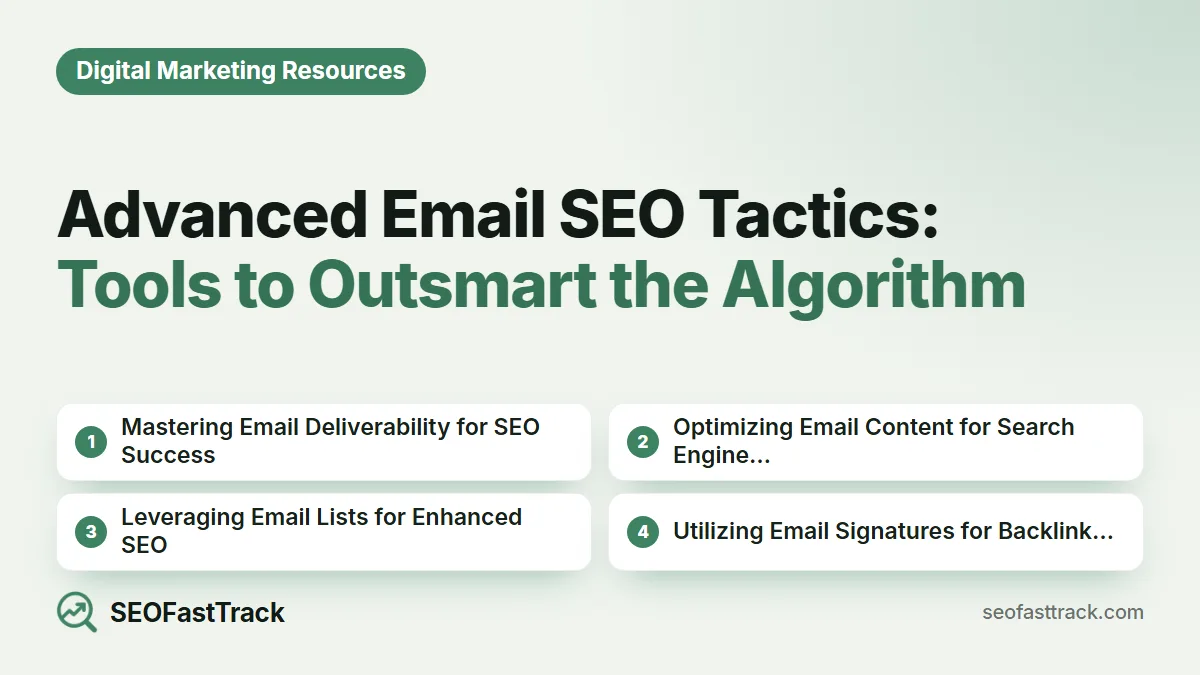
Advanced Email SEO Tactics: Tools to Outsmart the Algorithm

Welcome to SEOFastTrack!
Unlock the hidden potential of your inbox. In today's digital landscape, mastering Email SEO is no longer optional – it's crucial. Are you leaving money on the table by ignoring this powerful channel? Dive into our guide, " Advanced Email SEO Tactics: Tools to Outsmart the Algorithm," and discover actionable strategies for small businesses to boost visibility, engagement, and ultimately, your bottom line. Curious about how to optimize your email campaigns for search engines? Let's get started!
- Introduction: Unlocking Email SEO Power for Small Businesses
- Step 1: Mastering Email Deliverability for SEO Success
- Step 2: Optimizing Email Content for Search Engine Crawlers
- Step 3: Leveraging Email Lists for Enhanced SEO
- Step 4: Utilizing Email Signatures for Backlink Opportunities
- Step 5: Measuring and Refining Your Email SEO Strategy
- Conclusion: Staying Ahead of the Curve in Email SEO
-
Frequently Asked Questions
- What exactly is Email SEO, and why should a small business care?
- How does keyword research play a role in Email SEO strategies?
- What are some key on-page SEO elements to focus on within an email campaign?
- Can link-building techniques, typically used for website SEO, be applied to Email SEO?
- What kind of technical SEO considerations are important for email campaigns?
- Final Reflection: Mastering the Inbox Landscape
- Conquer Your Inbox: Maximize Your Email SEO Today!
Introduction: Unlocking Email SEO Power for Small Businesses
Email marketing, often perceived as a direct communication channel with customers, holds a surprisingly potent, yet frequently underestimated, role in bolstering your overall Search Engine Optimization (SEO) strategy. For small business owners, bloggers, and digital marketers striving to maximize their online visibility, understanding and leveraging the principles of Email SEO is crucial.
It's not just about sending emails; it's about strategically crafting and delivering them to indirectly enhance your website's search engine ranking and organic traffic. This article delves into advanced Email SEO tactics, providing actionable steps and tool recommendations to help you outsmart the algorithms and unlock the synergistic power of email and SEO.
While search engines don't directly crawl the content of your private emails to rank them, the positive signals generated by a well-executed email marketing campaign – increased website traffic, improved user engagement, and enhanced brand authority – are all factors that search engines consider when evaluating your website's relevance and ranking. Therefore, integrating Email SEO strategies into your broader digital marketing efforts is not just an option, but a necessity for sustained online success.
Step 1: Mastering Email Deliverability for SEO Success
Understanding the Impact of Email Deliverability on SEO
Email deliverability, the ability of your emails to reach your subscribers' inboxes rather than spam folders, is the foundational pillar of any effective Email SEO strategy. Think of it this way: if your emails consistently land in spam, they are essentially invisible to your audience, rendering any SEO-focused content within them useless. Poor deliverability directly translates to lower open rates, click-through rates, and ultimately, reduced website traffic originating from your email campaigns.
Search engines, like Google, Bing, and others, indirectly gauge user engagement as a signal of website quality and relevance. If your email marketing efforts are consistently failing to drive traffic because of deliverability issues, it weakens this crucial signal.
Moreover, consistently low deliverability can negatively impact your sender reputation. Internet Service Providers (ISPs) and email clients use sophisticated algorithms to assess sender reputation based on factors like bounce rates, spam complaints, and engagement metrics. A poor sender reputation can lead to stricter filtering of your emails, further exacerbating deliverability problems and creating a vicious cycle.
For instance, if your bounce rate exceeds the industry average of around 2%, and spam complaint rates rise above the typical 0.1%, ISPs may begin to flag your emails more aggressively. This not only diminishes the immediate impact of your email campaigns but can also, over time, subtly erode your domain's perceived authority in the digital space, indirectly impacting your overall SEO performance. Therefore, prioritizing and actively managing email deliverability is the first and non-negotiable step in leveraging email for SEO enhancement.
Tool Recommendation: Using Mailgun Deliverability Test to Improve Sender Score
To proactively address and improve email deliverability, utilizing specialized tools like Mailgun Deliverability Test is highly recommended. Mailgun, a popular email delivery service, offers a suite of tools, including a deliverability test that simulates real-world email delivery scenarios across various ISPs and spam filters. This test helps you identify potential issues that might be hindering your emails from reaching inboxes.
When you run a deliverability test with Mailgun, it sends test emails through your email infrastructure to a network of seed email addresses hosted across different email providers (Gmail, Yahoo, Outlook, etc.) and spam filters like SpamAssassin. The tool then analyzes the results, providing a comprehensive report on your sender score, authentication status (SPF, DKIM, DMARC), and placement in inboxes, spam folders, or if emails are blocked altogether.
The report from Mailgun Deliverability Test offers actionable insights to improve your sender score. For example, it might highlight issues with your SPF (Sender Policy Framework), DKIM (DomainKeys Identified Mail), or DMARC (Domain-based Message Authentication, Reporting & Conformance) records – crucial authentication protocols that verify your identity and prevent email spoofing. If the test reveals authentication failures, you can promptly update your DNS records to correctly configure these protocols.
Furthermore, the report may point out content-related issues that are triggering spam filters. For instance, using excessive spam trigger words in your subject lines or email body, having a poor text-to-HTML ratio, or including broken links can all contribute to lower deliverability.
By addressing the specific issues identified in the Mailgun Deliverability Test report, you can systematically improve your sender score, enhance email deliverability, and ensure that your Email SEO strategies have a fighting chance of reaching their intended audience and driving valuable traffic to your website. Regularly using such tools, ideally before launching significant email campaigns, is a best practice for maintaining optimal email deliverability and maximizing the SEO benefits of your email marketing efforts.
Step 2: Optimizing Email Content for Search Engine Crawlers
How Search Engines "See" Your Emails: The Text-to-HTML Ratio
While search engines cannot directly crawl and index the content of your emails in recipients' inboxes due to privacy and security reasons, they indirectly "see" your emails through the signals generated by user interactions and the overall structure of your email content. One crucial aspect that impacts both deliverability and user experience, and thus indirectly influences SEO, is the text-to-HTML ratio of your emails.
The text-to-HTML ratio refers to the proportion of plain text content compared to HTML code in your email. A balanced and healthy ratio is vital because spam filters often scrutinize emails with excessively high HTML content and minimal text, as spammers frequently use such structures to obfuscate malicious content or bypass text-based spam detection.
Emails that are heavily reliant on images and complex HTML layouts, with little actual text, can be flagged as suspicious and may end up in spam folders or promotional tabs, hindering your deliverability rates. Conversely, a higher text-to-HTML ratio, where the majority of your email content is in plain text with clean and semantic HTML, is generally favored by spam filters. Aiming for a text-to-HTML ratio of around 70-80% text is a good benchmark. This means ensuring that your email content is primarily text-based, with HTML used judiciously for formatting, structure, and visual appeal. Prioritize clear and concise text, use headings and subheadings (using HTML tags like <h2> and <h3> within your email's HTML structure) to break up content and improve readability, and ensure that your key message is easily understood even if images fail to load. By optimizing your text-to-HTML ratio, you not only improve your email deliverability, ensuring your messages reach the inbox, but also enhance the user experience, making your emails more accessible and engaging. This, in turn, contributes to stronger SEO signals by driving more traffic to your website and increasing user engagement metrics.
Optimizing Subject Lines and Preview Text for Improved Click-Through Rates
Subject lines and preview text are the gatekeepers to your email content. They are the first and often only impression recipients have of your email in their crowded inboxes. Optimizing these elements is paramount for maximizing open rates and click-through rates (CTR), which are critical for driving traffic to your website and indirectly boosting your SEO.
A compelling subject line needs to be concise, engaging, and relevant to the recipient's interests. Incorporating relevant keywords related to your email content, and by extension, your SEO strategy, can subtly enhance relevance in the eyes of email clients and, more importantly, resonate with your audience. For instance, if you are promoting a blog post about "Email SEO strategies for small businesses," your subject line could be something like "Boost Your Business: Advanced Email SEO Strategies Revealed" or "Small Business Email SEO: Drive Traffic & Rankings."
Preview text, also known as pre-header text, is the snippet of text that appears after the subject line in most email clients, offering an additional opportunity to pique recipients' interest. Treat preview text as an extension of your subject line. Instead of repeating the subject or leaving it blank (which often defaults to "View this email in your browser"), craft compelling preview text that provides further context, creates urgency, or highlights a key benefit of opening the email.
For example, following the subject line "Boost Your Business: Advanced Email SEO Strategies Revealed," your preview text could be "Learn actionable tactics to increase website traffic and improve your search engine rankings using email marketing." A well-optimized combination of subject line and preview text significantly increases the likelihood of recipients opening your emails.
Higher open rates, coupled with compelling email content and clear calls-to-action, lead to improved CTR, driving more qualified traffic to your website. This influx of targeted traffic from email marketing not only contributes to immediate business goals but also sends positive signals to search engines, indicating user engagement and website value, which are crucial for long-term SEO success.
Step 3: Leveraging Email Lists for Enhanced SEO
Segmenting Your Email List for Targeted SEO Campaigns
Email list segmentation is the practice of dividing your email subscribers into smaller, more targeted groups based on shared characteristics, behaviors, or preferences. This strategic approach is not just about sending more personalized emails; it's a powerful tactic to enhance the effectiveness of your Email SEO strategies.
By segmenting your list, you can tailor your email content to resonate more deeply with specific audience segments, increasing engagement and driving more relevant traffic to your website. For example, you might segment your list based on demographics (location, industry), purchase history, website behavior (pages visited, content downloaded), or engagement level (frequency of email opens and clicks).
Imagine you are promoting a blog post specifically targeting "Email SEO strategies for small businesses" within your overall digital marketing resources. Instead of sending this email to your entire list, segment it to target subscribers who have previously shown interest in SEO-related content, small business topics, or email marketing. This targeted approach ensures that the email reaches an audience that is genuinely interested in the subject matter, significantly increasing open rates and CTR.
According to Mailchimp, segmented email campaigns see an average of 14.31% higher open rates and 100.95% higher click-through rates compared to non-segmented campaigns. Higher engagement rates translate directly to increased website traffic from your email campaigns.
This targeted traffic is more likely to convert into leads or customers and spend more time on your website, sending positive user engagement signals to search engines. Furthermore, segmented campaigns reduce the risk of sending irrelevant content to subscribers, minimizing unsubscribe rates and spam complaints, which are crucial for maintaining a healthy sender reputation and optimal email deliverability – the foundation of any successful Email SEO strategy.
Using Email Marketing Automation to Drive Website Traffic
Email marketing automation takes your Email SEO efforts to the next level by enabling you to send targeted and timely emails to subscribers based on predefined triggers and workflows. Automation is not just about saving time; it's a strategic tool for nurturing leads, building relationships, and consistently driving website traffic in a way that complements your SEO strategy.
For instance, you can set up an automated welcome series for new subscribers, introducing them to your brand, highlighting valuable resources on your website, and guiding them towards relevant content, including blog posts focused on "Email SEO strategies for small businesses." A welcome series, typically consisting of 3-5 emails sent over a few days or weeks, can significantly improve initial engagement and set the stage for ongoing communication.
Another powerful automation workflow is triggered by website behavior. For example, if a subscriber visits a specific page on your website, such as a blog post about keyword research, you can automatically trigger an email sequence offering related content, like an ebook on advanced SEO techniques or a case study showcasing successful email marketing campaigns for SEO.
Furthermore, you can automate promotional emails for new blog posts or content updates. Whenever you publish a new article on your website related to SEO or email marketing, an automated email can be sent to relevant segments of your list, driving immediate traffic to your new content.
Email marketing automation ensures consistent and targeted communication, nurturing subscribers, driving repeat traffic to your website, and reinforcing your brand's authority in the eyes of both your audience and search engines. By strategically automating email campaigns to promote website content and engage subscribers based on their interests and behaviors, you create a continuous loop of traffic generation that strengthens your overall SEO performance and online visibility.
Step 4: Utilizing Email Signatures for Backlink Opportunities
The Power of Optimized Email Signatures for Link Building
Email signatures, often overlooked as a simple contact detail at the end of your emails, represent a surprisingly potent and consistently present opportunity for subtle yet effective backlink building within your Email SEO strategy. Every email you and your team send is a potential touchpoint and a chance to promote your website and key resources. Optimized email signatures transform these daily communications into mini-marketing platforms, subtly driving traffic and building valuable backlinks to your website.
Think about the sheer volume of emails your team sends daily. Each of these emails, reaching potential customers, partners, and industry contacts, can subtly promote your brand and website if equipped with a strategically designed email signature.
An optimized email signature should, at a minimum, include your name, title, company name, and, most importantly, a direct link to your website's homepage. However, to maximize its SEO potential, go beyond just a homepage link. Consider including links to key resource pages on your website, such as your blog, services page, or a specific landing page related to "Email SEO strategies for small businesses."
For example, if you have a comprehensive guide on your website about email marketing for SEO, you could include a call-to-action in your signature like "Learn Email SEO Tactics to Boost Your Rankings" linking directly to that guide. While backlinks from email signatures are typically "nofollow" links (meaning they don't directly pass link equity in the same way as "dofollow" links), they still offer significant SEO benefits.
They drive referral traffic to your website, increasing brand visibility and potentially leading to valuable user engagement. Moreover, consistent branding across all your email communications, reinforced through a professional and optimized signature, enhances brand recognition and credibility, which are indirectly beneficial for your overall SEO reputation.
Tool Recommendation: Using WiseStamp for Consistent Branding
To effectively manage and implement optimized email signatures across your organization and ensure consistent branding, utilizing a dedicated email signature management tool like WiseStamp is highly recommended. WiseStamp is a platform specifically designed to create, manage, and deploy professional and branded email signatures for individuals and teams across various email clients and devices. It goes beyond basic signature creation, offering a range of features to enhance brand consistency and marketing effectiveness through email signatures.
With WiseStamp, you can create visually appealing and professionally designed email signatures using pre-built templates or custom designs, ensuring that your brand's visual identity is consistently represented in every email. The platform allows for centralized management of signatures, making it easy to update signatures across your entire team from a single dashboard, ensuring consistency in branding and messaging.
WiseStamp also offers features to include dynamic elements in your signatures, such as social media icons linking to your company's social profiles, promotional banners for upcoming events or new content, and, crucially for Email SEO, direct links to key pages on your website, including blog posts, resource guides, or landing pages. For example, you can easily add a banner promoting your latest guide on "Email SEO strategies for small businesses" to all employee signatures with a few clicks.
Furthermore, WiseStamp provides analytics to track the performance of your email signatures, allowing you to monitor clicks on links and banners, providing insights into the effectiveness of your signature marketing efforts.
By using WiseStamp, you streamline the process of creating and managing optimized email signatures, ensuring brand consistency across all communications and maximizing the potential of your email signatures as a subtle yet effective tool for driving traffic, building backlinks, and reinforcing your Email SEO strategy.
Step 5: Measuring and Refining Your Email SEO Strategy
Tracking Key Metrics for Email SEO Performance
Measuring the performance of your Email SEO strategy is crucial for understanding what's working, identifying areas for improvement, and ensuring that your efforts are driving tangible results. Tracking key metrics provides data-driven insights that guide your optimization efforts and maximize the return on your investment in email marketing for SEO enhancement. Several key metrics should be consistently monitored to gauge the effectiveness of your Email SEO initiatives.
Open rates and click-through rates (CTR) are fundamental metrics that indicate the engagement level of your email campaigns. Higher open rates suggest compelling subject lines and effective segmentation, while higher CTR signifies engaging email content and clear calls-to-action that drive traffic to your website.
Website traffic from email is a direct measure of how well your email campaigns are driving users to your website. Use analytics platforms like Google Analytics to track traffic originating from your email marketing efforts. Set up UTM parameters in your email links to accurately attribute website traffic to specific email campaigns and measure the quality of this traffic by analyzing metrics like bounce rate, pages per session, and average session duration.
Conversion rates track how effectively email-driven traffic converts into desired actions on your website, such as form submissions, product purchases, or content downloads. Monitoring conversion rates helps you assess the ROI of your Email SEO efforts and identify areas to optimize for better results. Email deliverability metrics, including bounce rates, spam complaint rates, and inbox placement rates, are crucial for maintaining a healthy sender reputation and ensuring that your emails reach your audience.
Continuously monitor these metrics and use tools like Mailgun Deliverability Test to identify and address any deliverability issues promptly. By consistently tracking these key metrics, you gain a comprehensive understanding of your Email SEO performance, enabling data-driven optimization and continuous improvement of your strategies.
A/B Testing Your Email Campaigns for Optimal Results
A/B testing, also known as split testing, is a fundamental technique for optimizing your email campaigns and maximizing the effectiveness of your Email SEO strategy. It involves creating two or more variations of an email element (e.g., subject line, email content, call-to-action) and sending each variation to a segment of your audience to determine which version performs better based on key metrics. A/B testing allows you to make data-driven decisions about your email design and content, ensuring that you are continuously improving your campaigns for optimal results.
Subject lines are prime candidates for A/B testing. Experiment with different subject line lengths, phrasing, use of emojis, and personalization techniques to identify what resonates most with your audience and drives higher open rates. For example, test a question-based subject line against a benefit-driven subject line for the same email to see which performs better.
Email content elements, such as the email body copy, images, and layout, can also be A/B tested. Try different versions of your email copy, varying the tone, length, and value proposition. Test different image styles and placements to see how they impact engagement. Experiment with different email layouts, such as single-column versus multi-column designs, to determine which format is most effective for your audience.
Call-to-action (CTA) buttons and links are crucial for driving website traffic. A/B test different CTA button colors, text, and placement within your email to optimize for higher click-through rates. Try different wording for your CTAs, such as "Learn More," "Discover Now," or "Get Started Today," to see which drives the most clicks. When conducting A/B tests, ensure that you test only one element at a time to isolate the impact of each variation.
Use statistically significant sample sizes and allow your tests to run for a sufficient duration to gather reliable data. Analyze the results of your A/B tests and implement the winning variations in your ongoing email campaigns. A/B testing is an iterative process; continuously test and refine your email elements to stay ahead of the curve, optimize your Email SEO performance, and drive maximum results from your email marketing efforts.
Conclusion: Staying Ahead of the Curve in Email SEO
Mastering advanced Email SEO tactics is an ongoing journey, requiring continuous learning, adaptation, and a willingness to experiment. By focusing on key areas like email deliverability, content optimization, strategic list segmentation, and consistent measurement and refinement, small businesses, bloggers, and digital marketers can unlock the powerful synergy between email marketing and SEO.
Remember that effective Email SEO is not just about sending emails; it’s about building meaningful connections with your audience, driving valuable traffic to your website, and indirectly strengthening your search engine rankings. As search engine algorithms and email client technologies evolve, staying informed about best practices and emerging trends is crucial.
Continuously monitor industry updates, experiment with new tactics, and leverage data-driven insights to refine your Email SEO strategies. By embracing a proactive and adaptive approach, you can stay ahead of the curve and harness the full potential of email marketing to amplify your SEO efforts and achieve sustained online success in the ever-changing digital landscape.
Frequently Asked Questions
What exactly is Email SEO, and why should a small business care?
Email SEO is the process of optimizing your email campaigns to improve their visibility and deliverability within email clients. Small businesses should care because it can help bypass spam filters and reach more of their target audience's inboxes, leading to increased engagement and conversions.
How does keyword research play a role in Email SEO strategies?
Keyword research helps you understand the language your audience uses when searching for solutions related to your products or services. Incorporating these relevant keywords in your email subject lines and body can improve search engine rankings within email clients and increase open rates.
What are some key on-page SEO elements to focus on within an email campaign?
Focus on optimized subject lines that are concise and compelling, using relevant keywords naturally. Also, ensure your email content is well-structured and easy to read, with clear calls to action and optimized image alt text.
Can link-building techniques, typically used for website SEO, be applied to Email SEO?
While you can't directly "build links" to an email, including relevant and high-quality links to your website or valuable resources within your emails indirectly helps. It drives traffic to your site, potentially boosting its overall SEO performance and improving domain authority.
What kind of technical SEO considerations are important for email campaigns?
Technical SEO for email mainly focuses on improving deliverability. This includes ensuring your email is properly authenticated (SPF, DKIM, DMARC), avoiding spam trigger words, and maintaining a clean email list to reduce bounce rates and improve your sender reputation.
Final Reflection: Mastering the Inbox Landscape
The strategies outlined in this article, focused on Email SEO strategies for small businesses, are not merely theoretical exercises; they represent a vital lifeline in today's increasingly crowded digital marketplace. The ability to cut through the noise and land directly in the inbox is no longer a luxury, but a necessity for small businesses striving to connect with their audience and build lasting relationships.
The impact of effective Email SEO extends far beyond open rates and click-throughs; it shapes the very perception of a brand and its ability to deliver value. My own experience has shown me that a well-crafted email strategy, optimized for search, can transform a struggling business into a thriving community. The best marketing doesn't feel like marketing.
- Tom Fishburne. This quote encapsulates the essence of Email SEO: creating valuable content that naturally rises to the top, fostering genuine engagement rather than intrusive advertising.
As you navigate the ever-evolving world of email marketing, remember that the algorithm is not an adversary, but a guide. Embrace the tools and tactics discussed, not as shortcuts, but as pathways to deeper understanding and more meaningful connections. Let this knowledge empower you to craft emails that not only reach the inbox but also resonate with the hearts and minds of your audience, building a future where your message is always heard.
Conquer Your Inbox: Maximize Your Email SEO Today!
Thank you for exploring advanced email SEO strategies! We hope you've discovered powerful techniques to improve your email deliverability and engagement. Now, it's time to put your new knowledge into practice.
Ready to elevate your email marketing? Here's how:
- Immediately apply at least three of the discussed tactics to your next email campaign and carefully monitor the results. Seeing the impact firsthand is crucial, and data will guide your future efforts.
- Explore additional email optimization tools and techniques on SEOFastTrack.com for a comprehensive SEO strategy.
- Share this article with a fellow marketer or team member who could benefit from these insights. Let's collaborate and succeed together!
Which advanced email SEO tactic are you most eager to try, and what outcomes do you anticipate? Share your thoughts in the comments below!