SEO Team Collaboration and Workflow
Read more about this topic
Streamline your SEO projects with seamless team collaboration and efficient workflow management—the cornerstone of scaling organic growth without chaos. When your SEO team operates in silos, deadlines slip, keyword research duplicates, and content strategies lose alignment. Our focused approach helps you centralize task ownership, automate status updates, and integrate feedback loops across editors, developers, and strategists. From content calendars to technical audits, learn how to assign clear roles, set priority matrices, and track deliverables in real time using tools like Trello, Asana, or Slack. We cover practical tactics for cross-functional handoffs, version-controlled documentation, and reporting cadences that keep stakeholders informed. Whether you’re a solo blogger hiring freelancers or an agency juggling multiple clients, mastering SEO workflow design reduces friction, boosts accountability, and accelerates rank improvements. Eliminate endless email threads by adopting shared dashboards, comment-based approvals, and sprint-style iterations.
1 article

Articles in SEO Team Collaboration and Workflow
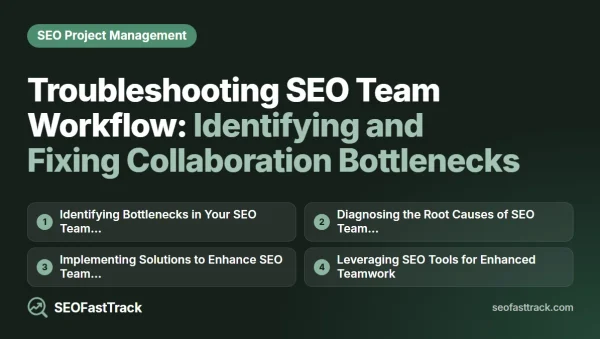
SEO Team Collaboration and Workflow: Streamline Your SEO Projects for Maximum Impact
Managing SEO is rarely a solo mission—it’s a symphony of content creators, technical developers, link builders, and data analysts working in harmony. The SEO Team Collaboration and Workflow subcategory under SEO Project Management is your blueprint for turning chaotic task lists into a structured, efficient engine. Here, you’ll discover how to align your team’s roles, communication channels, and approval processes so that every optimization effort moves from ideation to execution without bottlenecks. Whether you’re a small business owner juggling a virtual assistant or a digital marketer leading a cross-functional squad, mastering collaboration directly boosts your search rankings, saves hours weekly, and reduces costly errors.
🔧 Defining Roles and Responsibilities in Your SEO Workflow
Before any task tracking begins, every team member must know their exact lane. In this section, you’ll learn how to create a RACI matrix (Responsible, Accountable, Consulted, Informed) tailored to SEO tasks like keyword research, on-page updates, and technical audits. Clear role definition prevents duplicate work and missed deadlines—for instance, who owns the final say on meta descriptions? Who verifies that 301 redirects are correctly mapped? You’ll also explore job descriptions for freelancers and in-house staff, ensuring that your content writer isn’t accidentally debugging JavaScript and your developer isn’t rewriting anchor text.
By separating strategic oversight from tactical execution, you build accountability. Expect practical templates for onboarding new team members, plus advice on setting up recurring check-ins (daily stand-ups, weekly sprint reviews) that align with agile or waterfall project management styles. This foundation reduces friction and makes your SEO pipeline predictable, which search engines reward through consistent content freshness and site health.
📅 Building a Collaborative Content and Optimization Calendar
A shared calendar is the heartbeat of any SEO team. Here, you’ll dive into creating a centralized editorial workflow that connects keyword research to publication and post-publish optimization. Learn how to manage statuses like “Ideation → Drafting → SEO Review → Technical QA → Published → Performance Tracking” using tools like Google Sheets, Asana, or Trello. You’ll discover how to set deadlines with buffer time for unexpected Google core updates or competitor moves, and how to automate recurring tasks—such as monthly rank tracking or content refresh reminders—so nothing slips through the cracks.
This section also covers integrating your calendar with Google Search Console and Analytics data. For example, you can schedule automatic checkpoints to revisit underperforming pages every 90 days. You’ll get tips on color-coding task types (content, technical, off-page), assigning priority scores, and using Kanban boards for visual progress. The result is a workflow where your team always sees the next critical action, eliminating the “what do I do now?” friction that stalls many small SEO teams.
💬 Effective Communication Channels for SEO Teams
Miscommunication is the #1 killer of SEO momentum. This block focuses on setting up structured communication protocols that keep everyone informed without drowning in notifications. You’ll learn which updates belong in Slack or Teams (quick syncs, tool alerts) versus which require email or project management comments (approvals, detailed feedback). Discover how to create a shared “SEO Glossary” to keep terminology consistent—so “link building” doesn’t mean different things to your PR specialist and your technical developer.
You’ll also explore asynchronous communication best practices, especially for remote or freelance teams across time zones. For example, how to leave actionable comments directly on Google Docs or Figma wireframes so your developer can work overnight. We’ll cover weekly status reports that summarize wins, blockers, and upcoming priorities, and how to run effective virtual whiteboarding sessions for hreflang or site architecture decisions. Strong communication directly reduces revision loops, speeding up your time-to-rank for new content.
✅ Approval Workflows and Quality Assurance in SEO
Nothing tanks a project faster than a publish button hit without checks. This subcategory shows you how to implement multi-step approval gates that balance speed with quality. You’ll design a checklist for every SEO deliverable—content, technical changes, backlink outreach—covering SEO basics like keyword placement, internal linking, schema markup, and mobile friendliness. Learn how to use version control (like GitHub for code, plus WordPress revisions) to track every change, and how to run Peer Reviews where a second set of eyes catches issues like duplicate title tags or broken canonical URLs.
Additionally, you’ll see how to build a “QA sandbox” environment to test redirects and metadata before going live. This section includes templates for acceptance criteria, so your team knows exactly what “done” looks like. By standardizing QA, you lower the risk of penalties from thin content or over-optimization, and you ensure that every blog post or product page fully aligns with your overall SEO strategy—not just a writer’s instincts.
📊 Tracking Performance and Iterating Workflows
An efficient workflow is never static—it evolves based on data. Here, you’ll learn how to measure collaboration effectiveness through KPIs like task cycle time, rework rate, and on-time delivery percentage. You’ll connect these internal metrics to external SEO outcomes (keywords ranked, organic traffic, conversions) so your team sees the direct impact of smoother operations. Discover how to run regular retrospective meetings where you honestly discuss what’s slowing down tasks—maybe your keyword research tool is too complex, or your content review process has too many touchpoints.
You’ll also explore how to integrate automation tools like Zapier to move tasks between your CMS, analytics, and project manager without manual entry. This section provides a simple formula to calculate your team’s “SEO Velocity”—the number of optimized pages or backlinks per sprint—and how to benchmark it against your monthly goals. Plus, we cover how to document your workflow in a living playbook, ensuring new hires are productive within week one, not month three.
Frequently Asked Questions
What is the best free tool for SEO team collaboration?
For a free option, Google Workspace is ideal—use Google Sheets as a shared task tracker, Google Docs for content drafts with comment threads, and Google Calendar for deadlines. Trello offers a generous free tier for Kanban boards. Combine them with a free Slack workspace for quick communication. This stack covers task assignment, document collaboration, and real-time updates without any cost.
How do I stop my SEO team from working in silos?
Create a shared “source of truth” dashboard that everyone updates daily—even just a simple sheet with current projects, blockers, and next steps. Schedule one 15-minute stand-up meeting three times a week to air dependencies. Use shared tags in your project management tool like “waiting on developer” or “content approved.” Cross-training sessions, where each team member spends 30 minutes learning another’s role, also break down barriers.
How many people do I need for an effective SEO workflow?
You can run a solid SEO workflow with just one person using automation—but for growth, three roles are ideal: a strategist, a content creator, and a technical developer. If you’re solo, use a virtual assistant for repetitive tasks like link prospecting. The key is not headcount but clear ownership of keyword research, content production, and technical implementation; even two part-time freelancers can cover these if roles are defined.
How often should I review my SEO team’s workflow?
Review your workflow lightly every two weeks (just check for bottlenecks) and do a deep analysis monthly. After any significant change—like a Google core update, a new WordPress plugin, or hiring a team member—run an immediate retrospective. You’ll want to track time per task and error rates; if those increase, it’s time to simplify permissions, reduce approval steps, or adopt better tools like a dedicated SEO project manager.
What are typical signs that my team’s SEO workflow is failing?
Missed deadlines on content updates, frequent duplicate meta tags, backlinks going live without validation, and team members missing context on why a task matters. Also, watch for “ping-pong” comments—drafts bouncing between writer and editor. If your organic traffic stagnates despite regular output, that’s a workflow signal. Finally, if you spend more time in status meetings than doing actual SEO work, your process has too many micromanagement layers.
Related topics