Analyzing Keyword Ranking Data
Read more about this topic
Unlock the true potential of your SEO strategy by diving deep into analyzing keyword ranking data—the backbone of any performance-driven campaign. Instead of just tracking positions, learn to interpret trends, spot opportunities, and diagnose ranking drops before they hurt your traffic. Whether you’re a small business owner, blogger, or digital marketer, mastering this analysis transforms raw numbers into actionable insights that boost visibility, outpace competitors, and refine your content plan. From identifying high-value keywords to understanding search intent shifts and SERP feature changes, this guide helps you turn data into decisive, data-backed wins for sustainable growth.
1 article

Articles in Analyzing Keyword Ranking Data
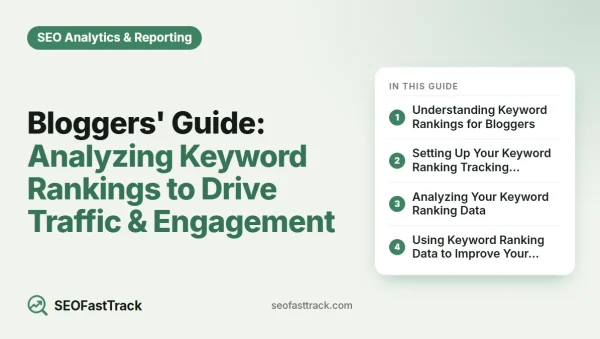
Unlock the Power of Analyzing Keyword Ranking Data
Welcome to the Analyzing Keyword Ranking Data subcategory, a core pillar of our SEO Analytics & Reporting hub at SEOFastTrack. Here, you’ll move beyond simply tracking positions and dive into the strategic interpretation of your search performance. This guide is designed for small business owners, bloggers, and digital marketers who want to turn raw ranking numbers into actionable decisions. By mastering this analysis, you can identify growth opportunities, spot algorithm impacts, and refine your content strategy with confidence, all while aligning with Google’s latest quality expectations.
📊 Interpreting Rank Fluctuations vs. Penalties
When your keyword positions jump around, it’s easy to panic. However, not all movement indicates a penalty. In this section, we break down how to differentiate between normal volatility (due to personalization, SERP features, or new competitors) and algorithmic penalties (like manual actions or core updates). We’ll teach you to analyze timeframes, check Google Search Console for manual actions, and use historical data to establish a baseline. Expect practical checklists to audit your own drops before making drastic changes.
You’ll also learn to interpret seasonal trends that cause legitimate ranking dips, such as holiday buying spikes or industry-specific cycles. By tracking your “winners” and “losers” over 30-day windows, you can separate noise from meaningful trends. This skill prevents wasted effort on unnecessary fixes and helps you focus on sustainable optimization. We provide real-world examples of businesses that mistakenly “fixed” non-issues, losing time and rankings—so you avoid those pitfalls.
🔍 Segmenting Keywords by Intent and Conversion
Not all keywords are created equal. Ranking for “best coffee maker” is different from ranking for “buy espresso machine online.” Here, we guide you through segmenting your keyword portfolio by search intent—informational, navigational, transactional, and commercial investigation. By analyzing which intents bring the most traffic and which convert best, you can prioritize your optimization efforts. We’ll show you how to use ranking data to spot keyword clusters that are underperforming despite high impressions, indicating a content mismatch.
Additionally, we cover how to align your ranking data with conversion metrics from Google Analytics. Instead of obsessing over position #1 for a low-value term, you’ll learn to identify “money keywords” that drive sign-ups or sales. Expect step-by-step methods for tagging URLs, creating custom reports, and correlating rank changes with lead volume. This strategic lens transforms your analytics from a vanity metric into a revenue-driving tool, ideal for small businesses with limited budgets.
⚙️ Using Rank Tracking Tools to Their Fullest
Most people set up rank trackers and never look beyond the default dashboard. This section explores advanced features of tools like Ahrefs, Semrush, and Serpstat—specifically for analyzing historical ranking data. We’ll teach you to set up custom date ranges, compare multiple keywords side-by-side, and export data for deeper statistical analysis. You’ll also discover how to track local SEO rankings with location-specific filters, which is crucial for brick-and-mortar businesses. We even cover free alternatives like Google Search Console’s performance report.
Beyond just positions, we dive into SERP feature tracking—knowing if your keyword triggers featured snippets, people-also-ask boxes, or video carousels. Analyzing this data helps you understand why your click-through rate (CTR) might be low even at rank #1, and how to adjust your schema markup or content format. Expect tips on automating weekly ranking snapshots and setting up alerts for unusual drops. We also discuss the importance of tracking branded vs. non-branded keywords separately to avoid skewed analytics.
📈 Correlating Ranking Data with Traffic and Revenue
Ranking data is only valuable if it connects to business outcomes. Here, we demonstrate how to merge your rank tracking exports with your analytics platform using UTM parameters or custom dimensions. You’ll learn to calculate share of search—your visibility relative to total impressions for your target keywords—and how to detect “false wins” (high rank, low CTR due to title tags or metadata issues). We provide Excel and Google Sheets formulas for quick correlation analysis, helping you see if a #5 rank with a high CTR is better than #1 with poor CTR.
We also cover how to use ranking data to forecast traffic potential based on click-through curves per position. For example, moving from #10 to #5 might triple your clicks, while moving from #2 to #1 might double them—but only if your snippet is compelling. This analysis helps you prioritize page-level improvements over link-building campaigns. Finally, we explore multi-touch attribution: how a keyword’s ranking influences later conversions even if it isn’t the last click. This sophisticated view is essential for modern digital marketers.
🔄 Creating Actionable Reports for Stakeholders
If you can’t communicate your ranking analysis, its impact is lost. This section focuses on building executive-friendly dashboards and weekly/monthly reports that highlight progress without drowning in raw data. We’ll show you how to create “winners and losers” lists, compare performance against competitors, and use visual trends to tell a story. You’ll also learn to set KPIs beyond position, such as organic clicks, average position for top 10 keywords, and visibility score. We provide templates for small business owners who need simple, clear updates.
Additionally, we guide you in using annotations—marking algorithm updates, site migrations, or content campaigns on your ranking charts. This contextual analysis helps stakeholders understand why rankings changed, reducing panic and building trust. We also cover how to segment reports by team needs: content teams want keyword movement, sales teams want lead-generating keywords, and executives want overall visibility. Expect practical advice on frequency (daily, weekly, monthly) and how to automate report generation using Google Data Studio or Looker Studio.
🚨 Responding to Algorithm Updates via Rank Data
When Google rolls out a core update, your ranking data becomes your lifeline. In this section, we teach you how to detect algorithmic impacts early by monitoring your top-50 keywords for sudden, correlated drops. You’ll learn to isolate the impacted pages, compare content freshness, and review your E-E-A-T signals (experience, expertise, authoritativeness, trustworthiness). We provide a step-by-step post-update audit checklist: check indexing, review quality guidelines, and look for competitor gains. This structured approach beats random tweaks.
We also delve into rollback analysis—if you changed a page just before an update, your rank drop might be due to your own changes, not Google’s. Learn to use version history in your CMS to test hypotheses. Additionally, we discuss how to monitor secondary keywords that often shift first, acting as early warning signals. Finally, we emphasize the importance of patience: most updates settle within 2–4 weeks. Our guidance helps you avoid overreacting to short-term perturbations while taking decisive action when patterns become clear.
Frequently Asked Questions
Why do my keyword rankings change daily even without any changes on my site?
Daily fluctuations are normal due to personalization (search history, location), new content from competitors, and Google’s continuous re-indexing. Small position changes (e.g., #4 to #6) rarely impact traffic. Focus on 7–14 day moving averages to identify true trends. Only investigate if a sustained drop exceeds 5–10 positions or affects high-value keywords.
What’s the best free tool for analyzing keyword ranking data?
Google Search Console is the most reliable free option. It shows average positions, impressions, clicks, and CTR for your tracked queries. It’s accurate and directly from Google. For historical comparisons, download custom date ranges. For competitor tracking, consider paid tools, but GSC is excellent for your own site’s baseline.
How often should I analyze my keyword ranking data?
For most small businesses, a weekly review suffices. Daily checks lead to unnecessary stress. After algorithm updates or major site changes, increase frequency to every 2–3 days. Monthly deep-dives are ideal for strategic planning, focusing on trends and content gaps rather than daily noise. Consistency matters more than frequency.
Can I fix a ranking drop without waiting for the next algorithm update?
Yes, often. First, verify if it’s a technical issue: check indexing, robots.txt, canonical tags, and page speed. Then, review your content for relevance updates—refresh stats, add new sections, improve internal links. If the drop is algorithmic, don’t revert; align with quality guidelines. Monitor for 2–3 weeks before major changes.
How do I know if a keyword is worth pursuing after analyzing its ranking trends?
Look at three factors: search volume (via tools), click-through rate (from GSC), and conversion rate (from analytics). If a keyword has low volume but high conversion, it may still be worth it. If it ranks well but has a terrible CTR, improve your title/meta. Use your ranking analysis to spot “stagnant” keywords that deserve a content refresh.
Related topics