Automation Tools to Streamline SEO Tasks
Read more about this topic
Unlock peak productivity with automation tools engineered to streamline repetitive SEO tasks—from rank tracking and reporting to keyword clustering and backlink monitoring. Save hours weekly while boosting accuracy, consistency, and scalability across your campaigns. Perfect for freelancers, in-house marketers, and agencies aiming to work smarter, not harder.
1 article
Articles in Automation Tools to Streamline SEO Tasks
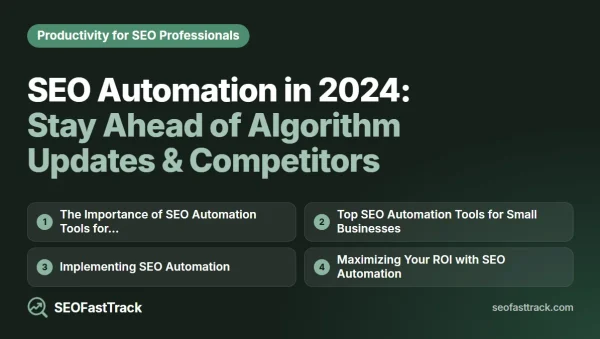
Automation Tools to Streamline SEO Tasks
Welcome to our dedicated hub on automation tools to streamline SEO tasks, part of the broader Productivity for SEO Professionals category. Here at SEOFastTrack, we understand that the modern SEO landscape is fast-paced, repetitive, and data-heavy. Manually auditing sites, tracking rankings, or generating reports can consume hours—time better spent on strategy and creative growth. This subcategory is your curated guide to the best software, scripts, and workflows that eliminate busywork. We focus on practical, real-world solutions that help you reclaim your day, reduce errors, and scale your efforts. Whether you are a solo blogger or part of a growing digital marketing team, these automation tools are essential for gaining a competitive edge in search engine rankings.
🤖 Rank Tracking & SERP Monitoring Automation
Automated rank tracking is the backbone of any serious SEO campaign. Instead of manually checking Google search results for your target keywords, modern tools like SEMrush, Ahrefs, and ProRankTracker provide daily, even hourly, snapshots of your positions. They automatically detect algorithm fluctuations, track local pack changes, and monitor mobile vs. desktop results. This data feeds directly into your decision-making process, allowing you to see exactly which pages are dropping or climbing without opening a single browser tab. For SEO professionals managing multiple clients, this real-time visibility is non-negotiable for proactive optimization.
Beyond basic position checks, these automation tools can be configured to send triggers—for example, an email alert when a keyword enters the top 10 or when a competitor overtakes you. This proactive alerting is invaluable because it transforms raw data into actionable insights. Additionally, many platforms integrate with Google Search Console, pulling in query performance and click-through data to show a holistic view. By automating rank tracking, you not only save time but also eliminate the risk of human error in spreadsheet logging. You can finally focus on the 'why' behind the rankings, not just the metrics themselves, and pivot your content strategy swiftly.
⚙️ Technical SEO Audit & Crawling Bots
Technical SEO audits used to be a tedious manual crawl of your website, checking for broken links, missing meta tags, and duplicate content. Automation has completely transformed this process. Tools like Screaming Frog, DeepCrawl, and Sitebulb use intelligent crawlers that simulate a search engine bot. They can scan hundreds of thousands of URLs in minutes, identifying critical issues such as orphan pages, slow-loading resources, schema errors, and redirect chains. This automated workflow not only saves days of work but also provides a comprehensive, prioritized list of fixes, so you never miss a hidden technical problem that could be hurting your rankings.
What makes these tools truly 'automation' is their ability to schedule recurring crawls and compare them over time. You can set a weekly or monthly audit that runs automatically, sending reports to your inbox. This means you will always be aware of new broken links after a site migration or a sudden spike in 404 errors from a botched update. Most platforms also offer integration with issue trackers like Jira or Slack, streamlining the handoff from discovery to dev team resolution. By leveraging these automated crawlers, you move from a reactive, break-fix approach to a proactive, continuous improvement model, ensuring your site’s technical health is always optimal for both users and search engines.
📝 Content Workflow & AI-Powered Writing Assistants
Creating SEO-friendly content is a multi-step process involving briefs, drafting, optimization, and publishing. Automation tools here act as your virtual content operations manager. Platforms like Clearscope, Surfer SEO, and MarketMuse automate the content brief creation by analyzing top-ranking pages for a keyword. They automatically suggest secondary keywords, outline headings, and estimate ideal word counts, using real-time data from Google’s search results. This ensures every piece of content you write is structurally sound and semantically complete from the outset, drastically reducing research time and improving relevance.
Furthermore, AI-powered writing assistants, such as Jasper or Copy.ai, can draft paragraphs, meta descriptions, and even internal linking suggestions based on your target terms. While human editing is still essential for quality and brand voice, these tools eliminate the 'blank page' problem and speed up the initial drafting phase. Combined with automated publishing integrations (e.g., WordPress plugins that auto-format and schedule posts), you can create a seamless pipeline from idea to live URL. This automation not only boosts your content output but also ensures consistency across your blog, category pages, and product descriptions, helping your SEO strategy stay cohesive and scalable.
🔗 Link Building Outreach & Backlink Monitoring
Link building is often the most labor-intensive SEO activity, but automation can handle the repetitive parts. Automated outreach tools like Pitchbox, Buzzstream, and Ninja Outreach help you discover relevant blogs, find contact emails, and send personalized email sequences at scale. You can automate follow-ups, track open rates, and manage all communication from a single dashboard. Moreover, these tools often integrate with link prospect databases, allowing you to filter for high-DR sites that accept guest posts or resource links, saving hours of manual prospecting research.
On the monitoring side, automation ensures you never lose a valuable backlink. Ahrefs and Majestic offer automated alerts that notify you when a new backlink is acquired or, more critically, when a high-quality link is lost or becomes toxic (e.g., from a penalized site). This allows you to immediately contact the webmaster to reclaim the link or update your disavow file. Additionally, automated link monitoring tracks competitor backlink profiles, showing you which sites are linking to them but not to you—an excellent prospecting source. By automating the repetitive and analytical parts of link building, you can focus on the creative outreach pitch and relationship building that truly moves the needle for your domain authority.
📊 Automated Reporting & Data Integration (API)
Delivering monthly SEO reports to clients or stakeholders is a necessary evil, but it doesn’t have to eat up your weekend. Automation tools like Google Data Studio (Looker Studio), Whatagraph, and Reportz connect via API to your Google Analytics, Search Console, rank trackers, and ad platforms. They automatically pull the latest data into beautifully formatted, branded dashboards. Once set up, you simply schedule a report to be sent every Friday or first of the month—no manual copying and pasting of screenshots or tables. This ensures reporting accuracy and frees up significant time for analysis and strategic recommendations.
Beyond standard dashboards, API integration allows for highly custom workflows. Using Zapier or Make, you can link your SEO tools to your CRM, Slack channels, or project management software. For example, a spike in organic traffic can trigger a Slack notification, or a new keyword ranking in the top 10 might create a task to write a supporting article. This type of 'event-driven automation' turns your SEO data into real-time internal actions. It reduces friction between departments, ensures no insight is lost in a spreadsheet, and demonstrates a high level of professionalism and responsiveness to your clients. Automated reporting is the final piece that makes your entire SEO operation lean, transparent, and trustworthy.
Frequently Asked Questions
What is the best all-in-one automation tool for small SEO teams?
For small teams, Ahrefs is often the most comprehensive choice combining rank tracking, site audits, and content research in one platform. It integrates with Google Analytics and Zapier, enabling you to automate alerts and reports without managing multiple subscriptions. While it has a learning curve, its data accuracy and breadth of features make it ideal for budget-conscious but efficiency-focused small teams.
How much time do SEO automation tools actually save me per week?
Most professionals report saving between 5 to 10 hours per week. The biggest savings come from automating manual rank checks, technical crawls (which can take days), and monthly report generation. If you manage multiple clients or websites, the savings multiply significantly. Even with setup time, the return on investment is typically realized within the first month of consistent use.
Do I still need to manually check search results if I use rank trackers?
Not on a routine basis. Automated trackers pull data directly from search APIs for high accuracy. However, you should manually check your top keywords once a month in incognito mode to validate the tool’s data and account for personalization effects that APIs may filter out. This is a quick hygiene check, not a time-consuming task.
Can automation tools handle content generation entirely without human input?
No, not effectively. AI writing tools like Jasper or Surfer can draft SEO outlines and short paragraphs, but they lack a deep understanding of your brand voice, nuance, and factual accuracy for complex topics. Automation excels at structuring, optimizing, and scheduling, but a human editor must always review for quality, style, and legal compliance to avoid thin or inaccurate content that could harm your rankings.
What is the easiest way to start automating SEO as a beginner?
Start with low-commitment, free integrations using Google Search Console and Looker Studio. Connect them, build a simple dashboard to view your queries and impressions, and schedule a weekly email to yourself. Once comfortable, add a free rank tracker (like Serprobot) and use Zapier to set up a Slack alert for new keyword wins. This gradual approach builds your confidence without overwhelming you with complex tools upfront.
Related topics