
Unlock HighQuality Backlinks: Your StepbyStep Guide to Guest Blogging Success

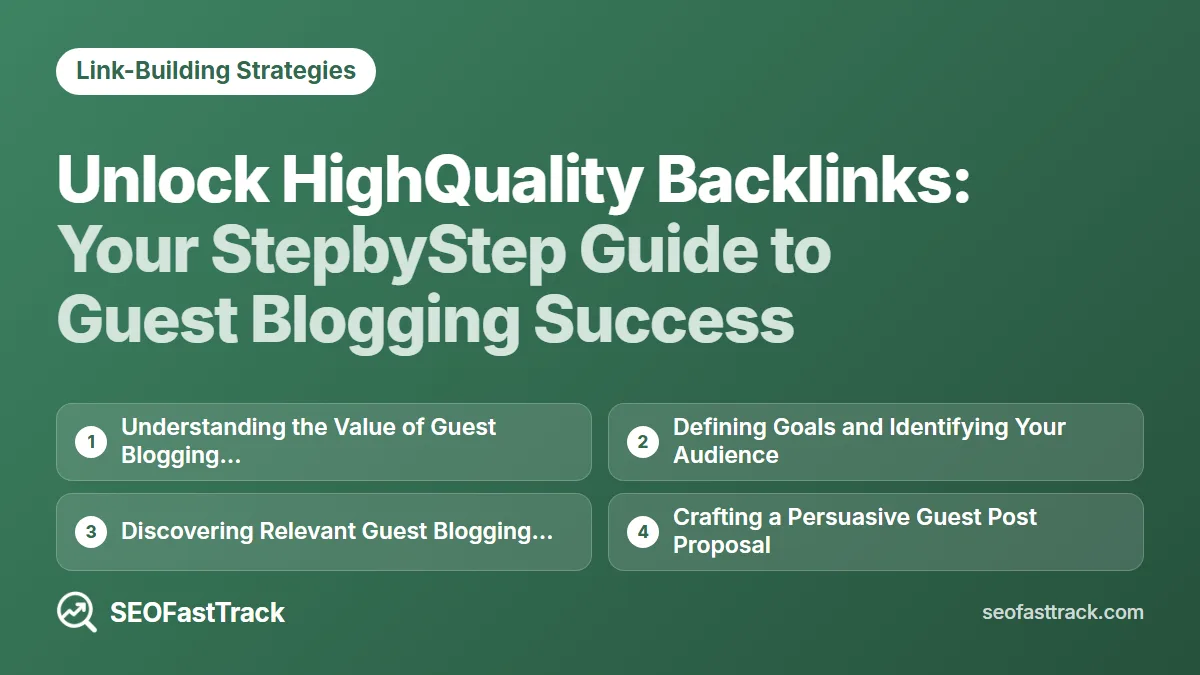
Welcome to SEOFastTrack, where we empower small business owners, bloggers, and digital marketers to conquer the world of search engine optimization. Are you ready to elevate your website's authority and drive targeted traffic? This week, we're diving deep into one of the most effective link-building strategies available: guest blogging.
Discover how strategic Guest Blogging for Quality Backlinks can transform your SEO efforts. This isn't just about getting any link; it's about securing valuable, high-authority backlinks that boost your rankings and credibility. Intrigued? Let's unlock the secrets to guest blogging success!
- Introduction to Guest Blogging for [Your Niche] Professionals
- Understanding the Value of Guest Blogging for Backlinks
- Step 1: Defining Goals and Identifying Your Audience
- Step 2: Discovering Relevant Guest Blogging Opportunities
- Step 3: Crafting a Persuasive Guest Post Proposal
- Step 4: Writing a High-Quality Guest Post That Attracts Backlinks
- Step 5: Building Relationships and Promoting Your Guest Post
- Step 6: Tracking Results and Measuring ROI
- Advanced Guest Blogging Strategies
- Common Pitfalls and How to Avoid Them
- Conclusion: Achieving Sustainable Link Building Success Through Guest Blogging
-
Frequently Asked Questions
- What exactly is guest blogging and why is it important for SEO?
- How do I find relevant websites to pitch for guest blogging opportunities?
- What should I include in my guest post pitch to increase my chances of acceptance?
- How can I ensure my guest posts provide genuine value to the target website's audience?
- What are some common mistakes to avoid when pursuing guest blogging for backlinks?
- Final Reflection: Building Bridges, One Backlink at a Time
- Elevate Your Site Authority: Start Guest Blogging Today!
Introduction to Guest Blogging for [Your Niche] Professionals
In the ever-evolving landscape of digital marketing, securing high-quality backlinks remains a cornerstone of effective Search Engine Optimization (SEO). For small business owners, bloggers striving to expand their reach, and digital marketers seeking to amplify their online presence, understanding and leveraging robust link-building strategies is paramount. Amidst various techniques, guest blogging stands out as a particularly potent method, offering a dual advantage: acquiring valuable backlinks and establishing yourself as a thought leader within your industry. This guide is specifically tailored to equip professionals like you with a comprehensive, step-by-step approach to mastering guest blogging for impactful backlink acquisition.
Guest blogging, at its core, involves writing and publishing an article on a third-party website. While it might seem like a simple content contribution, when executed strategically, it transforms into a powerful SEO tool. For professionals in competitive niches, guest blogging provides a pathway to tap into established audiences, gain credibility, and, most importantly, earn backlinks from reputable domains. This guide will navigate you through the intricacies of guest blogging, from setting clear objectives to measuring the return on investment, ensuring you can effectively integrate this strategy into your broader SEO efforts.
Understanding the Value of Guest Blogging for Backlinks
Why Guest Blogging is a Powerful Link-Building Tactic
Guest blogging’s power as a link-building tactic stems from its inherent win-win nature. Website owners are perpetually seeking fresh, high-quality content to engage their audience and enhance their site's value. By providing well-crafted, insightful guest posts, you offer them valuable content while simultaneously positioning yourself to earn a backlink to your own website.
This exchange is mutually beneficial, fostering a collaborative environment within the digital ecosystem. Unlike some link acquisition methods that can be perceived as manipulative or solely self-serving, guest blogging, when done right, is seen as a legitimate and valuable contribution, making it more sustainable and less susceptible to search engine penalties.
Furthermore, guest blogging allows for contextual link placement. Within the body of your guest post, you can naturally weave in links to relevant pages on your website, using anchor text that aligns with your SEO keywords. This contextual relevance is crucial for search engines like Google, which prioritize links that are organically integrated within valuable content.
This contrasts sharply with backlinks obtained through directories or comment sections, which often lack contextual relevance and may be viewed as less valuable by search algorithms. The ability to control the context and anchor text within a guest post significantly enhances the SEO potency of the acquired backlink, making guest blogging a highly effective and strategic link-building approach.
Securing backlinks from high-authority websites through guest posting offers a multitude of SEO advantages that extend far beyond simply increasing your link count. High-authority websites, often characterized by strong Domain Authority (DA) and Page Authority (PA) metrics, are trusted by search engines as reliable sources of information.
A backlink from such a website acts as a strong endorsement in the eyes of search algorithms, signaling that your website is also a credible and valuable resource within your niche. This endorsement can significantly boost your website's search engine rankings, especially for targeted keywords related to your guest post topic and anchor text.
Beyond improved rankings, high-authority backlinks drive qualified referral traffic to your website. Readers of reputable websites are often deeply engaged in the niche and actively seeking valuable information. When they encounter your insightful guest post and click on a backlink to your site, they are more likely to be genuinely interested in your offerings, whether it's your products, services, or content.
This targeted traffic is far more valuable than generic traffic from less reputable sources, as it translates to higher engagement rates, increased brand awareness, and potentially, improved conversion rates. Essentially, high-authority backlinks not only enhance your SEO but also contribute to building a more engaged and relevant audience for your business.
Guest Blogging vs. Other Link Acquisition Strategies
When comparing guest blogging to other link acquisition strategies, its distinct advantages in terms of quality, control, and long-term SEO value become readily apparent. Strategies like directory submissions and forum link building, while sometimes easier to implement initially, often yield backlinks from low-authority or irrelevant websites. These links carry less weight with search engines and can even be detrimental if perceived as spammy. In contrast, guest blogging focuses on earning backlinks from carefully selected, high-authority websites that are directly relevant to your niche. This targeted approach prioritizes quality over quantity, resulting in more impactful SEO benefits.
Another common link acquisition strategy is link exchange or reciprocal linking. While seemingly straightforward, this method can be less effective and potentially risky if not managed carefully. Search engines can penalize excessive or unnatural link exchanges, especially if the linked websites are not genuinely related. Guest blogging, however, avoids this pitfall by focusing on providing value to the target website’s audience through original content.
The backlink earned is a natural byproduct of this value exchange, rather than the primary purpose of the interaction. Furthermore, guest blogging offers greater control over anchor text and link placement compared to many other strategies. You can strategically choose anchor text that aligns with your keyword targets and ensure the link is contextually relevant within the guest post, maximizing its SEO impact. This level of control and quality makes guest blogging a superior and more sustainable link-building strategy compared to many alternatives.
Step 1: Defining Goals and Identifying Your Audience
Defining Your Backlink Profile and Anchor Text Strategy
Before embarking on any guest blogging campaign, it's crucial to define your desired backlink profile and establish a clear anchor text strategy. Your backlink profile is essentially the collection of backlinks pointing to your website. A healthy and diverse backlink profile is characterized by links from a variety of reputable domains, relevant to your niche, with a natural distribution of anchor text.
Defining your ideal profile involves considering the types of websites you want backlinks from (e.g., industry blogs, news sites, educational institutions), their authority, and their relevance to your target keywords. This strategic approach ensures that your guest blogging efforts contribute to a well-rounded and effective SEO strategy.
Developing an anchor text strategy is equally important. Anchor text is the clickable text used in a hyperlink. While it's tempting to use exact match keywords as anchor text for every backlink, this can appear unnatural and trigger search engine penalties.
A balanced anchor text strategy involves a mix of different anchor text types, including: brand name anchors (e.g., "SEOFastTrack"), generic anchors (e.g., "click here," "this website"), naked URLs (e.g., "seofasttrack.com"), partial match keywords (e.g., "SEO tips for small business"), and long-tail keyword anchors (e.g., "best guest blogging practices for backlinks"). By diversifying your anchor text, you create a more natural and organic backlink profile, signaling to search engines that your backlinks are earned legitimately and enhance your website's credibility and keyword relevance.
Understanding Your Target Audience's Content Needs
Successful guest blogging hinges on understanding the target audience of the websites you're aiming to contribute to. Each website caters to a specific audience with unique interests, knowledge levels, and content preferences. Before pitching guest post ideas, thoroughly research the target website's existing content, analyze their audience demographics (if available), and identify the types of topics that resonate most strongly with their readers. Understanding these content needs allows you to craft guest posts that are not only valuable and engaging for the target website's audience but also align with your own expertise and SEO goals.
For instance, if you're targeting a website focused on beginner-level digital marketing, avoid pitching highly technical or jargon-heavy topics. Instead, focus on introductory guides, step-by-step tutorials, or case studies that are accessible and actionable for their audience.
Conversely, if you're targeting a website aimed at experienced SEO professionals, you can delve into more advanced strategies, data-driven analyses, or in-depth explorations of algorithm updates. By aligning your guest post content with the target audience's needs and interests, you increase the likelihood of your pitch being accepted, your guest post being well-received, and ultimately, earning a high-quality backlink that drives relevant traffic and enhances your SEO.
Setting Measurable Goals for Your Guest Blogging Initiatives
To ensure your guest blogging efforts are effective and contribute to your overall marketing objectives, it's essential to set measurable goals. Vague goals like "get more backlinks" are difficult to track and assess. Instead, focus on setting SMART goals: Specific, Measurable, Achievable, Relevant, and Time-bound.
For example, a SMART goal could be: "Secure guest posts on 5 websites with a Domain Authority of 50+ within the next quarter, resulting in a 10% increase in organic traffic to our blog." This goal is specific (5 websites, DA 50+), measurable (5 guest posts, 10% traffic increase), achievable (realistic within a quarter), relevant (directly contributes to SEO and traffic goals), and time-bound (within the next quarter).
When setting your guest blogging goals, consider various metrics beyond just the number of backlinks acquired. Track metrics such as: referral traffic from guest posts to your website (using Google Analytics or similar tools), domain authority and page authority of the websites you guest post on, social shares and engagement on your guest posts, keyword ranking improvements for target keywords related to your guest post topics, and conversion rates of traffic originating from guest posts (if applicable).
Regularly monitoring these metrics allows you to assess the ROI of your guest blogging initiatives, identify what's working well, and make data-driven adjustments to your strategy to maximize your results and ensure you are effectively utilizing guest blogging for quality backlink acquisition and broader business growth.
Step 2: Discovering Relevant Guest Blogging Opportunities
Identifying Niche-Specific Websites for Guest Contributions
The foundation of a successful guest blogging strategy lies in identifying websites that are highly relevant to your niche and actively accept guest contributions. Relevance is paramount because backlinks from niche-specific websites carry significantly more weight with search engines and drive more targeted traffic. Start by brainstorming keywords directly related to your industry, products, or services. Then, use these keywords to search for blogs, online publications, and industry websites that cover similar topics. For example, if you're in the "sustainable fashion" niche, search for terms like "sustainable fashion blogs," "eco-friendly clothing websites," or "ethical fashion publications."
Beyond general keyword searches, explore industry-specific directories and resource lists that often curate relevant websites. Many industries have online communities, forums, or associations that maintain lists of influential blogs and publications within their sector. Leveraging these resources can uncover hidden gems and niche websites that might not appear in broader search results. Furthermore, pay attention to websites that your target audience frequents.
Where do they go online for information, news, and insights related to your industry? These are prime candidates for guest blogging opportunities. Prioritize websites that not only align with your niche but also demonstrate a genuine audience engagement and a commitment to publishing high-quality content.
Utilizing Advanced Search Techniques for Guest Blogging Prospects
To efficiently uncover guest blogging opportunities, leverage advanced search operators in search engines like Google. These operators refine your searches and help you pinpoint websites that are actively seeking guest contributors. Combine your niche keywords with search operators like: "guest post guidelines", "write for us", "become a contributor", "submit a guest post", "guest blogging opportunities", and "contribute to our blog". For instance, searching for "SEO" + "write for us" will yield websites in the SEO niche that have pages explicitly outlining their guest blogging guidelines or inviting contributions.
Experiment with variations of these search operators and keywords to broaden your search and uncover a wider range of potential guest blogging targets. You can also use operators like inurl: and intitle: to further refine your searches. For example, inurl:guest-post "SEO" will search for pages with "guest-post" in the URL that also mention "SEO." Similarly, intitle:"write for us" "digital marketing" will search for pages with "write for us" in the title that are related to "digital marketing." By mastering these advanced search techniques, you can efficiently identify a substantial list of relevant websites actively seeking guest bloggers in your niche, saving you time and maximizing your prospecting efforts.
Analyzing Competitor Backlinks to Find Potential Targets
Competitor backlink analysis is a goldmine for discovering potential guest blogging opportunities. Tools like Ahrefs, SEMrush, and Moz Pro allow you to analyze the backlink profiles of your top competitors. By examining where your competitors have secured backlinks, you can identify websites that are already receptive to content within your industry and are likely open to guest contributions. Focus on backlinks from websites that appear to be blogs, online publications, or resource sites, rather than directories or forums.
When analyzing competitor backlinks, pay attention to the context of the backlinks. If you notice a competitor has backlinks from multiple guest posts on a particular website, it strongly suggests that website accepts guest contributions and is relevant to your niche. Create a spreadsheet to systematically track these potential guest blogging targets.
Note the website URL, the competitor that has a backlink from it, and the type of content the website publishes. This competitor-based approach not only helps you find relevant websites but also validates their acceptance of guest posts, increasing the efficiency of your outreach efforts and improving your chances of securing valuable backlinks.
Once you have a list of potential guest blogging targets, it's crucial to evaluate their authority and relevance before reaching out. Not all websites are created equal when it comes to SEO value. Focus on websites that possess strong authority metrics and are genuinely relevant to your niche. Key metrics to consider include Domain Authority (DA), Page Authority (PA), and organic traffic.
DA and PA, provided by Moz, are scores that predict a website's ranking ability in search engines. Generally, aim for websites with a DA of 30 or higher, and ideally 50+. SEMrush and Ahrefs offer similar authority metrics like Domain Rating (DR) and Authority Score, which can also be used for evaluation.
Beyond authority metrics, assess the website's relevance to your niche. Does the website primarily cover topics related to your industry? Is their target audience aligned with your own? Review their content to ensure it's high-quality, engaging, and aligns with your brand values. A backlink from a highly relevant website, even with a moderate DA, can be more valuable than a backlink from a high-DA website that is irrelevant to your niche.
Additionally, consider the website's organic traffic. Websites with substantial organic traffic are more likely to drive referral traffic to your site and indicate a strong presence in search engine results. Use tools like SEMrush or Ahrefs to estimate a website's organic traffic. By carefully evaluating website authority and relevance using these key metrics, you can prioritize your outreach efforts and focus on securing guest posts on websites that will deliver the most significant SEO benefits.
Step 3: Crafting a Persuasive Guest Post Proposal
Understanding the Target Website's Content Guidelines
Before crafting your guest post proposal, meticulously review the target website's content guidelines. Most websites that accept guest posts have a dedicated "Write for Us" or "Guest Post Guidelines" page outlining their specific requirements. These guidelines typically cover topics they are interested in, content format preferences (e.g., listicles, tutorials, case studies), word count requirements, formatting instructions, and any specific style guidelines. Ignoring these guidelines is a surefire way to have your pitch rejected, regardless of the quality of your writing or ideas.
Pay close attention to the tone and style of the website's existing content. Is it formal or informal? Is it data-driven or more anecdotal? Mimic the website's style in your proposal and guest post to demonstrate that you understand their audience and can seamlessly contribute to their platform.
Some websites may also specify topics they don't want to cover or topics they've already covered extensively. Adhering to these "do not pitch" topics is crucial. Thoroughly understanding and respecting the target website's content guidelines demonstrates professionalism, attention to detail, and increases the likelihood of your proposal being seriously considered and ultimately accepted.
Developing Unique and Valuable Guest Post Ideas
To stand out from the competition and increase your chances of getting your guest post accepted, develop unique and valuable ideas that haven't been extensively covered on the target website. Simply rehashing existing content is unlikely to impress editors. Start by brainstorming topics that align with your expertise and the target website's niche, but offer a fresh perspective, deeper insights, or a unique angle.
Conduct thorough keyword research to identify content gaps and trending topics within the target website's niche. Tools like SEMrush's Topic Research tool or BuzzSumo can help you discover popular content and identify potential areas for improvement or expansion.
Consider offering case studies, original research, data-driven analyses, or expert interviews in your guest post ideas. These types of content are highly valuable and tend to attract more attention and engagement. Personalize your ideas to the specific website you're pitching.
Reference specific articles on their blog and explain how your guest post idea will complement or build upon their existing content. Highlight the unique value proposition of your idea and clearly articulate how it will benefit the target website's audience. By presenting well-researched, unique, and audience-centric guest post ideas, you significantly increase your chances of securing a guest blogging opportunity and earning a valuable backlink.
Writing a Personalized and Engaging Outreach Email
Your outreach email is the first impression you make on the website editor, so it must be personalized, engaging, and professional. Generic, mass-produced outreach emails are easily identifiable and often deleted without a second glance. Start by finding the correct contact person. Avoid generic email addresses like "info@" or "contact@." Research the website's "About Us" or "Contact Us" page, or use LinkedIn to identify the editor, content manager, or blog manager. Addressing your email to a specific person demonstrates that you've done your homework and are genuinely interested in contributing to their website.
In your email, clearly state your purpose – you are pitching a guest post idea. Briefly introduce yourself and your website, highlighting your relevant expertise and experience. Personalize the email by referencing specific articles on their website that you enjoyed or found valuable. Explain why you admire their website and why you believe your guest post idea would be a great fit for their audience.
Clearly and concisely present your guest post idea, highlighting its unique value proposition and the benefits it will offer to their readers. Keep your email brief, professional, and focused on the value you can provide to the target website. Avoid overly promotional language or demanding backlinks. The primary goal of your outreach email is to pique the editor's interest and secure permission to submit a full guest post draft.
Optimizing Subject Lines for Improved Open Rates
The subject line of your outreach email is the gatekeeper to getting your message read. A compelling subject line significantly improves your email open rates, increasing the chances of your guest post pitch being considered. Generic subject lines like "Guest Post Submission" are unlikely to stand out in a busy inbox. Instead, craft subject lines that are personalized, intriguing, and clearly communicate the value of your email. Include the website name in the subject line to personalize it and show you've specifically targeted their website. For example, "Guest Post Idea for [Website Name] - [Compelling Topic]."
Use numbers or data in your subject line to make it more attention-grabbing. For example, "Data-Driven Guest Post Idea for [Website Name]: [Specific Statistic or Benefit]." Highlight the value proposition of your guest post idea directly in the subject line.
For example, "Exclusive Guest Post Idea: [Unique Angle or Solution] for [Website Name] Readers." Keep your subject lines concise and to the point, ideally under 50 characters to ensure they are fully visible in most email clients. A/B test different subject line variations to see which ones generate the highest open rates and continuously refine your approach to optimize your outreach effectiveness.
Including Relevant Writing Samples to Demonstrate Expertise
To further strengthen your guest post proposal and showcase your writing abilities, always include relevant writing samples in your outreach email. Editors want to ensure that you can write high-quality content that aligns with their website's style and standards. Provide links to 2-3 of your best published articles or blog posts that are relevant to the target website's niche and the guest post idea you're pitching. Choose samples that demonstrate your writing skills, expertise in the subject matter, and ability to create engaging and valuable content.
If you don't have published guest posts yet, include links to high-quality blog posts on your own website or articles you've written on platforms like Medium or LinkedIn. Avoid sending writing samples that are poorly written, irrelevant, or outdated. Your writing samples are a crucial piece of evidence that convinces editors you are a capable and reliable guest contributor. By providing strong, relevant writing samples, you significantly increase your credibility and improve your chances of getting your guest post pitch accepted.
Step 4: Writing a High-Quality Guest Post That Attracts Backlinks
Creating Content That Provides Value to the Reader
The cornerstone of a successful guest post is providing genuine value to the reader. Your guest post should not be a thinly veiled advertisement for your website or business. Instead, focus on creating content that is informative, insightful, actionable, and engaging for the target website's audience. Thoroughly research your topic and present accurate, well-supported information. Offer practical tips, step-by-step guides, real-world examples, or data-driven insights that readers can immediately apply to their own challenges or goals.
Consider the reader's perspective and address their pain points, questions, and interests. Write in a clear, concise, and engaging style that resonates with the website's target audience. Use compelling storytelling, relatable anecdotes, or thought-provoking questions to capture and maintain reader attention. Prioritize quality over quantity and ensure your guest post is meticulously edited for grammar, spelling, and clarity. A valuable guest post not only earns you a backlink but also establishes you as a credible expert in your niche and builds a positive relationship with the target website's audience.
Optimizing Your Guest Post for SEO: Keywords and Readability
While providing value to the reader is paramount, optimizing your guest post for SEO is also important to maximize its reach and impact. Naturally incorporate relevant keywords throughout your guest post, including in the title, headings, subheadings, and body text. Focus on using long-tail keywords and keyword variations to avoid keyword stuffing and maintain a natural writing style. Use keyword research tools like Google Keyword Planner or SEMrush to identify relevant keywords with reasonable search volume and low competition.
Optimize your guest post for readability by using short paragraphs, bullet points, subheadings, and visuals (if permitted by the website – although instructions prohibit visuals here). Break up large blocks of text to make your content easier to scan and digest. Use a clear and concise writing style, avoiding jargon or overly technical language unless it's appropriate for the target audience.
Tools like Grammarly or Hemingway Editor can help you assess and improve the readability of your guest post. A well-optimized and readable guest post is more likely to rank well in search engine results, attract organic traffic, and drive more value for both the target website and your own SEO efforts.
Strategically Incorporating Relevant Links
The primary goal of guest blogging for backlinks is to strategically incorporate relevant links back to your website within your guest post. While you shouldn't overdo it or make your guest post overly promotional, including 1-2 contextual links to relevant pages on your website is generally acceptable and beneficial for SEO. Choose anchor text that is natural, relevant to the linked page, and aligns with your keyword strategy. Avoid using exact match keywords as anchor text for every link, as this can appear unnatural.
Link to pages on your website that provide further value to the reader and are directly relevant to the context of your guest post. For example, if your guest post is about "keyword research for beginners," you could link to a detailed guide on your website about "advanced keyword research techniques." Ensure the linked pages are high-quality, informative, and provide a seamless user experience.
In addition to linking to your own website, consider linking to other authoritative websites or resources within your guest post to further enhance its credibility and value. The key is to incorporate links naturally and contextually, focusing on providing a helpful and informative experience for the reader while strategically earning valuable backlinks.
Adhering to the Website's Style and Formatting Guidelines
Meticulously adhere to the website's style and formatting guidelines when writing your guest post. This demonstrates professionalism and respect for the editor's time and preferences. Re-review the website's "Write for Us" page and any specific instructions provided by the editor. Pay close attention to formatting requirements such as heading styles, paragraph spacing, font preferences, and image specifications (even though images are prohibited in this exercise). Ensure your guest post is formatted consistently with the website's existing content.
Follow their style guide regarding tone, voice, and writing style. If the website uses a specific citation style, adhere to it meticulously. Proofread your guest post thoroughly for grammar, spelling, and punctuation errors before submitting it. Use a grammar and spell checker tool and ideally, have someone else proofread it as well. Submitting a well-formatted, error-free guest post that adheres to the website's guidelines significantly increases the chances of it being published quickly and without requiring extensive revisions from the editor.
Avoiding Common Guest Blogging Mistakes
To maximize your guest blogging success, be aware of and avoid common mistakes that can sabotage your efforts. Avoid pitching irrelevant or poorly researched guest post ideas. Always thoroughly research the target website and tailor your pitch to their audience and content guidelines. Don't submit generic, mass-produced guest post pitches. Personalize each pitch and demonstrate genuine interest in the specific website. Avoid writing low-quality, thin content that doesn't provide real value to the reader. Focus on creating in-depth, insightful, and actionable content.
Don't over-promote your website or business within your guest post. Keep the focus on providing value and incorporate links naturally and contextually. Avoid keyword stuffing or unnatural anchor text usage. Optimize for SEO naturally and prioritize readability. Don't ignore the website's style and formatting guidelines. Meticulously adhere to their requirements. Finally, don't forget to proofread your guest post thoroughly before submitting it. By being mindful of these common mistakes and proactively avoiding them, you can significantly improve the effectiveness of your guest blogging strategy and achieve better results.
Step 5: Building Relationships and Promoting Your Guest Post
Engaging with Comments and Responding to Reader Feedback
Once your guest post is published, your engagement doesn't end there. Actively engage with comments and respond to reader feedback on your guest post. This demonstrates your commitment to the community, fosters interaction, and further establishes your expertise. Monitor the comment section of your guest post and promptly respond to questions, comments, and feedback. Be polite, helpful, and genuinely engage with readers' inquiries.
Thank readers for their positive comments and address any constructive criticism professionally and thoughtfully. Engaging in the comment section not only builds rapport with the target website's audience but also increases the visibility and longevity of your guest post. Active participation in the comments signals to the website owner that you are invested in the success of your guest post and are a valuable contributor to their community. This positive engagement can open doors to future guest blogging opportunities and strengthen your relationship with the website.
To amplify the reach and impact of your guest post, actively promote it on your social media platforms. Share your guest post on platforms like Twitter, LinkedIn, Facebook, and any other social channels where your target audience is active. Craft engaging social media updates that highlight the key takeaways and value proposition of your guest post. Tag the website and the editor (if appropriate) in your social media posts to give them visibility and acknowledge their platform.
Encourage your followers to read and share your guest post. Consider using relevant hashtags to expand the reach of your social media promotion. Promoting your guest post on social media not only drives traffic to the target website (which is appreciated by the website owner) but also increases the visibility of your guest post and your own brand. This broader reach can lead to more referral traffic to your website, increased brand awareness, and further opportunities for collaboration and networking within your industry.
Building Relationships with Editors and Other Contributors
Guest blogging is not just about acquiring a backlink; it's also about building valuable relationships within your industry. Nurturing relationships with website editors and other contributors can lead to long-term benefits, including future guest blogging opportunities, collaborations, and networking connections. After your guest post is published, send a thank-you email to the editor, expressing your gratitude for the opportunity and reiterating your commitment to providing valuable content.
Engage with other contributors on the website by reading and commenting on their articles. Follow the editor and other contributors on social media and engage with their content. Offer to share their articles with your audience and genuinely support their work. Building these authentic relationships can create a mutually beneficial network of professionals within your niche. Strong relationships with website editors can lead to repeat guest blogging invitations and potentially even more collaborative opportunities, further enhancing your link-building and brand-building efforts.
Step 6: Tracking Results and Measuring ROI
Monitoring Backlink Acquisition and Website Traffic
To determine the effectiveness of your guest blogging strategy, it's crucial to track your results and measure the return on investment (ROI). Start by monitoring the backlinks you acquire through guest blogging. Use backlink analysis tools like Ahrefs, SEMrush, or Google Search Console to track new backlinks pointing to your website. Monitor the domain authority and page authority of the websites from which you've acquired backlinks to assess their quality and SEO value.
Track referral traffic from your guest posts to your website using Google Analytics or similar web analytics platforms. Set up custom tracking URLs for your guest post backlinks to accurately measure referral traffic. Monitor the volume of referral traffic, bounce rate, time on page, and conversion rates of traffic originating from your guest posts. Analyzing website traffic data provides valuable insights into the direct impact of your guest blogging efforts on driving relevant visitors to your website.
Measuring the Impact on Search Engine Rankings
Beyond backlinks and traffic, assess the impact of your guest blogging efforts on your search engine rankings. Track the ranking of your target keywords in search engine results pages (SERPs) before and after publishing your guest posts. Use keyword tracking tools like SEMrush, Ahrefs, or Rank Tracker to monitor your keyword rankings.
Look for improvements in keyword rankings for terms related to your guest post topics and anchor text. While it's difficult to isolate the impact of guest blogging alone on ranking improvements, consistent guest blogging on high-authority websites can contribute significantly to overall SEO performance and keyword ranking gains over time.
Consider using SEO rank tracking tools to monitor your overall website visibility and organic traffic trends. Analyze whether your organic traffic has increased following your guest blogging efforts. While search engine rankings are influenced by various factors, monitoring keyword rankings and organic traffic provides a broader perspective on the overall SEO impact of your guest blogging strategy and helps you assess its contribution to your website's online visibility.
Analyzing Performance and Identifying Areas for Improvement
Regularly analyze the performance of your guest blogging campaigns to identify what's working well and areas for improvement. Review your tracking data for backlink acquisition, website traffic, and search engine rankings. Identify which guest posts and websites have generated the most valuable backlinks and referral traffic. Analyze which types of topics and content formats have resonated most strongly with target audiences.
Assess the effectiveness of your outreach emails and subject lines. Identify which strategies have resulted in higher acceptance rates for your guest post pitches. Continuously refine your guest blogging strategy based on your performance analysis. Experiment with different outreach approaches, content topics, and target websites to optimize your results. Guest blogging is an iterative process. By consistently analyzing your performance and identifying areas for improvement, you can continuously enhance your strategy and maximize the ROI of your guest blogging efforts for sustainable link building success.
Advanced Guest Blogging Strategies
Developing Long-Term Relationships with Influencers
Elevate your guest blogging strategy by developing long-term relationships with influencers and key individuals within your niche. Instead of solely focusing on transactional guest post exchanges, cultivate genuine connections with editors, website owners, and prominent bloggers in your industry. Engage with their content on social media, leave thoughtful comments on their blog posts, and participate in industry discussions where they are active.
Offer to collaborate on joint projects, such as webinars, podcasts, or co-authored content. Building these relationships can lead to more than just guest blogging opportunities. Influencers can become valuable partners, collaborators, and advocates for your brand. Long-term relationships can open doors to exclusive guest blogging invitations, cross-promotional opportunities, and valuable networking connections that extend far beyond individual guest posts. By shifting your focus from short-term link acquisition to long-term relationship building, you can unlock more significant and sustainable benefits from your guest blogging efforts.
Adapting Guest Post Content for Other Channels
Maximize the ROI of your guest post content by adapting and repurposing it for other marketing channels. Your guest post represents valuable, well-researched content that can be leveraged beyond its initial publication. Repurpose your guest post into a blog post on your own website, expanding on certain points, adding updated information, or tailoring it to your specific audience. Create social media snippets, infographics, or short videos based on key takeaways from your guest post to share on social platforms.
Transform your guest post into a presentation for webinars or online events. Extract key quotes or statistics from your guest post to use in email newsletters or marketing materials. By repurposing your guest post content across multiple channels, you extend its reach, reinforce your key messages, and maximize its value as a content asset. This content repurposing strategy not only saves you time and effort but also amplifies the overall impact of your guest blogging efforts.
Leveraging Guest Blogging for Brand Building
Beyond backlink acquisition, strategically leverage guest blogging for brand building and establishing thought leadership. Guest blogging provides a platform to showcase your expertise, share your unique insights, and build credibility within your industry. Choose guest blogging opportunities on reputable websites that align with your brand values and target audience. Craft guest posts that reflect your brand voice, personality, and core messaging.
Include a professional author bio with a link to your website and social media profiles. Actively engage in the comment section and respond to reader feedback to further build your brand presence and connect with your target audience. Consistent guest blogging on relevant websites positions you as a knowledgeable and authoritative voice in your niche. This brand-building aspect of guest blogging can lead to increased brand awareness, improved brand reputation, and enhanced trust with your target audience, ultimately contributing to long-term business growth beyond just SEO benefits.
Common Pitfalls and How to Avoid Them
Avoiding Low-Quality Websites and Link Schemes
A critical aspect of successful guest blogging for quality backlinks is avoiding low-quality websites and link schemes. Backlinks from low-authority, spammy, or irrelevant websites can actually harm your SEO efforts and potentially lead to search engine penalties. Thoroughly evaluate the authority and relevance of websites before pursuing guest blogging opportunities. Be wary of websites with low DA/PA scores, thin or duplicate content, excessive advertising, or a history of spammy link building practices.
Avoid participating in link schemes, such as reciprocal link exchanges or paid link insertions disguised as guest posts. These tactics are against search engine guidelines and can result in penalties. Focus on earning backlinks organically through genuine guest blogging on reputable websites that provide real value to their audience. Prioritize quality over quantity and always err on the side of caution when evaluating potential guest blogging targets. A few high-quality backlinks from authoritative websites are far more valuable than numerous backlinks from low-quality or spammy sources.
Recognizing and Avoiding Black Hat Tactics
Be vigilant in recognizing and avoiding black hat SEO tactics in guest blogging. Black hat tactics are unethical and manipulative SEO practices that violate search engine guidelines and can lead to severe penalties, including website deindexing. Avoid practices such as keyword stuffing, hidden links, cloaking, and automated guest post submission software. Never engage in link buying or participate in private blog networks (PBNs) for guest blogging purposes.
Focus on white hat SEO techniques that prioritize providing value to users and building sustainable, long-term website authority. Create high-quality, original content for your guest posts that genuinely benefits the target website's audience. Earn backlinks naturally through legitimate guest blogging outreach and relationship building. Stay informed about the latest search engine algorithm updates and guidelines to ensure your guest blogging practices remain compliant and ethical. Adhering to white hat SEO principles is crucial for long-term SEO success and protecting your website from penalties.
Protecting Your Website from Penalties
Protecting your website from search engine penalties is paramount when implementing a guest blogging strategy. Google and other search engines actively penalize websites that engage in manipulative link building practices. To mitigate the risk of penalties, diversify your backlink profile and avoid relying solely on guest blogging for link acquisition. Build backlinks through a variety of legitimate methods, such as content marketing, broken link building, and resource page link building.
Regularly monitor your website's backlink profile using tools like Google Search Console and disavow any suspicious or low-quality backlinks. If you notice a sudden drop in organic traffic or receive a manual penalty notification from Google, take immediate action to identify and rectify the issue. Consult with an experienced SEO professional if you are unsure how to address a penalty or clean up your backlink profile. Proactive monitoring and adherence to white hat SEO principles are essential for protecting your website from penalties and ensuring the long-term success of your guest blogging strategy.
Conclusion: Achieving Sustainable Link Building Success Through Guest Blogging
Guest blogging, when executed strategically and ethically, stands as a powerful and sustainable link-building strategy for small business owners, bloggers, and digital marketers. By following this step-by-step guide, you can unlock the potential of guest blogging to acquire high-quality backlinks, drive targeted traffic, and establish yourself as a thought leader in your niche. Remember to prioritize quality over quantity, focus on providing value to your target audience, and build genuine relationships with website editors and industry influencers.
Avoid common pitfalls, steer clear of black hat tactics, and continuously monitor your results to optimize your guest blogging efforts. By consistently implementing these best practices, you can harness the long-term benefits of guest blogging to achieve sustainable link building success, improve your search engine rankings, and ultimately, grow your online presence and business. Guest blogging is not a quick fix, but a strategic investment in your website's long-term SEO health and brand authority. Embrace this powerful tactic and unlock its potential to propel your digital marketing success.
Frequently Asked Questions
What exactly is guest blogging and why is it important for SEO?
Guest blogging involves writing articles for other websites in your niche. It's important because it can help you earn high-quality backlinks, driving traffic and boosting your search engine rankings.
How do I find relevant websites to pitch for guest blogging opportunities?
Start by searching Google for blogs in your industry that accept guest posts. Use search operators like "write for us" or "guest post guidelines" combined with your target keywords.
What should I include in my guest post pitch to increase my chances of acceptance?
Your pitch should be personalized, concise, and demonstrate value for the target website's audience. Highlight your expertise and propose unique, engaging content ideas that align with their editorial guidelines.
How can I ensure my guest posts provide genuine value to the target website's audience?
Focus on creating high-quality, original content that offers actionable insights and solves problems for the readers. Avoid overly promotional content and prioritize providing real value.
What are some common mistakes to avoid when pursuing guest blogging for backlinks?
Avoid using low-quality websites, submitting duplicate content, and focusing solely on backlinks without providing value. Remember to follow the website's guidelines and build genuine relationships with editors.
Okay, here's a final reflection you can use for your article, "Unlock High-Quality Backlinks: Your Step-by-Step Guide to Guest Blogging Success," tailored to the theme of guest blogging for quality backlinks and designed to resonate with your audience:
Final Reflection: Building Bridges, One Backlink at a Time
The pursuit of quality backlinks through guest blogging isn't just about SEO; it's about forging genuine connections within your industry and establishing yourself as a thought leader. In today's digital landscape, where algorithms constantly evolve, the enduring value of authentic relationships and authoritative content remains paramount. Guest blogging, when approached strategically and ethically, offers a powerful avenue to achieve both.
The impact of guest blogging extends far beyond mere link acquisition. It's a testament to the power of collaboration and shared knowledge. Personally, I've witnessed firsthand how a well-placed guest post can elevate a brand's visibility and credibility, opening doors to new opportunities and partnerships. The currency of the internet is trust. Guest blogging, done right, is an investment in that currency.
This sentiment underscores the importance of providing value and building trust with your audience, which ultimately translates into long-term success.
Now, armed with the knowledge and strategies outlined in this guide, I encourage you to embark on your own guest blogging journey. Don't just chase backlinks; strive to create content that resonates, inspires, and educates. Let your expertise shine through, and let your contributions build bridges that connect you with a wider audience. The world needs your voice, your insights, and your unique perspective. Go forth and share it!
You've learned how to significantly improve your SEO with guest blogging. Now you have the knowledge to acquire valuable backlinks and increase your website's visibility. Ready to put this knowledge to work?
Here's how to get started:
- Begin brainstorming relevant guest blogging topics related to your niche. This is your fast track to building high-quality backlinks.
- Identify three high-authority websites in your niche that accept guest posts and carefully review their submission guidelines.
- Share this article with fellow SEO professionals on social media and highlight your favorite guest blogging strategy.
Which website will you target first, and what compelling topic will you pitch? Share your plans in the comments below!