
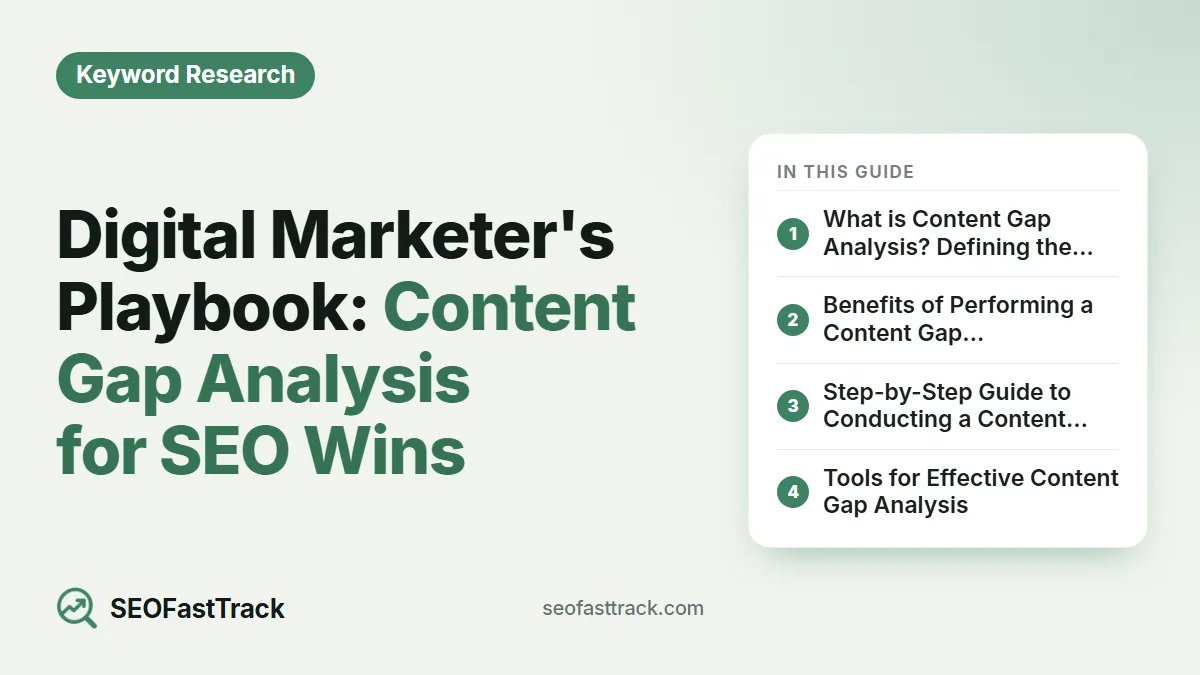
Digital Marketer's Playbook: Content Gap Analysis for SEO Wins

Welcome to SEOFastTrack, your definitive resource for mastering the art of search engine optimization. Are you leaving valuable traffic on the table? Dive in to uncover the secrets of Content Gap Analysis for SEO, a powerful strategy that reveals exactly what your audience is searching for and how you can fill the void. Discover how this crucial keyword research technique can unlock untapped opportunities for small business owners, bloggers, and digital marketers alike – and start dominating the search results today!
- Introduction to Content Gap Analysis for SEO
- What is Content Gap Analysis? Defining the Process
- Benefits of Performing a Content Gap Analysis for SEO
-
Step-by-Step Guide to Conducting a Content Gap Analysis
- Step 1: Identify Your Target Keywords and Topics
- Step 2: Analyze Your Existing Content Inventory
- Step 3: Research Your Competitors' Content Strategy
- Step 4: Identify Content Gaps: The Core of the Analysis
- Step 5: Prioritize Content Gaps Based on Business Goals
- Step 6: Create a Content Plan to Fill the Gaps
-
Tools for Effective Content Gap Analysis
- SEO Tools for Keyword Research and Competitor Analysis
- Content Optimization Tools for Improving Existing Content
- Semrush: Comprehensive SEO platform for keyword research and competitor analysis.
- Ahrefs: Powerful tool for backlink analysis, keyword research, and content exploration.
- Surfer SEO: Content optimization tool for improving content relevance and ranking.
- Content Gap Analysis Examples: Real-World SEO Wins
- Avoiding Common Mistakes in Content Gap Analysis
- Measuring the Success of Your Content Gap Analysis Efforts
- Content Gap Analysis: Advanced Strategies
- Conclusion: Content Gap Analysis – Your Key to SEO Success
-
Frequently Asked Questions
- What is a Content Gap Analysis and why is it important for SEO?
- How does a Content Gap Analysis help small business owners?
- What are some key steps involved in performing a Content Gap Analysis for SEO?
- Which SEO tools can assist with Content Gap Analysis?
- How often should I conduct a Content Gap Analysis?
- Final Reflection: Bridging the Content Divide
- Unleash Hidden SEO Power: Start Your Content Gap Analysis Now!
Introduction to Content Gap Analysis for SEO
Understanding the Power of Content Gaps in SEO Strategy
In the ever-evolving landscape of digital marketing, Search Engine Optimization (SEO) remains a cornerstone for online success. To truly excel in SEO, digital marketers must move beyond basic keyword targeting and delve into strategic content planning. This is where the concept of content gaps comes into play, representing a powerful opportunity to enhance your SEO strategy.
Content gaps are essentially the topics, keywords, and information that your target audience is actively searching for online, but which your website is not adequately addressing compared to your competitors. Identifying and filling these gaps can significantly boost your search engine rankings, attract more organic traffic, and establish your brand as an authority in your niche.
Think of the internet as a vast library, and your website as a section within it. Your potential customers are librarians, constantly searching for specific books (information). If your section is missing crucial books that other sections (competitors' websites) possess, you are losing out on readers.
Content gap analysis helps you identify these missing "books" – the content your audience needs but isn't finding on your site. By strategically creating content to fill these gaps, you are not only improving your website's SEO but also directly catering to the needs and interests of your target audience, ultimately leading to a more robust and effective online presence.
Why Content Gap Analysis is Crucial for Businesses
For businesses of all sizes, especially small business owners and bloggers striving for online visibility, content gap analysis is not merely a beneficial tactic; it's a crucial element of a sustainable SEO strategy. In today's competitive digital environment, simply creating content is no longer enough. You need to create the right content – content that answers your audience's questions, solves their problems, and provides genuine value, while also outperforming your competitors.
Content gap analysis provides the roadmap to achieve this. By understanding what content is missing from your website in comparison to top-ranking competitors, you can pinpoint precise areas for content creation and optimization, ensuring your efforts are laser-focused and yield maximum impact.
Furthermore, content gap analysis is intrinsically linked to understanding customer needs and search behavior. It forces you to step into the shoes of your target audience and analyze their search queries. This process reveals not just what keywords they are using, but also the underlying intent behind those searches.
Are they looking for information, solutions, comparisons, or products? By addressing these intents through targeted content, you can attract a more qualified audience to your website – visitors who are genuinely interested in what you offer and are more likely to convert into customers or loyal readers. In essence, content gap analysis transforms your SEO efforts from a shot in the dark to a precisely aimed arrow, significantly increasing your chances of achieving your business objectives.
Content Gap Analysis: A Keyword Research Essential
While traditional keyword research focuses on identifying high-volume and relevant keywords, content gap analysis takes this process a step further, transforming it into a strategic tool for content creation. It recognizes that simply targeting keywords is insufficient if your competitors are already dominating the search results with comprehensive and high-quality content around those same keywords. Content gap analysis builds upon keyword research by analyzing the content landscape surrounding your target keywords.
It asks, "What topics and subtopics are my competitors covering that I am not?" and "What user intents are they satisfying that I am missing?" This deeper level of analysis uncovers opportunities that traditional keyword research alone might overlook.
Content gap analysis is therefore an essential extension of keyword research, providing a more nuanced and actionable understanding of the search landscape. It helps you move beyond simply identifying keywords to strategically planning content that is not only keyword-optimized but also fills genuine gaps in the existing online information.
This approach ensures that your content is not just competing for attention but is actually offering something unique and valuable to your target audience, thereby significantly increasing its chances of ranking higher, attracting more organic traffic, and achieving your SEO goals. By integrating content gap analysis into your keyword research process, you are equipping yourself with a powerful strategic advantage in the competitive world of SEO.
What is Content Gap Analysis? Defining the Process
Identifying Missing Content Opportunities
Content gap analysis is fundamentally about uncovering areas where your website's content is lacking compared to your competitors, and, more importantly, in relation to what your target audience is searching for. This process begins with a thorough investigation of your current content inventory and a parallel examination of the content strategies employed by your top-ranking competitors.
The goal is to pinpoint specific topics, keywords, or user intents that your competitors are addressing effectively but you are not. These "missing pieces" are your content gaps – opportunities to create content that can attract more organic traffic, improve your search engine rankings, and establish your authority in your niche.
Identifying missing content opportunities is not just about finding keywords your competitors rank for. It's about understanding the context and depth of their content coverage. For example, you might both be targeting the keyword "best running shoes," but your competitor might have in-depth guides on choosing running shoes for different terrains, foot types, and running styles, while your content is limited to a general product category page.
This deeper analysis reveals a content gap: the lack of detailed, specialized guides on running shoes. By identifying such gaps, you can create content that is more comprehensive, user-centric, and ultimately more valuable than your competitors', giving you a competitive edge in search engine rankings.
Comparing Your Content to Competitors' Content
A core component of content gap analysis is the direct comparison of your website's content to that of your competitors. This isn't about simply copying what they are doing, but rather about understanding their strengths and weaknesses in terms of content coverage. By analyzing the topics they address, the keywords they target, the content formats they use (blog posts, videos, infographics, etc. ), and the depth of information they provide, you can gain valuable insights into their content strategy and identify areas where they excel and, more importantly, where they might be vulnerable.
This comparative analysis involves several key steps. First, identify your top-ranking competitors for your target keywords. Tools like Semrush and Ahrefs can be invaluable for this. Next, systematically review their website content, paying close attention to their blog, resource sections, and any content directly related to your target keywords and topics. Analyze the structure of their content, the keywords they naturally incorporate, the questions they answer, and the overall user experience they provide.
Compare this to your own content. Where do you fall short? Are there topics they cover in detail that you only touch upon briefly? Are they using content formats you haven't considered? This detailed comparison will reveal specific content gaps and highlight opportunities for improvement and expansion.
Focusing on User Intent and Search Queries
Effective content gap analysis goes beyond simply looking at keywords and competitor content; it delves into the crucial aspect of user intent. Understanding why people are searching for specific keywords is paramount to creating content that truly resonates with your target audience and effectively fills content gaps. Search queries are not just strings of words; they are expressions of user needs, questions, and desires. By analyzing the search queries related to your target keywords, you can gain a deeper understanding of the user intent behind those searches.
For instance, someone searching for "content gap analysis template" is likely looking for a practical tool to implement this strategy, while someone searching for "what is content gap analysis" is seeking foundational knowledge. These different intents require different types of content. A template would satisfy the first intent, while a comprehensive guide like this article fulfills the second.
By focusing on user intent, you can tailor your content to directly address the specific needs and questions of your audience at each stage of their journey. This user-centric approach is not only crucial for effective content gap analysis but also for building a strong and engaged online audience, ultimately driving better SEO results and achieving your business goals.
Benefits of Performing a Content Gap Analysis for SEO
Improved Keyword Rankings and Visibility
One of the most direct and significant benefits of conducting a content gap analysis is the potential for improved keyword rankings and increased visibility in search engine results pages (SERPs). By identifying and filling content gaps, you are strategically creating content that directly addresses user search queries and aligns with the topics your target audience is interested in. When you provide comprehensive and valuable content on topics that your competitors are neglecting or under-serving, you increase your chances of ranking higher for relevant keywords.
Search engines like Google prioritize websites that offer comprehensive and authoritative information. Content gap analysis helps you achieve this by guiding you to create content that is not only keyword-optimized but also fills informational voids in your niche.
For example, if your competitors are only covering broad topics related to "digital marketing," but missing specific subtopics like "content gap analysis for local SEO," identifying and addressing this gap can position you as a specialist in that area and significantly improve your rankings for related long-tail keywords. This improved ranking translates directly into increased visibility, making it more likely that potential customers or readers will find your website when searching for relevant information.
Increased Organic Traffic and Lead Generation
Improved keyword rankings and visibility naturally lead to a significant increase in organic traffic to your website. When your content ranks higher in search results, more users are likely to click on your links, driving targeted traffic to your pages. This is particularly valuable because organic traffic is highly qualified – these are users who are actively searching for information related to your products, services, or niche, indicating a higher level of interest and a greater likelihood of engagement and conversion.
Moreover, content gap analysis helps you create content that not only attracts traffic but also effectively guides users through the customer journey. By addressing user intents and providing valuable information at each stage, from awareness to consideration to decision, you can nurture leads and drive conversions. For instance, if you identify a content gap around "best SEO tools for small businesses," creating a comprehensive comparison guide can attract users actively researching these tools.
Within this guide, you can naturally incorporate calls-to-action, such as offering a free trial of your own SEO tool or providing downloadable resources, effectively converting traffic into leads. Therefore, content gap analysis is not just about attracting more visitors; it's about attracting the right visitors and strategically converting them into valuable leads and customers.
Enhanced User Experience and Engagement
Beyond the direct SEO benefits, content gap analysis plays a crucial role in enhancing user experience and engagement on your website. By focusing on user intent and creating content that directly addresses their needs and questions, you are providing a more valuable and satisfying online experience. When users find the information they are looking for quickly and easily, and when the content is comprehensive, well-structured, and engaging, they are more likely to spend more time on your website, explore more pages, and return in the future.
Content that fills gaps is inherently user-centric. It's created with the specific purpose of providing answers, solutions, and insights that users are actively seeking. This focus on user needs translates into a better overall user experience.
For example, if you identify a content gap around "common SEO mistakes for bloggers," creating a detailed article or checklist addressing these mistakes will be incredibly valuable for your target audience. Users will appreciate the practical guidance, spend more time engaging with your content, and perceive your website as a helpful and reliable resource. This positive user experience contributes to lower bounce rates, increased time on page, and higher overall engagement metrics, all of which are positive signals for search engines and further enhance your SEO performance.
Consistently creating content that fills content gaps is a powerful strategy for building authority and establishing expertise in your niche. When you proactively identify and address the informational needs of your target audience, and when you do so in a comprehensive and high-quality manner, you position yourself as a go-to resource within your industry. Over time, this consistent delivery of valuable content builds trust and credibility with your audience, and signals to search engines that your website is a reliable source of information.
Authority is a crucial factor in SEO. Search engines favor websites that are perceived as authoritative and trustworthy. By systematically filling content gaps, you demonstrate a deep understanding of your niche, a commitment to providing valuable information, and a willingness to go above and beyond what your competitors are offering.
For example, if you consistently create in-depth guides, case studies, and original research on topics related to "content gap analysis," you will gradually become recognized as an expert in this area. This authority not only improves your search engine rankings but also enhances your brand reputation, attracts more backlinks from other websites, and ultimately drives long-term SEO success.
Step-by-Step Guide to Conducting a Content Gap Analysis
Step 1: Identify Your Target Keywords and Topics
The first step in conducting a content gap analysis is to solidify your foundation by identifying your target keywords and topics. This isn't just about brainstorming a list of keywords; it's about strategically selecting keywords that are relevant to your business, your target audience, and your overall SEO goals. Start by considering the products or services you offer, the problems you solve for your customers, and the topics your audience is interested in. This initial brainstorming will give you a broad range of potential keywords and topics to explore.
Once you have a preliminary list, it's time to refine it using keyword research tools and techniques. Focus on keywords that have a reasonable search volume, are relevant to your niche, and have a manageable level of competition. Consider both broad, head keywords (e.g., "SEO tools") and more specific, long-tail keywords (e.g., "best free SEO tools for small businesses").
A balanced mix of both is often ideal. Tools like Google Keyword Planner, Semrush, and Ahrefs can be invaluable for this stage. They provide data on search volume, keyword difficulty, and related keywords, helping you to make informed decisions about which keywords to target for your content gap analysis.
Using Keyword Research Tools for Content Gap Discovery
Keyword research tools are not just for finding keywords; they are powerful instruments for uncovering potential content gaps. Beyond providing data on search volume and keyword difficulty, these tools offer features that directly aid in content gap discovery. For example, Semrush's Keyword Gap tool specifically allows you to compare your keyword profile with those of your competitors, identifying keywords they rank for but you don't. Ahrefs' Content Gap feature performs a similar function, showing you topics your competitors are covering that you are missing.
Furthermore, tools like AnswerThePublic and BuzzSumo can help you understand the questions your target audience is asking and the topics they are engaging with online. AnswerThePublic visualizes search queries as questions, prepositions, and comparisons around a keyword, revealing user intents and potential content topics.
BuzzSumo analyzes the most shared and engaged content on social media for a given topic, highlighting trending topics and content formats that resonate with your audience. By leveraging these features, you can move beyond basic keyword research and proactively identify areas where your content is lacking and where there are opportunities to fill genuine content gaps.
Focusing on Long-Tail Keywords for Specific Gaps
While broad keywords are important for attracting a wide audience, long-tail keywords are particularly valuable for identifying specific and often overlooked content gaps. Long-tail keywords are longer, more specific phrases that users type into search engines. They often indicate a more defined user intent and represent niche topics that might be underserved by broader content. For example, instead of just targeting "SEO," consider long-tail keywords like "content gap analysis for e-commerce SEO" or "how to measure content gap analysis success."
Focusing on long-tail keywords allows you to drill down into very specific user needs and identify highly targeted content gaps. These keywords often have lower search volume but also lower competition, making it easier to rank and attract a highly qualified audience.
By creating content that specifically addresses these long-tail keyword queries, you can capture niche traffic and establish yourself as an expert in very specific areas within your broader niche. This targeted approach is highly effective for content gap analysis, as it helps you uncover opportunities to create content that is not only valuable but also highly differentiated from your competitors' offerings.
Step 2: Analyze Your Existing Content Inventory
Once you have a solid understanding of your target keywords and topics, the next crucial step is to thoroughly analyze your existing content inventory. This involves taking a comprehensive look at all the content currently published on your website, from blog posts and articles to landing pages and product descriptions. The goal is to understand what content you already have, its strengths and weaknesses, and how well it aligns with your target keywords and topics. This audit will provide a baseline for identifying content gaps and opportunities for improvement.
This content inventory analysis should be systematic and organized. Create a spreadsheet or document listing all your key content pieces, along with relevant information such as the topic, target keywords, publication date, URL, and performance metrics (e.g., organic traffic, bounce rate, time on page). Categorize your content by topic or keyword cluster to get a clear overview of your content coverage in different areas. This structured approach will make it easier to identify areas where you have strong content coverage and areas where you might be lacking.
Auditing Your Website's Content for Relevance
Within your content inventory analysis, a critical aspect is auditing your website's content for relevance. This goes beyond simply listing your content; it involves evaluating how well each piece of content aligns with your target keywords, user intent, and overall business goals. Ask yourself: Is this content still relevant to my target audience? Does it accurately and comprehensively address the topic? Is it optimized for the keywords I am targeting? Is it up-to-date and accurate?
Content relevance is paramount for SEO success. Search engines prioritize content that is highly relevant to user search queries. Outdated, inaccurate, or poorly optimized content can actually harm your SEO efforts. During your content audit, identify pieces of content that are no longer relevant, are underperforming, or are not effectively targeting your desired keywords. These pieces of content represent potential areas for improvement or even removal. By focusing on content relevance, you ensure that your website is filled with high-quality, targeted content that effectively attracts and engages your target audience, laying a solid foundation for content gap analysis.
Identifying Content That Needs Improvement or Updating
A key outcome of your content inventory analysis is identifying content that needs improvement or updating. In the dynamic world of online information, content can quickly become outdated or lose its relevance. SEO best practices also evolve, meaning that content optimized even a year ago might now be underperforming.
Your content audit should pinpoint pieces of content that are ripe for updates or improvements. This could include refreshing outdated information, expanding on topics to make them more comprehensive, optimizing content for current SEO best practices, or even repurposing content into different formats (e.g., turning a blog post into a video or infographic).
Updating existing content is often a more efficient and effective way to improve SEO performance than solely focusing on creating new content. Search engines favor fresh and updated content, and updates can quickly boost rankings and traffic. Identify content that is ranking on page two or three of search results – these are prime candidates for optimization. By strategically updating and improving your existing content, you can not only fill content gaps but also maximize the value of your current content assets and achieve faster SEO wins.
Step 3: Research Your Competitors' Content Strategy
With a clear understanding of your own content inventory, the next essential step is to delve into researching your competitors' content strategy. This involves identifying your top-ranking competitors for your target keywords and systematically analyzing their content to understand what they are doing well, where they are excelling, and, crucially, where they might be leaving gaps that you can exploit. This competitive analysis is a cornerstone of effective content gap analysis.
Competitor research isn't about copying their content; it's about understanding the landscape, identifying best practices, and uncovering opportunities to differentiate yourself. Focus on analyzing not just the topics they cover but also the depth of their coverage, the content formats they use, their keyword targeting strategies, and their overall content quality. This comprehensive analysis will provide valuable insights into the content strategies that are working in your niche and highlight areas where you can potentially outperform your competitors.
Identifying Top-Ranking Competitors for Key Terms
The first step in competitor research is to accurately identify your top-ranking competitors for your key terms. These are not necessarily your direct business competitors but rather the websites that consistently rank highest in search results for the keywords you are targeting. To identify these competitors, manually search for your target keywords on Google and note the websites that appear in the top positions.
You can also use SEO tools like Semrush, Ahrefs, and Moz Keyword Explorer to identify top-ranking pages and domains for specific keywords. These tools often provide reports that list your top organic competitors based on keyword overlap.
Once you have identified a list of your top-ranking competitors, prioritize analyzing those that are most relevant to your niche and target audience. Focus on competitors who are similar in size and scope to your business, as their content strategies are likely to be more directly comparable and actionable for your own content gap analysis efforts.
Analyzing Competitor Content for Keywords and Topics
After identifying your top competitors, the next step is to thoroughly analyze their content to understand their keyword and topic coverage. Systematically review their websites, paying particular attention to their blog, resource sections, and any content directly related to your target keywords and topics. Examine the types of content they are creating – are they primarily using blog posts, videos, infographics, or a mix? Analyze the depth and comprehensiveness of their content. Are they providing in-depth guides, short articles, or listicles?
Pay close attention to the keywords they are targeting and how they are naturally incorporating these keywords into their content. Use SEO tools like Semrush's Organic Research and Ahrefs' Site Explorer to analyze the keywords your competitors are ranking for and the pages that are driving the most organic traffic to their websites. This analysis will reveal the topics and keywords that are most effective for your competitors and provide valuable insights into their content strategy.
Using SEO Tools to Uncover Competitor Content Gaps
SEO tools are invaluable for uncovering competitor content gaps efficiently and effectively. Tools like Semrush's Content Gap tool and Ahrefs' Content Gap feature are specifically designed to identify keywords and topics that your competitors are ranking for but you are not. These tools allow you to input your domain and the domains of your competitors, and they will generate reports highlighting content gaps based on keyword overlap.
These reports typically show you a list of keywords that your competitors are ranking for, along with data on their ranking positions and search volume. By analyzing these reports, you can quickly identify topics and keywords that represent content gaps in your own strategy. For example, if a competitor is ranking highly for "best content gap analysis tools" but you don't have any content on this topic, this represents a clear content gap opportunity. By leveraging these SEO tools, you can streamline your competitor research and efficiently pinpoint actionable content gaps for your own website.
Step 4: Identify Content Gaps: The Core of the Analysis
This is the heart of the content gap analysis process – actually identifying the content gaps. Having analyzed your own content inventory and researched your competitors' content strategies, you are now equipped to pinpoint the specific areas where your content is lacking and where opportunities exist to create valuable and differentiated content. This step involves comparing your content coverage to that of your competitors and looking for discrepancies, omissions, and unmet user needs.
Identifying content gaps is not just about finding keywords your competitors rank for; it's about understanding the nature of those gaps. Are they topical gaps – are your competitors covering entire topics that you are completely missing? Are they keyword gaps – are your competitors ranking for specific keywords that are highly relevant to your business but you are not targeting?
Are they user intent gaps – are your competitors better addressing the underlying needs and questions of users searching for specific keywords? Understanding the type of content gap is crucial for formulating an effective content strategy to fill it.
Comparing Your Content to Competitor Content
A direct comparison of your content to your competitors' content is essential for identifying content gaps. This involves a side-by-side analysis of your content and theirs on similar topics and keywords. For each target keyword or topic, compare the depth, comprehensiveness, and quality of your content to that of your top-ranking competitors. Ask yourself: Is my content as detailed and informative as theirs? Does it cover all the relevant aspects of the topic? Does it answer the user's questions as effectively? Is it presented in a user-friendly and engaging format?
This comparative analysis will reveal specific areas where your content falls short. Perhaps your competitors have more in-depth guides, more recent information, or more engaging content formats. Identify these shortcomings and note them as potential content gaps. For example, if your competitor has a comprehensive guide on "content gap analysis best practices" and your content is limited to a brief overview, this represents a clear content gap – the lack of in-depth guidance on best practices. By systematically comparing your content to your competitors', you can pinpoint specific areas for improvement and content creation.
Discovering Untapped Keyword Opportunities
Content gap analysis is a powerful method for discovering untapped keyword opportunities that might be overlooked by traditional keyword research methods. By analyzing the keywords your competitors are ranking for but you are not, you can uncover valuable keywords that are relevant to your niche and audience but that you haven't yet targeted. These untapped keywords represent opportunities to create new content that can attract additional organic traffic and expand your website's reach.
Focus on keywords with a reasonable search volume and a manageable level of competition. Long-tail keywords are particularly valuable in this context, as they often represent niche topics and specific user intents that are underserved by broader content. For example, you might discover that your competitors are ranking for long-tail keywords related to "content gap analysis examples for SaaS companies" or "content gap analysis template for beginners." These keywords represent untapped opportunities to create highly targeted content that can attract a specific audience and fill niche content gaps.
Identifying Topics Your Audience is Searching For But You're Not Covering
Perhaps the most crucial aspect of content gap analysis is identifying topics that your target audience is actively searching for but that you are not currently covering on your website. These are the most significant content gaps, representing missed opportunities to attract and engage your audience, improve your SEO, and establish your authority in your niche. To uncover these topics, go beyond keyword analysis and delve into understanding your audience's needs, questions, and pain points.
Use tools like AnswerThePublic and BuzzSumo to explore the questions your audience is asking online and the topics they are engaging with on social media. Analyze forum discussions, social media groups, and customer feedback to gain insights into their information needs. For example, you might find that your audience is frequently asking questions about "how to use content gap analysis for local SEO" or "common content gap analysis mistakes to avoid." These questions represent clear topics that your audience is interested in but that you might not be addressing on your website, highlighting valuable content gaps to fill.
Step 5: Prioritize Content Gaps Based on Business Goals
Once you have identified a list of content gaps, the next critical step is to prioritize them based on your business goals. Not all content gaps are created equal. Some will have a greater potential impact on your SEO, traffic, and overall business objectives than others. Prioritization ensures that you focus your content creation efforts on the gaps that will yield the most significant results and align with your strategic priorities.
Consider factors such as the potential traffic volume associated with each content gap, the relevance of the topic to your business, the level of competition for related keywords, and the resources required to create high-quality content to fill the gap. Prioritize gaps that align most closely with your business goals, offer the greatest potential return on investment, and are feasible to address within your available resources.
Assessing the Potential Impact of Each Content Opportunity
To effectively prioritize content gaps, it's essential to assess the potential impact of each content opportunity. This involves evaluating several factors, including the potential traffic volume, keyword difficulty, relevance to your business, and the potential for conversion. Use keyword research tools to estimate the search volume for keywords related to each content gap. Higher search volume generally indicates a greater potential for traffic. Analyze the keyword difficulty to assess the level of competition and the effort required to rank for those keywords.
Consider the relevance of each content gap to your business goals. Will filling this gap attract your target audience? Will it help you achieve your business objectives, such as lead generation, sales, or brand awareness? Evaluate the potential for conversion – will content created to fill this gap attract users who are likely to convert into customers or leads? By systematically assessing these factors, you can quantify the potential impact of each content opportunity and make informed decisions about prioritization.
Prioritizing High-Value Content Gaps for Immediate Action
Based on your assessment of potential impact, prioritize the high-value content gaps for immediate action. These are the gaps that offer the greatest potential for SEO wins, traffic growth, and business impact. Focus on gaps that align closely with your business goals, have a reasonable search volume, manageable competition, and are feasible to address with your available resources.
Start by tackling the "low-hanging fruit" – content gaps that are relatively easy to fill and offer a quick win. This might include updating existing content to target missed keywords, creating short blog posts on underserved topics, or expanding on existing content to make it more comprehensive.
Once you have addressed the low-hanging fruit, move on to tackling more challenging and high-impact content gaps that require more significant content creation efforts, such as creating in-depth guides, cornerstone content, or original research. This strategic prioritization ensures that you maximize your content creation efforts and achieve the most significant results from your content gap analysis.
Step 6: Create a Content Plan to Fill the Gaps
The final step in the content gap analysis process is to create a concrete content plan to fill the identified gaps. This plan should outline the specific content pieces you will create, the target keywords for each piece, the content format, the publication timeline, and the resources required. A well-defined content plan ensures that your content creation efforts are organized, strategic, and aligned with your content gap analysis findings and business goals.
Your content plan should be more than just a list of topics; it should be a detailed roadmap for content creation. For each content gap you plan to fill, specify the target keyword, the content title, the content format (e.g., blog post, video, infographic), a brief outline of the content, the target publication date, and the team member responsible for creating the content. This level of detail ensures accountability and helps keep your content creation process on track.
Developing a Content Calendar for New Content Creation
A content calendar is an essential tool for implementing your content plan and ensuring a consistent flow of new content to fill your identified gaps. Your content calendar should visually represent your content plan, showing the scheduled publication dates for each piece of content. This calendar helps you visualize your content pipeline, manage your content creation workflow, and ensure a consistent publishing schedule.
Use a spreadsheet, project management software, or a dedicated content calendar tool to create your calendar. Schedule content publication dates realistically, taking into account your team's capacity and the time required for content creation and optimization. A consistent publishing schedule is crucial for SEO, as it signals to search engines that your website is actively updated and provides fresh content. Your content calendar ensures that you are systematically filling content gaps and consistently providing valuable content to your audience.
Optimizing Existing Content to Target Missed Keywords
In addition to creating new content, optimizing existing content is a crucial part of filling content gaps. Your content gap analysis might reveal that some of your existing content is already relevant to your target keywords and topics but is not fully optimized for those keywords. This presents an opportunity to quickly and efficiently improve your SEO performance by optimizing existing content to target missed keywords and fill content gaps.
Identify existing content pieces that are thematically related to your content gaps. Review these pieces and identify opportunities to naturally incorporate target keywords into the text, headings, and meta descriptions. Update the content with fresh information, expand on topics to make them more comprehensive, and improve the overall quality and user experience. Optimizing existing content is often a faster and more cost-effective way to improve SEO and fill content gaps than creating entirely new content from scratch.
Utilizing Different Content Formats (Blog Posts, Videos, Infographics)
To effectively fill content gaps and cater to diverse user preferences, consider utilizing different content formats beyond just blog posts. Variety in content format can significantly enhance user engagement and reach a wider audience. Explore formats such as videos, infographics, podcasts, interactive tools, and downloadable resources. Different content formats can be more effective for addressing certain types of content gaps and catering to different user learning styles.
For example, if you identify a content gap around "how to perform content gap analysis," a video tutorial might be a more engaging and effective format than a lengthy blog post for demonstrating the process visually. Infographics are excellent for presenting data and statistics related to content gap analysis in a visually appealing and easily digestible format. Experiment with different content formats to see what resonates best with your audience and effectively fills your identified content gaps.
Tools for Effective Content Gap Analysis
SEO Tools for Keyword Research and Competitor Analysis
Effective content gap analysis relies heavily on the use of SEO tools for keyword research and competitor analysis. These tools provide the data and insights necessary to identify target keywords, analyze competitor strategies, and uncover content gaps. A range of SEO tools is available, each offering different features and functionalities. Selecting the right tools is crucial for streamlining your content gap analysis process and maximizing its effectiveness.
Tools like Google Keyword Planner, Semrush, Ahrefs, Moz Keyword Explorer, and Ubersuggest are popular choices for keyword research, providing data on search volume, keyword difficulty, related keywords, and keyword ideas. For competitor analysis, Semrush, Ahrefs, SpyFu, and Majestic are valuable resources, offering features to analyze competitor keyword rankings, backlink profiles, and content strategies. Many of these tools also offer specific features designed for content gap analysis, such as Semrush's Content Gap tool and Ahrefs' Content Gap feature.
Content Optimization Tools for Improving Existing Content
In addition to tools for keyword research and competitor analysis, content optimization tools are essential for improving existing content and ensuring that new content effectively fills content gaps. These tools help you optimize your content for relevant keywords, improve readability, and enhance overall content quality. Content optimization tools analyze your content and provide recommendations for improvement based on SEO best practices and competitor analysis.
Tools like Surfer SEO, Clearscope, MarketMuse, and Frase analyze top-ranking content for your target keywords and provide insights into content structure, keyword density, semantic keywords, and readability. They offer suggestions for optimizing your content to improve its relevance and ranking potential. These tools are invaluable for ensuring that your content is not only filling content gaps but also optimized to perform well in search engine results pages.
Semrush: Comprehensive SEO platform for keyword research and competitor analysis.
Semrush is a comprehensive SEO platform that offers a wide range of tools and features for keyword research, competitor analysis, and content gap analysis. It is a popular choice among digital marketers and SEO professionals due to its robust data, user-friendly interface, and versatile functionalities. Semrush provides tools for keyword research, including keyword overview, keyword magic tool, and keyword gap analysis. Its competitor analysis features allow you to analyze competitor keyword rankings, organic traffic, backlink profiles, and advertising strategies.
Specifically for content gap analysis, Semrush offers the Content Gap tool, which allows you to compare your keyword profile with those of your competitors and identify keywords they rank for but you don't. Semrush also provides content marketing tools, including topic research, SEO writing assistant, and content audit, to help you create and optimize content that effectively fills content gaps and improves your SEO performance. Its comprehensive suite of features and reliable data make Semrush a powerful tool for content gap analysis and overall SEO strategy.
Ahrefs: Powerful tool for backlink analysis, keyword research, and content exploration.
Ahrefs is another leading SEO tool suite renowned for its powerful backlink analysis capabilities, comprehensive keyword research features, and robust content exploration tools. It is widely used by SEO professionals for in-depth website analysis, competitor research, and content strategy development. Ahrefs offers a comprehensive Site Explorer tool for analyzing website backlink profiles, organic traffic, and top-performing content. Its Keywords Explorer tool provides detailed keyword data, including search volume, keyword difficulty, and clickstream data.
For content gap analysis, Ahrefs offers the Content Gap feature, which allows you to identify topics and keywords that your competitors are covering but you are missing. Ahrefs also provides content explorer and content ideas tools to help you discover trending topics, identify content opportunities, and generate content ideas to fill content gaps. Its extensive data, powerful analysis features, and user-friendly interface make Ahrefs a valuable tool for content gap analysis and a cornerstone of many SEO workflows.
Surfer SEO: Content optimization tool for improving content relevance and ranking.
Surfer SEO is a dedicated content optimization tool designed to help you improve your content relevance and ranking potential in search engine results pages. It focuses on providing data-driven insights and actionable recommendations for optimizing your content based on analysis of top-ranking content for your target keywords. Surfer SEO analyzes the top-ranking pages for your target keyword and provides a detailed content score based on factors such as keyword density, semantic keywords, content structure, and readability.
It offers a content editor that provides real-time feedback and suggestions as you write, guiding you to create content that is highly optimized for your target keyword and user intent. Surfer SEO also includes a content planner feature to help you plan your content strategy and identify content gaps. Its focus on content optimization and data-driven recommendations makes Surfer SEO a valuable tool for ensuring that your content effectively fills content gaps and achieves high search engine rankings.
Content Gap Analysis Examples: Real-World SEO Wins
A small e-commerce store specializing in handmade jewelry conducted a content gap analysis to improve their organic traffic. Initially, their keyword strategy focused primarily on broad product categories like "necklaces," "earrings," and "bracelets." However, their content gap analysis revealed that competitors were ranking highly for more specific, product-related keywords, such as "silver pendant necklaces for women," "handmade gemstone earrings," and "bohemian style bracelets." These long-tail keywords represented a significant content gap, as the e-commerce store's website lacked dedicated content targeting these specific product variations and styles.
To fill this gap, the store created dedicated product category pages and blog posts targeting these missing product-related keywords. They optimized product descriptions with these long-tail keywords and created blog posts showcasing different jewelry styles and how to choose the right pieces. Within three months of implementing these changes, the e-commerce store saw a remarkable 40% increase in organic traffic.
Their rankings for the targeted long-tail keywords improved significantly, driving more qualified traffic to their product pages and resulting in a noticeable boost in sales. This case study demonstrates the power of content gap analysis in identifying and capitalizing on missed keyword opportunities to drive substantial organic traffic growth for e-commerce businesses.
Case Study 2: SaaS company improves lead generation by creating content addressing competitor alternatives.
A SaaS company offering project management software wanted to improve their lead generation through SEO. Their initial content strategy focused on general project management topics and product features. However, a content gap analysis revealed that a significant portion of their target audience was searching for "competitor alternatives" – users actively comparing different project management software options. The analysis showed that competitors were ranking well for keywords like "Asana alternatives," "Trello alternatives," and "Monday.com alternatives," but the SaaS company lacked content directly addressing these competitor comparisons.
Recognizing this content gap, the SaaS company created a series of "alternatives" comparison pages and blog posts. These content pieces directly compared their software to popular competitor platforms, highlighting their unique strengths and features while acknowledging the pros and cons of alternatives. They targeted keywords like "[Competitor Name] alternatives" and "best alternatives to [Competitor Name]."
Within two months of launching this competitor-focused content, the SaaS company experienced a 25% increase in lead generation. Their rankings for "alternatives" keywords improved dramatically, attracting users actively evaluating different software options. This case study illustrates how content gap analysis can uncover valuable opportunities to target users at the decision stage of the buyer journey, significantly boosting lead generation for SaaS businesses.
Avoiding Common Mistakes in Content Gap Analysis
Focusing Solely on Keywords Without Considering User Intent
A common mistake in content gap analysis is focusing solely on keywords without adequately considering user intent. While keyword research is a crucial starting point, it's essential to remember that keywords are simply a representation of user searches. Effective content gap analysis goes beyond just identifying keywords; it delves into understanding the why behind those searches – the underlying user intent. Failing to consider user intent can lead to creating content that targets keywords but doesn't actually satisfy the user's needs or answer their questions, ultimately hindering SEO success.
For example, targeting the keyword "content gap analysis" might seem straightforward, but users searching for this term could have different intents. Some might be looking for a definition of content gap analysis (informational intent), others might be seeking tools to perform content gap analysis (transactional intent), and still others might be looking for case studies or examples (navigational intent).
Creating content that only focuses on the keyword without addressing these diverse intents will likely fail to engage a significant portion of your target audience. Always analyze the search results for your target keywords to understand the dominant user intent and tailor your content accordingly.
Neglecting to Update Existing Content
Another frequent mistake is neglecting to update existing content as part of your content gap analysis efforts. Content gap analysis is not solely about creating new content; it's also about optimizing and improving your existing content assets. In the dynamic online environment, content can quickly become outdated, inaccurate, or less relevant. Neglecting to update your existing content can lead to missed opportunities to improve rankings, attract more traffic, and fill content gaps more efficiently.
Your content gap analysis should include a review of your existing content inventory to identify pieces that are underperforming, outdated, or not fully optimized for your target keywords. Updating and improving these content pieces is often a faster and more cost-effective way to fill content gaps than solely focusing on creating new content from scratch. Regularly updating your content signals to search engines that your website is a fresh and reliable source of information, boosting your SEO performance and maximizing the value of your content assets.
Ignoring Mobile Optimization and User Experience
In today's mobile-first world, ignoring mobile optimization and user experience during content gap analysis is a critical mistake. A significant portion of web traffic now comes from mobile devices, and search engines like Google prioritize mobile-friendliness in their ranking algorithms. Creating content to fill content gaps without considering mobile optimization and user experience can severely limit your SEO success and user engagement.
Ensure that all content created as part of your content gap analysis is fully mobile-responsive and provides a seamless user experience across all devices. Optimize your website's loading speed, use mobile-friendly design elements, and ensure that content is easy to read and navigate on smaller screens. A poor mobile experience can lead to high bounce rates, low engagement, and ultimately, diminished SEO performance, negating the benefits of your content gap analysis efforts. Always prioritize mobile optimization and user experience when creating and optimizing content to fill content gaps.
Measuring the Success of Your Content Gap Analysis Efforts
Tracking Keyword Rankings and Organic Traffic
The most direct and readily measurable indicators of success for your content gap analysis efforts are tracking keyword rankings and organic traffic. As you implement your content plan and fill identified content gaps, you should monitor your website's rankings for the target keywords and track changes in organic traffic to your website and specific content pieces. Improvements in keyword rankings and organic traffic are clear signs that your content gap analysis strategy is working and yielding positive results.
Use SEO tools like Semrush, Ahrefs, or Google Search Console to track your keyword rankings over time. Monitor your rankings for the target keywords before and after implementing your content plan to assess the impact of your efforts. Regularly analyze your website's organic traffic using Google Analytics. Track overall organic traffic trends, as well as traffic to specific content pieces created or optimized as part of your content gap analysis. Increases in both keyword rankings and organic traffic are strong indicators that your content gap analysis strategy is driving SEO success.
Monitoring User Engagement Metrics (Bounce Rate, Time on Page)
Beyond keyword rankings and organic traffic, monitoring user engagement metrics is crucial for assessing the quality and effectiveness of your content gap analysis efforts. User engagement metrics, such as bounce rate, time on page, pages per session, and scroll depth, provide valuable insights into how users are interacting with your content and whether it is effectively meeting their needs and expectations. Improvements in user engagement metrics indicate that your content is not only attracting traffic but also providing value and keeping users engaged.
Analyze these metrics for content pieces created or optimized as part of your content gap analysis. A decrease in bounce rate and an increase in time on page and pages per session suggest that your content is more engaging and relevant to users. Monitor scroll depth to understand how deeply users are engaging with your content. High engagement metrics signal that your content is effectively filling content gaps and providing a positive user experience, contributing to long-term SEO success.
Analyzing Conversions and Lead Generation
For businesses focused on lead generation or sales, analyzing conversions and lead generation is the ultimate measure of success for content gap analysis efforts. While improved rankings and traffic are important, the true value of content gap analysis lies in its ability to drive tangible business results, such as increased leads, sales, and revenue. Track conversions and lead generation metrics to assess the direct impact of your content gap analysis strategy on your business objectives.
Set up conversion tracking in Google Analytics to monitor key actions, such as form submissions, product purchases, or ebook downloads, that indicate conversions or leads. Analyze conversion rates and lead generation volume for content pieces created or optimized as part of your content gap analysis. An increase in conversions and lead generation attributed to your content gap analysis efforts demonstrates a direct return on investment and validates the effectiveness of your strategy in driving business growth.
Content Gap Analysis: Advanced Strategies
Utilizing Semantic SEO to Enhance Content Relevance
To take your content gap analysis to the next level, consider utilizing semantic SEO principles to enhance content relevance and improve search engine understanding. Semantic SEO focuses on creating content that is not just keyword-optimized but also semantically related to your target topics and concepts. This involves using synonyms, related terms, and concepts to provide a richer and more comprehensive understanding of the topic for both users and search engines.
Instead of solely focusing on keyword density, semantic SEO emphasizes topical depth and breadth. When filling content gaps, go beyond just targeting specific keywords and aim to create content that comprehensively covers the entire topic and related subtopics. Use semantic SEO tools to identify related terms and concepts to incorporate into your content. This approach not only improves content relevance but also signals to search engines that your content is a valuable and authoritative resource on the topic, potentially boosting your rankings and attracting a more engaged audience.
Content gap analysis is a powerful strategy for building topical authority and establishing your website as a go-to resource in your niche. Topical authority refers to the perceived expertise and comprehensiveness of your website's content on a specific topic or cluster of related topics. By systematically filling content gaps and creating a comprehensive library of content around your core topics, you can build topical authority and dominate your niche in search engine results pages.
When conducting content gap analysis, think beyond individual keywords and consider broader topic clusters. Identify core topics within your niche and map out all the related subtopics and content gaps within those clusters. Develop a content plan to systematically fill these gaps, creating a cohesive and comprehensive content hub around each core topic. As your website becomes a comprehensive resource on these topics, you will build topical authority, signaling to search engines that your website is a leading expert in your niche, ultimately leading to improved rankings, increased traffic, and greater online visibility.
Implementing the Skyscraper Technique to create superior content.
The Skyscraper Technique is an advanced content strategy that can be effectively integrated into your content gap analysis efforts to create truly superior content that outranks competitors and fills content gaps in a highly impactful way. The Skyscraper Technique involves three key steps: 1) Find popular content in your niche, 2) Create something even better, and 3) Reach out to the right people to promote your content. When applied to content gap analysis, this technique can be particularly powerful.
Identify competitor content that is ranking well for your target keywords and topics and that is filling a content gap. Analyze this content to understand its strengths and weaknesses. Then, create content that is significantly better – more comprehensive, more up-to-date, more visually appealing, or more user-friendly.
For example, if a competitor has a listicle on "content gap analysis tools," you could create a more comprehensive guide that includes in-depth reviews, comparisons, and user case studies. By creating "skyscraper" content that is demonstrably superior to existing content, you can effectively fill content gaps and dramatically improve your chances of ranking higher and attracting more organic traffic.
Conclusion: Content Gap Analysis – Your Key to SEO Success
The Importance of Ongoing Content Gap Analysis
Content gap analysis is not a one-time task; it's an ongoing process that is crucial for sustained SEO success in the ever-evolving digital landscape. Search engine algorithms change, competitor strategies evolve, and user search behavior shifts over time. To maintain a competitive edge and continue to attract organic traffic, it's essential to make content gap analysis a regular part of your SEO strategy. Ongoing content gap analysis ensures that your website remains relevant, comprehensive, and aligned with the latest search trends and user needs.
Regularly revisit your content gap analysis process, perhaps on a quarterly or semi-annual basis. Re-evaluate your target keywords, re-analyze your competitor landscape, and re-assess your content inventory. Identify new content gaps that have emerged and update your content plan accordingly. This continuous cycle of analysis and optimization ensures that your content strategy remains dynamic and responsive to changes in the search environment, allowing you to consistently improve your SEO performance and maintain a competitive online presence.
Content Gap Analysis: A Continuous Improvement Process.
Content gap analysis should be viewed as a continuous improvement process, not just a project with a defined start and end date. It's an iterative cycle of analysis, planning, creation, optimization, and measurement that should be integrated into your ongoing SEO workflow. By embracing a continuous improvement mindset, you can leverage content gap analysis to consistently enhance your website's content, improve your SEO performance, and achieve your long-term business goals.
Treat content gap analysis as a feedback loop. Continuously monitor your SEO performance, user engagement metrics, and business results. Use these insights to refine your content gap analysis process, adjust your content strategy, and identify new opportunities for improvement. By embracing a data-driven and iterative approach, you can ensure that your content gap analysis efforts are constantly evolving and becoming more effective over time, ultimately driving sustained SEO success and achieving your online marketing objectives.
Frequently Asked Questions
What is a Content Gap Analysis and why is it important for SEO?
A Content Gap Analysis is the process of identifying missing content on your website that your target audience is actively searching for. It's important for SEO because it helps you create valuable content that addresses user needs and improves your search engine rankings.
How does a Content Gap Analysis help small business owners?
By identifying and filling content gaps, small business owners can attract more traffic to their websites. This increased traffic can lead to higher brand awareness and ultimately, more conversions and sales.
What are some key steps involved in performing a Content Gap Analysis for SEO?
Key steps include identifying your target keywords, analyzing competitor content, and identifying topics your competitors cover that you don't. The final step is creating a content plan to address those gaps.
Which SEO tools can assist with Content Gap Analysis?
Several SEO tools can help, including Semrush, Ahrefs, and Moz. These tools offer features like keyword research, competitor analysis, and content gap identification to streamline the process.
How often should I conduct a Content Gap Analysis?
It's recommended to perform a Content Gap Analysis at least annually or semi-annually. The digital landscape is constantly evolving, so regular analysis ensures your content remains relevant and competitive.
Final Reflection: Bridging the Content Divide
The insights shared throughout this playbook highlight the critical role of content gap analysis in achieving sustainable SEO success. In today's fiercely competitive digital landscape, simply creating content isn't enough; we must strategically identify and fill the voids that separate us from our target audience and desired search rankings. Understanding these gaps is not just about chasing keywords; it's about truly understanding user intent and providing valuable, comprehensive resources.
The impact of content gap analysis extends far beyond mere keyword rankings. It fundamentally shapes how we connect with our audience, fostering trust and establishing ourselves as authoritative voices in our respective fields. This process of identifying and addressing content gaps has profoundly influenced my own approach to digital marketing, shifting my focus from simply publishing to strategically serving the needs of my audience. The best marketing doesn't feel like marketing.
- Tom Fishburne. This quote perfectly encapsulates the essence of content gap analysis: by focusing on providing genuine value, we naturally attract and retain our ideal customers.
As you embark on your own content gap analysis journey, I encourage you to look beyond the data and consider the human element. Reflect on the questions your audience is asking, the challenges they face, and the solutions they seek. By truly understanding their needs and crafting content that resonates, you can not only achieve SEO wins but also build lasting relationships and create a meaningful impact in the digital world.
Okay, here's a CTA draft for the end of an article titled "Digital Marketer's Playbook: Content Gap Analysis for SEO Wins" for a website called SEOFastTrack (SEOFastTrack.com):
Thanks for taking the time to delve into the world of content gap analysis! By now, you've unlocked invaluable insights into how to optimize your content strategy for maximum SEO impact. Now, let's put that knowledge into action and start seeing those wins.
Here are a few immediate steps you can take to transform your content and boost your rankings:
- Immediately identify ONE key competitor and analyze their top 3 ranking keywords. What content are they using that you aren't? This is your starting point for uncovering critical content gaps.
- Share this article with a fellow marketer who could benefit from content gap analysis. Collaboration can lead to even greater SEO breakthroughs!
- Explore SEOFastTrack.com for additional resources and advanced strategies on content optimization and SEO.
What surprising content gaps did you uncover in your initial analysis, and how will you adapt your strategy to fill them? Share your initial findings in the comments below!