
Ecommerce Keyword Research for Beginners: A StepbyStep Guide to Find Winning Terms

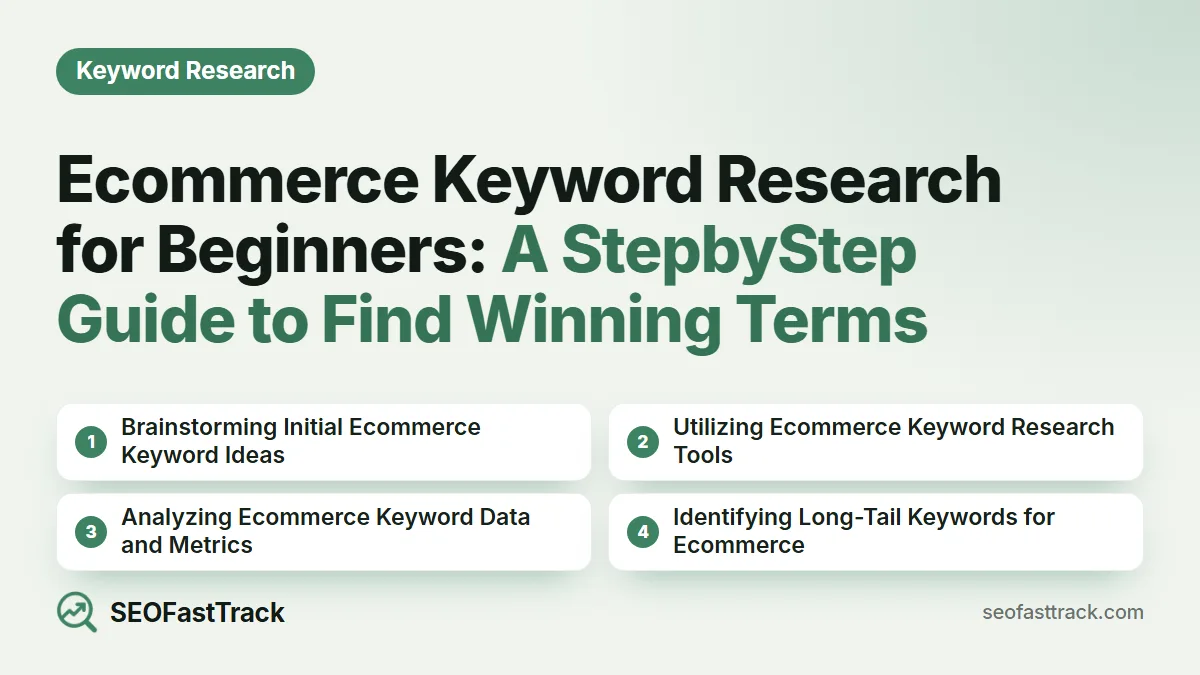
Welcome to SEOFastTrack, your go-to resource for mastering the world of search engine optimization! Are you ready to unlock the potential of your online store? This guide dives deep into ecommerce keyword research strategies, providing a step-by-step roadmap to uncover the winning search terms that will drive targeted traffic and boost your sales. Discover how to identify hidden opportunities and outperform your competition. Intrigued? Let's get started on your journey to SEO success!
- Introduction to Ecommerce Keyword Research Strategies
- Step 1: Brainstorming Initial Ecommerce Keyword Ideas
- Step 2: Utilizing Ecommerce Keyword Research Tools
- Step 3: Analyzing Ecommerce Keyword Data and Metrics
- Step 4: Identifying Long-Tail Keywords for Ecommerce
- Step 5: Competitor Keyword Analysis for Ecommerce
- Step 6: Categorizing and Prioritizing Ecommerce Keywords
- Step 7: Implementing Your Ecommerce Keyword Strategy
- Step 8: Monitoring and Refining Your Ecommerce Keyword Research
- Advanced Ecommerce Keyword Research Techniques
- Conclusion: Mastering Ecommerce Keyword Research for SEO Success
-
Frequently Asked Questions
- ### What is the most important reason to conduct keyword research for an ecommerce business?
- ### How is ecommerce keyword research different from regular keyword research?
- ### What are some essential tools recommended for ecommerce keyword research?
- ### What's the best way to identify long-tail keywords for my ecommerce store?
- ### How often should I update my ecommerce keyword research to stay competitive?
- Final Reflection: Unlocking Ecommerce Potential Through Strategic Keywords
- Unearth Your Ecommerce Potential!
Introduction to Ecommerce Keyword Research Strategies
Why Ecommerce Keyword Research Matters for Online Stores
Ecommerce keyword research is the bedrock of any successful online store's SEO strategy. Unlike brick-and-mortar stores that rely on foot traffic and local visibility, ecommerce businesses are heavily dependent on search engines to drive customers to their virtual storefronts. Effective keyword research allows you to understand precisely what your potential customers are searching for when they are looking to buy products like yours online.
By identifying and targeting these keywords, you can optimize your website content, product pages, and marketing efforts to attract qualified traffic – users who are actively looking to make a purchase. Without a solid foundation in ecommerce keyword research strategies, you risk missing out on valuable sales opportunities and being invisible to your target audience in the vast online marketplace.
Ignoring ecommerce keyword research is akin to opening a physical store in a deserted location with no signage. Even if you have the best products, no one will know you exist. Consider a small online boutique selling handmade jewelry.
Without keyword research, they might unknowingly optimize for overly broad terms like "jewelry," competing with massive retailers. However, by conducting thorough research, they might discover that "handmade silver earrings for sensitive ears" is a less competitive, yet highly relevant keyword phrase that attracts customers specifically interested in their unique offerings. This targeted approach, driven by keyword insights, leads to higher conversion rates and a better return on investment for their marketing efforts.
Understanding Search Intent in Ecommerce
In the realm of ecommerce, understanding search intent is paramount for effective keyword research. Search intent refers to the underlying reason why a user performs a search query. For ecommerce, search intent largely revolves around transactional queries – users who are actively looking to buy something. However, it also encompasses informational and navigational intents that can ultimately lead to a purchase. Recognizing these different intents allows you to tailor your keyword strategy to meet users at various stages of the buying journey.
For example, someone searching for "best running shoes 2024" is likely in the research phase (informational intent), while someone searching for "Nike Air Zoom Pegasus 39 size 10" is closer to making a purchase (transactional intent). Similarly, a user searching for "Amazon shoe store" has a navigational intent, aiming to reach a specific online retailer. By understanding these nuances, you can target keywords that align with each stage.
For informational intent, blog posts and guides can attract users initially; for transactional intent, product pages optimized for specific product names and categories are crucial. Mastering the understanding of search intent ensures that your ecommerce keyword research strategies are not only about attracting traffic, but attracting the right traffic – users who are genuinely interested in buying your products.
Setting Realistic Goals for Your Ecommerce Keyword Strategy
Before diving into the specifics of keyword research, it's crucial to set realistic and achievable goals for your ecommerce keyword strategy. Unrealistic expectations can lead to frustration and wasted resources. Instead of aiming to rank for highly competitive, generic keywords immediately, focus on identifying and targeting keywords that are attainable within your current resources and website authority. Setting SMART goals (Specific, Measurable, Achievable, Relevant, Time-bound) is a valuable framework to apply here.
For a new ecommerce store, a realistic initial goal might be to rank in the top 20 search results for 10-15 long-tail keywords within 3 months. This is specific and measurable. It's also achievable because long-tail keywords are generally less competitive. It's relevant because these keywords should directly relate to your product offerings.
And the 3-month timeframe provides a time-bound element. As your website gains authority and you accumulate more data, you can progressively set more ambitious goals, such as ranking in the top 5 for more competitive keywords or increasing organic traffic by a certain percentage within a quarter. Starting with realistic goals ensures that your ecommerce keyword research strategies are not just theoretical exercises, but actionable steps towards tangible business growth.
Step 1: Brainstorming Initial Ecommerce Keyword Ideas
Identifying Your Niche and Target Audience in Ecommerce
The first step in any effective ecommerce keyword research strategy is to deeply understand your niche and target audience. Your niche is the specific segment of the market you cater to. Defining it clearly helps you narrow down your keyword focus and avoid wasting time on irrelevant terms. Consider not just what you sell, but who you sell it to and why they would buy from you. A broad niche like "clothing" is incredibly competitive, while a narrower niche like "sustainable yoga apparel for women over 40" is much more targeted and allows for more focused keyword research.
Identifying your target audience involves creating detailed buyer personas. Think about their demographics (age, location, income), psychographics (interests, values, lifestyle), and online behavior (search habits, platforms used). For example, if you sell organic baby food, your target audience might be parents aged 25-35, health-conscious, and searching for terms like "organic baby food delivery" or "best baby food for sensitive stomachs." Understanding your niche and target audience provides the foundation for generating relevant and high-converting keyword ideas. It allows you to think like your customer and anticipate the language they use when searching for products like yours.
Listing Products and Categories for Your Online Store
Once you have a clear understanding of your niche and target audience, the next step is to create a comprehensive list of all the products and categories you offer in your online store. This list will form the basis for your initial keyword brainstorming. Go beyond just the product names and think about the different ways customers might search for them. Consider variations in product types, sizes, colors, brands, materials, and uses.
For instance, if you sell coffee beans, your list might include categories like "single-origin coffee," "espresso blends," "decaf coffee," and "flavored coffee." Within each category, list specific products like "Sumatra Mandheling beans," "Italian roast espresso blend," "Swiss water decaf," and "vanilla hazelnut flavored coffee." For each product, think of related terms like "best Sumatra coffee," "strong espresso beans," "caffeine-free coffee," and "gourmet vanilla coffee."
This detailed product and category inventory ensures that you don't miss any potential keyword opportunities and provides a structured approach to your brainstorming process. The more granular you are in this step, the richer your initial keyword pool will be.
Generating Seed Keywords for Ecommerce
With your niche, target audience, and product list in hand, it's time to start generating seed keywords. Seed keywords are the initial, broad terms that you will use as a starting point for your keyword research. These are typically short, generic keywords directly related to your products or niche. Think of them as the seeds from which your more specific and long-tail keywords will grow.
For an ecommerce store selling pet supplies, seed keywords might include: "dog food," "cat toys," "pet beds," "aquarium supplies," and "bird cages." For a clothing boutique, seed keywords could be: "dresses," "shirts," "jeans," "skirts," and "sweaters." To generate seed keywords effectively, put yourself in the shoes of your potential customers. What words would they type into Google when searching for your products?
Brainstorm freely and don't worry about being too specific at this stage. The goal is to create a broad list of initial keywords that you can then refine and expand upon using keyword research tools in the subsequent steps. These seed keywords are your launching pad for a more in-depth exploration of the ecommerce keyword landscape.
Step 2: Utilizing Ecommerce Keyword Research Tools
Exploring Google Keyword Planner for Ecommerce Keywords
Google Keyword Planner is a free tool provided by Google Ads, and it's an excellent starting point for ecommerce keyword research, especially for beginners. While primarily designed for paid advertising, it offers valuable insights into keyword search volume, competition, and related keyword ideas that are highly beneficial for SEO purposes.
To use Keyword Planner effectively for ecommerce, start by entering your seed keywords or even your website URL. The tool will then generate a list of keyword suggestions along with data like average monthly searches, competition level (for paid ads, but indirectly indicative of SEO difficulty), and suggested bid prices (again, for ads, but reflecting commercial value).
For instance, if you enter "dog food" into Keyword Planner, it might suggest related keywords like "best dog food brands," "cheap dog food," "organic dog food," and "grain-free dog food." It will also show you the average monthly search volume for each of these terms. While the search volume data in Keyword Planner is often presented in ranges (e.g., 1K-10K searches per month), it still provides a valuable indication of keyword popularity.
Keyword Planner is particularly useful for discovering broader keyword themes and identifying initial long-tail keyword ideas. It's a readily accessible and powerful tool to begin building your ecommerce keyword list and understanding the search landscape.
Leveraging Semrush for Ecommerce Keyword Analysis
Semrush is a comprehensive SEO and marketing toolkit that offers significantly more advanced features for ecommerce keyword analysis compared to Google Keyword Planner. While it's a paid tool, the depth of data and functionality it provides makes it a worthwhile investment for serious ecommerce businesses. Semrush allows you to conduct in-depth keyword research, competitor analysis, site audits, and track your keyword rankings over time. For ecommerce keyword research specifically, Semrush offers features like Keyword Magic Tool, which generates a vast list of keyword variations and long-tail keywords based on your seed keywords.
Using Semrush, you can analyze keyword difficulty more accurately than with Google Keyword Planner. Semrush's Keyword Difficulty metric assesses how challenging it would be to rank in the top organic positions for a given keyword, taking into account domain authority, page authority, and backlinks of the current top-ranking pages.
Furthermore, Semrush's Traffic Analytics and Organic Research tools allow you to analyze your competitors' keyword strategies, identify their top-performing keywords, and uncover keyword gaps in your own strategy. For ecommerce businesses looking for a robust and data-driven approach to keyword research, Semrush is a powerful ally, providing actionable insights to optimize your online visibility and drive sales.
Using Ahrefs for Competitor Analysis and Ecommerce Keyword Discovery
Ahrefs is another leading SEO tool suite, renowned particularly for its backlink analysis capabilities, but also offering excellent features for ecommerce keyword research and competitor analysis. Like Semrush, Ahrefs is a paid tool, but its comprehensive data and user-friendly interface make it a favorite among SEO professionals. Ahrefs' Keywords Explorer is a powerful tool for discovering keyword ideas, analyzing keyword difficulty, and understanding search intent. It boasts a massive keyword database and provides detailed metrics including keyword volume, keyword difficulty, click-through rate (CTR), and traffic potential.
One of Ahrefs' standout features for ecommerce is its ability to analyze competitor websites in depth. By entering a competitor's domain into Ahrefs' Site Explorer, you can see the keywords they are ranking for, the amount of organic traffic they are generating, and their top-performing content. This competitor analysis is invaluable for identifying keyword opportunities you might have missed and understanding what strategies are working for your rivals.
Ahrefs also offers Content Explorer, which allows you to search for content related to your niche and identify popular articles and pages that are generating significant traffic and backlinks. This can inspire content ideas and further refine your ecommerce keyword strategy. For ecommerce businesses seeking a comprehensive SEO tool with a strong focus on competitor analysis and keyword discovery, Ahrefs is a top-tier choice.
Other Useful Ecommerce Keyword Research Tools
Beyond Google Keyword Planner, Semrush, and Ahrefs, several other useful tools can enhance your ecommerce keyword research process. Ubersuggest, now owned by Neil Patel, offers a freemium model, providing a good balance of free and paid features for keyword research, content ideas, and competitor analysis. It’s a user-friendly option for beginners and smaller ecommerce businesses seeking more data than Google Keyword Planner provides, but without the investment of Semrush or Ahrefs.
Moz Keyword Explorer is another reputable tool, known for its accuracy and user-friendly interface. It provides keyword suggestions, keyword difficulty scores, organic CTR data, and priority scores to help you prioritize keywords effectively. For those focused on Amazon SEO, tools like Helium 10 and Jungle Scout are specifically designed for product and keyword research within the Amazon marketplace.
These tools offer features like product research, keyword research tailored to Amazon's algorithm, and competitor analysis within the platform. Ultimately, the best combination of tools depends on your budget, technical expertise, and the specific needs of your ecommerce business. Experimenting with different tools and leveraging their unique strengths can significantly improve the effectiveness of your ecommerce keyword research strategies.
Step 3: Analyzing Ecommerce Keyword Data and Metrics
Understanding Search Volume for Ecommerce Keywords
Search volume is a fundamental metric in ecommerce keyword research, representing the estimated number of times a particular keyword is searched for in a given period, typically per month. Understanding search volume helps you gauge the potential traffic a keyword can drive to your online store. Keywords with high search volume indicate broader interest and potentially larger traffic opportunities, but they also tend to be more competitive. Conversely, keywords with low search volume might attract less traffic, but often have higher conversion rates because they are more specific and targeted.
For example, a broad keyword like "shoes" might have a very high search volume, but it's incredibly competitive and likely to attract a generic audience. A long-tail keyword like "women's waterproof hiking boots size 7" will have a much lower search volume, but the users searching for this term are highly specific and likely to convert if you offer relevant products. When analyzing search volume for ecommerce keywords, consider the balance between traffic potential and keyword specificity.
Prioritize keywords that have a reasonable search volume within your niche and target audience, rather than solely focusing on the highest volume terms which may be too competitive or irrelevant. Tools like Google Keyword Planner, Semrush, and Ahrefs provide search volume data, allowing you to make informed decisions about which keywords to target in your ecommerce SEO strategy.
Assessing Keyword Difficulty for Ecommerce
Keyword difficulty is a crucial metric that helps you evaluate how challenging it will be to rank in the top search results for a specific keyword. In ecommerce, where competition is often fierce, understanding keyword difficulty is essential for prioritizing your SEO efforts effectively. Keyword difficulty is typically represented as a score, often ranging from 0 to 100, with higher scores indicating greater difficulty. This score is calculated based on various factors, including the domain authority of the websites currently ranking for the keyword, the number and quality of backlinks pointing to those pages, and on-page optimization factors.
For ecommerce businesses, targeting keywords with excessively high difficulty scores, especially when starting out, can be a resource-intensive and potentially fruitless endeavor. It's often more strategic to focus on keywords with low to medium difficulty, particularly long-tail keywords, which offer a better chance of ranking quickly and driving targeted traffic.
Keyword difficulty tools, like those provided by Semrush and Ahrefs, analyze the top-ranking pages for a keyword and provide a difficulty score, along with insights into the factors contributing to that score. By assessing keyword difficulty, you can make data-driven decisions about which keywords to target, optimizing your chances of achieving higher rankings and attracting relevant traffic to your ecommerce store.
Evaluating Keyword Relevance and Commercial Intent
Beyond search volume and keyword difficulty, evaluating keyword relevance and commercial intent is paramount for successful ecommerce keyword research. Relevance refers to how closely a keyword relates to the products you sell and the needs of your target audience. Commercial intent indicates the likelihood that users searching for a particular keyword are looking to make a purchase. Keywords with high search volume and low difficulty are only valuable if they are highly relevant to your offerings and demonstrate commercial intent.
For instance, if you sell organic skincare products, the keyword "skincare routine" might have high search volume, but it might attract users primarily interested in informational content rather than buying products immediately. On the other hand, keywords like "buy organic moisturizer online" or "best natural face serum for dry skin" demonstrate clear commercial intent and are highly relevant to your product offerings. When evaluating keywords, consider the search intent behind them.
Are users searching for information, navigation to a specific website, or are they in the transactional phase, ready to buy? Prioritize keywords that align with transactional intent and are highly relevant to your product categories. This ensures that your ecommerce keyword research strategies attract qualified traffic that is more likely to convert into paying customers.
Step 4: Identifying Long-Tail Keywords for Ecommerce
The Power of Long-Tail Keywords in Ecommerce SEO
Long-tail keywords are longer, more specific keyword phrases that typically have lower search volume than broad, generic keywords, but are incredibly powerful for ecommerce SEO. They represent niche search queries that are highly targeted and often indicate a user further along in the buying journey. While individually they may drive less traffic than head keywords, collectively, long-tail keywords can contribute significantly to overall organic traffic and, more importantly, to higher conversion rates.
For example, instead of targeting the broad keyword "coffee," an ecommerce store selling coffee might target long-tail keywords like "where to buy fair trade organic Ethiopian Yirgacheffe coffee beans online" or "best French press coffee for dark roast beans." These long-tail phrases are much more specific and attract users who know exactly what they are looking for. Because they are less competitive, it's often easier to rank for long-tail keywords, especially for new or smaller ecommerce businesses.
Focusing on long-tail keywords allows you to capture highly qualified traffic, improve your website's topical relevance, and ultimately increase your sales and ROI from SEO efforts. Ecommerce keyword research strategies that prioritize long-tail keywords are often more effective in driving sustainable growth.
Finding Long-Tail Keyword Opportunities for Your Online Store
Identifying long-tail keyword opportunities for your ecommerce store involves expanding upon your seed keywords and delving into the nuances of customer search behavior. One effective method is to use keyword research tools like Semrush or Ahrefs and enter your seed keywords. These tools often provide "phrase match" or "related keywords" reports that reveal longer, more specific keyword variations. Pay close attention to questions, modifiers (like "best," "cheap," "top-rated"), and specific product attributes (like color, size, material) that users include in their searches.
Another valuable approach is to analyze your website's internal search data and customer service inquiries. These sources often reveal the exact language customers use when searching for products on your site or asking questions about your offerings. Tools like AnswerThePublic can also be helpful for generating question-based long-tail keyword ideas related to your niche.
Furthermore, consider using Google Suggest (autocomplete) and "People Also Ask" boxes in search results to uncover long-tail keyword phrases that are frequently searched. By combining these methods, you can build a comprehensive list of long-tail keyword opportunities that are highly relevant to your ecommerce store and target audience.
Optimizing for Question-Based Ecommerce Queries
Question-based queries are a significant subset of long-tail keywords in ecommerce, representing user searches phrased as questions. These queries often indicate informational or pre-purchase research intent, and optimizing for them can be a powerful way to attract potential customers early in their buying journey. Users might ask questions like "What is the best type of coffee grinder for espresso?" or "How do I choose the right size hiking backpack?" Answering these questions directly on your product pages, in blog posts, or in FAQs can position your ecommerce store as a helpful resource and build trust with potential customers.
To identify question-based keyword opportunities, use tools like AnswerThePublic, which specifically generates questions related to your seed keywords. You can also manually brainstorm questions that your target audience might ask about your products or niche. Incorporate these questions into your content strategy by creating informative blog posts, detailed product descriptions that address common questions, or comprehensive FAQ sections.
Optimizing for question-based queries not only improves your search engine rankings for these specific keywords, but also enhances the user experience on your website by providing valuable information and addressing customer needs proactively. This approach can lead to increased engagement, higher conversion rates, and stronger customer loyalty.
Step 5: Competitor Keyword Analysis for Ecommerce
Identifying Your Main Ecommerce Competitors
Competitor keyword analysis is a critical component of any effective ecommerce keyword research strategy. It involves identifying your main ecommerce competitors and analyzing their keyword strategies to uncover opportunities for your own online store. Your competitors are not just any online stores selling similar products; they are specifically the websites that are currently ranking well in search results for the keywords you are targeting. These are the businesses you are directly competing with for organic traffic and customer attention.
To identify your main ecommerce competitors, start by searching Google for your primary seed keywords and long-tail keywords. Make a list of the websites that consistently appear in the top search results. Pay attention to both direct product competitors and larger marketplaces or aggregators that might be ranking for similar terms.
Tools like Semrush and Ahrefs can also help you identify competitors. By entering your domain into these tools, they can generate a list of your organic competitors based on keyword overlap. Once you have identified your main competitors, you can begin to analyze their keyword strategies to gain valuable insights and uncover untapped opportunities.
Analyzing Competitor Keyword Strategies
Analyzing your competitors' keyword strategies provides valuable insights into what's working in your niche and helps you identify keyword opportunities you might have missed. Tools like Semrush and Ahrefs are essential for this process. Using these tools, you can enter a competitor's domain and see a comprehensive list of keywords they are ranking for, the estimated traffic they are receiving from each keyword, and their top-performing pages. Pay attention to both the keywords they are ranking highly for and the keywords that are driving significant traffic to their website.
Look for patterns in their keyword targeting. Are they focusing on broad keywords, long-tail keywords, or a mix of both? What types of content are they creating to rank for these keywords (product pages, blog posts, category pages)? Analyze their top-performing product pages and blog posts to understand their on-page optimization strategies, including their use of keywords in titles, headings, descriptions, and image alt text. Competitor keyword analysis is not about copying their strategies verbatim, but rather about understanding what's working, identifying gaps in their approach, and finding inspiration for your own ecommerce keyword strategy.
Finding Untapped Keyword Opportunities from Competitor Research
Competitor keyword research is not just about understanding what your rivals are doing; it's also about uncovering untapped keyword opportunities that they might be missing. By analyzing your competitors' keyword profiles, you can identify keywords that are relevant to your niche but are not being effectively targeted by them. Look for keywords that your competitors are ranking for, but not ranking very highly (e.g., ranking in positions 11-20). These "low-hanging fruit" keywords might be easier for you to rank for and can provide quick wins in terms of traffic and visibility.
Also, identify keyword gaps – keywords that are relevant to your niche and have decent search volume, but are not being targeted by your competitors at all. These gaps represent valuable opportunities to establish yourself as a leader in a specific area and attract a targeted audience. Pay attention to long-tail keywords and question-based queries that your competitors might be overlooking.
By focusing on these untapped keyword opportunities, you can differentiate your ecommerce store, attract a unique audience, and gain a competitive edge in the search results. Competitor research, therefore, is not just about imitation, but about strategic differentiation and opportunity identification.
Step 6: Categorizing and Prioritizing Ecommerce Keywords
Organizing Keywords by Product Category and Theme
Once you have compiled a comprehensive list of ecommerce keywords through brainstorming and research, the next crucial step is to organize and categorize them effectively. Organizing keywords by product category and theme provides a structured approach to keyword management and ensures that your keyword strategy aligns with your website's structure and content. Start by grouping keywords based on your main product categories (e.g., "dog food," "cat toys," "pet beds"). Within each category, further subdivide keywords into thematic groups based on product types, features, or user needs (e.g., within "dog food": "grain-free dog food," "puppy food," "senior dog food").
For example, if you sell skincare products, you might categorize keywords under themes like "cleansers," "moisturizers," "serums," and "sunscreen." Within "moisturizers," you could further categorize by skin type: "moisturizer for dry skin," "moisturizer for oily skin," "moisturizer for sensitive skin." This hierarchical categorization helps you understand the relationships between keywords and ensures that you are targeting a comprehensive range of relevant terms for each product area. Organizing keywords by category and theme also simplifies the process of assigning keywords to specific pages on your website, ensuring that your on-page SEO is targeted and effective.
Prioritizing Keywords Based on Potential ROI
Not all ecommerce keywords are created equal. Prioritizing keywords based on their potential return on investment (ROI) is essential for maximizing the effectiveness of your SEO efforts and focusing on keywords that will drive the most valuable traffic and conversions. Consider several factors when prioritizing keywords, including search volume, keyword difficulty, relevance, and commercial intent. Keywords with high search volume and strong commercial intent, but moderate difficulty, often represent the best ROI opportunities.
For ecommerce, transactional keywords (those indicating a purchase intent, like "buy," "shop," "discount") should generally be prioritized over informational keywords (like "how to," "what is"). However, informational keywords can still play a role in attracting users at the top of the funnel and building brand awareness. Use a scoring system to prioritize keywords, assigning points based on each factor (e.g., high search volume = 3 points, medium difficulty = 2 points, high commercial intent = 3 points).
Keywords with the highest overall scores should be prioritized in your initial SEO efforts. Regularly review and adjust your keyword priorities based on performance data and changes in search trends to ensure you are consistently focusing on the keywords that deliver the best results for your ecommerce business.
Creating a Keyword Map for Your Ecommerce Website
A keyword map is a visual representation that links your prioritized keywords to specific pages on your ecommerce website. It's a crucial tool for ensuring that you are targeting the right keywords on the right pages and avoiding keyword cannibalization (multiple pages competing for the same keywords). Your keyword map should typically be structured around your website's navigation and product categories.
For each page on your website (homepage, category pages, product pages, blog posts), assign a primary keyword and several secondary keywords. The primary keyword should be the most relevant and highest-priority keyword for that page. Secondary keywords are related terms that further support the primary keyword and broaden the page's keyword coverage.
For example, your homepage might target broad brand keywords and high-level category keywords. Category pages should target category-specific keywords (e.g., "dog food," "cat toys"). Product pages should target specific product keywords (e.g., "grain-free puppy food," "interactive cat laser toy"). Blog posts can target informational and long-tail keywords related to your niche. Creating a keyword map ensures that your website's SEO is strategically organized, that each page has a clear keyword focus, and that your keyword strategy is implemented in a cohesive and effective manner across your entire ecommerce website.
Step 7: Implementing Your Ecommerce Keyword Strategy
Optimizing Product Pages with Target Keywords
Optimizing product pages with target keywords is a fundamental aspect of implementing your ecommerce keyword strategy. Product pages are the workhorses of your online store, designed to convert visitors into buyers. Therefore, it's crucial to strategically incorporate your prioritized product keywords into key on-page elements to improve their visibility in search results and attract relevant traffic. Start by optimizing the product title. Include your primary product keyword naturally and concisely in the title tag. This is one of the most important on-page SEO factors.
Next, optimize the product description. Weave your primary and secondary keywords naturally throughout the description, focusing on highlighting the product's features, benefits, and unique selling points. Don't stuff keywords unnaturally; prioritize clear, compelling, and informative language that resonates with your target audience.
Optimize image file names and alt text by using relevant keywords that describe the product visually. Use keywords in headings (H1, H2, H3 tags) to structure your product page content and highlight key product features. By systematically optimizing these on-page elements with your target keywords, you can significantly improve the search engine rankings and organic visibility of your product pages, driving more qualified traffic to your ecommerce store.
Creating Keyword-Rich Product Descriptions
Creating keyword-rich product descriptions is essential for both SEO and user engagement on your ecommerce website. Product descriptions should not only be informative and persuasive for potential customers, but also optimized with relevant keywords to improve search engine visibility. However, it's crucial to strike a balance between keyword optimization and readability. Avoid keyword stuffing, which can harm your website's ranking and detract from the user experience. Instead, focus on naturally integrating keywords into compelling and informative descriptions.
Start by understanding your target audience and the language they use when searching for products like yours. Incorporate your primary and secondary keywords naturally throughout the description, focusing on highlighting the product's key features, benefits, and unique selling propositions. Use variations of your keywords and related terms to broaden your keyword coverage and avoid repetition.
Write descriptions that are engaging, persuasive, and answer potential customer questions. Focus on creating high-quality, original content for each product description, rather than simply copying manufacturer descriptions. Keyword-rich product descriptions that are also user-friendly are a powerful asset for both SEO and conversion optimization in ecommerce.
Using Keywords in Meta Titles and Descriptions
Meta titles and meta descriptions are HTML tags that provide concise summaries of your webpage content to search engines and search users. They are displayed in search engine results pages (SERPs) and play a crucial role in attracting clicks and improving your website's click-through rate (CTR). Optimizing meta titles and descriptions with relevant keywords is a vital aspect of on-page SEO for ecommerce websites.
Your meta title should be a concise and compelling summary of the page's content, ideally under 60 characters to avoid truncation in SERPs. Include your primary keyword naturally at the beginning of the meta title if possible, as keywords closer to the beginning tend to carry more weight.
Your meta description should be a slightly longer (under 160 characters) and more detailed summary of the page's content, designed to entice users to click on your search result. Incorporate your primary and secondary keywords naturally within the meta description, focusing on highlighting the page's value proposition and relevance to the user's search query.
Use action-oriented language and create a sense of urgency or benefit to encourage clicks (e.g., "Shop Now," "Free Shipping," "Limited Time Offer"). Well-crafted meta titles and descriptions that are optimized with relevant keywords can significantly improve your website's CTR from search results, leading to increased organic traffic and ultimately, more conversions.
Step 8: Monitoring and Refining Your Ecommerce Keyword Research
Tracking Keyword Rankings and Website Traffic
Monitoring keyword rankings and website traffic is essential for evaluating the effectiveness of your ecommerce keyword research strategy and making data-driven adjustments. Keyword ranking tracking involves monitoring your website's position in search results for your target keywords over time. Tools like Semrush, Ahrefs, and Google Search Console allow you to track keyword rankings automatically and identify trends and fluctuations in your positions. Tracking keyword rankings helps you understand which keywords are performing well, which are declining, and which require further optimization efforts.
Website traffic analysis involves monitoring the overall organic traffic to your website, as well as traffic to specific pages targeted for particular keywords. Google Analytics is the primary tool for website traffic analysis. It allows you to track organic traffic trends, identify top-performing pages, and analyze user behavior metrics like bounce rate and time on page.
By correlating keyword ranking data with website traffic data, you can gain a comprehensive understanding of how your keyword strategy is impacting your website's visibility and traffic. Regularly monitoring these metrics allows you to identify areas for improvement, refine your keyword targeting, and optimize your content and SEO efforts for better results.
Analyzing Conversion Rates for Targeted Keywords
While ranking high for keywords and driving traffic to your ecommerce website is important, the ultimate goal is to convert that traffic into sales. Analyzing conversion rates for your targeted keywords provides crucial insights into the effectiveness of your keyword strategy in driving revenue. Conversion rate is the percentage of website visitors who complete a desired action, such as making a purchase. By tracking conversion rates for traffic originating from specific keywords, you can identify which keywords are driving the most valuable traffic – traffic that is most likely to convert into paying customers.
Use Google Analytics to track conversion rates for organic traffic and segment the data by landing page and keyword (if possible, through Search Console integration). Identify keywords that have high conversion rates and focus on further optimizing for these terms. Conversely, identify keywords that are driving traffic but have low conversion rates.
This might indicate that the keyword is not attracting the right audience, the landing page is not optimized for conversions, or there is a disconnect between the keyword intent and the page content. Analyzing conversion rates for targeted keywords allows you to refine your keyword strategy, prioritize keywords that drive revenue, and improve the overall ROI of your ecommerce SEO efforts.
Adapting Your Keyword Strategy Based on Performance Data
Ecommerce keyword research is not a one-time task; it's an ongoing process that requires continuous monitoring, analysis, and adaptation based on performance data. Search engine algorithms, user search behavior, and competitor strategies are constantly evolving, so your keyword strategy must be flexible and responsive to these changes. Regularly review your keyword rankings, website traffic, and conversion rate data to identify trends and areas for improvement. If you notice that certain keywords are declining in rankings or traffic, investigate the reasons why and adjust your optimization efforts accordingly.
If you identify new keyword opportunities through ongoing research or competitor analysis, incorporate them into your strategy. Experiment with targeting different types of keywords, such as long-tail keywords or question-based queries, and track their performance. Stay informed about algorithm updates and industry best practices to ensure your keyword strategy remains aligned with the latest SEO trends. By continuously adapting your keyword strategy based on performance data and industry changes, you can ensure that your ecommerce website remains competitive in search results, attracts relevant traffic, and achieves its business goals.
Advanced Ecommerce Keyword Research Techniques
Using Google Trends for Ecommerce Keyword Insights
Google Trends is a free tool from Google that provides valuable insights into the popularity of search terms over time and across different regions. It can be a powerful tool for advanced ecommerce keyword research, helping you identify trending product categories, seasonal keyword variations, and emerging search interests within your niche. Use Google Trends to analyze the search volume trends for your seed keywords and identify seasonal fluctuations.
For example, if you sell swimwear, you might see a significant spike in search volume for "swimsuits" during the summer months. This seasonality insight can inform your content calendar and marketing campaigns.
Explore related queries and topics in Google Trends to discover new keyword ideas and identify emerging trends in your industry. For instance, if you search for "coffee beans," Google Trends might reveal trending related queries like "cold brew coffee beans" or "mushroom coffee beans," indicating growing consumer interest in these niche coffee types. Compare the search volume trends of different keywords to identify which terms are gaining popularity and which are declining.
Use regional data in Google Trends to understand geographic variations in keyword search volume and tailor your keyword strategy to specific target markets. Google Trends provides a dynamic and real-time view of search interest, allowing you to stay ahead of the curve and adapt your ecommerce keyword strategy to evolving consumer demands.
Exploring Amazon Keyword Research for Product Optimization
For ecommerce businesses selling on Amazon, Amazon keyword research is just as crucial as Google keyword research. Amazon has its own internal search engine, and optimizing your product listings for relevant Amazon keywords is essential for improving product visibility and driving sales on the platform. Amazon keyword research tools, such as Helium 10 and Jungle Scout, are specifically designed for this purpose. These tools provide data on search volume, keyword competitiveness, and product ranking within Amazon's marketplace.
Use Amazon keyword research tools to identify keywords that Amazon shoppers are using to search for products like yours. Focus on keywords that are relevant to your product features, benefits, and target audience. Analyze your competitors' Amazon listings to see which keywords they are targeting in their product titles, bullet points, and descriptions.
Optimize your Amazon product titles, bullet points, product descriptions, and backend keywords with your researched Amazon keywords. Consider using long-tail keywords and question-based queries in your Amazon listings to target specific customer needs and improve conversion rates. Amazon keyword research is a specialized but essential aspect of ecommerce keyword strategy for businesses selling on the world's largest online marketplace.
Local Ecommerce Keyword Research for Brick-and-Mortar Stores
For ecommerce businesses with physical brick-and-mortar stores, local ecommerce keyword research is crucial for bridging the gap between online and offline sales. Local SEO focuses on optimizing your online presence to attract local customers who are searching for products or services in your geographic area. Combine traditional ecommerce keyword research with local SEO keyword research to create a comprehensive strategy that drives both online and in-store traffic. Incorporate location-based keywords into your keyword research, such as "coffee shop near me," "best shoe store in [city]," or "[city] pet supply store."
Optimize your Google My Business listing with relevant local keywords and ensure your business information (name, address, phone number) is consistent across all online platforms. Create local landing pages on your website targeting specific cities or neighborhoods where you have physical stores. Optimize these landing pages with local keywords, maps, directions, and store hours.
Encourage customer reviews on Google My Business and other local review platforms, as reviews are a significant ranking factor in local search. Local ecommerce keyword research and optimization are essential for brick-and-mortar businesses to leverage their online presence to drive local foot traffic and increase overall sales.
Conclusion: Mastering Ecommerce Keyword Research for SEO Success
Key Takeaways for Ecommerce Keyword Optimization
Mastering ecommerce keyword research is an ongoing journey, but by focusing on the core principles and techniques outlined, you can significantly improve your online store's SEO performance and drive sustainable growth. The key takeaway is that effective ecommerce keyword research is not just about finding high-volume keywords; it's about understanding search intent, targeting relevant keywords, and continuously adapting your strategy based on data and insights. Remember to start with a deep understanding of your niche and target audience, brainstorm seed keywords, and leverage keyword research tools to expand your keyword list and analyze keyword metrics.
Prioritize long-tail keywords and question-based queries to capture highly targeted traffic and improve conversion rates. Conduct thorough competitor keyword analysis to uncover untapped opportunities and refine your strategy. Organize and prioritize keywords based on product categories, themes, and potential ROI.
Create a keyword map to guide your on-page optimization efforts and ensure keyword relevance across your website. Implement your keyword strategy by optimizing product pages, creating keyword-rich descriptions, and using keywords strategically in meta titles and descriptions. Finally, continuously monitor your keyword rankings, website traffic, and conversion rates, and adapt your keyword strategy based on performance data to ensure ongoing SEO success.
Next Steps: Implementing a Winning Ecommerce SEO Strategy
With a solid understanding of ecommerce keyword research strategies, the next step is to implement a winning ecommerce SEO strategy that drives traffic, conversions, and business growth. Begin by conducting a comprehensive keyword audit of your existing website and identify areas for improvement. Develop a detailed keyword map that aligns your prioritized keywords with specific pages on your website. Optimize your product pages, category pages, and homepage with your target keywords, focusing on on-page elements like titles, descriptions, headings, and image alt text.
Create high-quality, keyword-rich content, including blog posts, guides, and FAQs, to attract users at different stages of the buying journey and build topical authority. Build high-quality backlinks to your website from reputable sources to improve your domain authority and keyword rankings. Continuously monitor your SEO performance using tools like Google Analytics and Google Search Console, track your keyword rankings, website traffic, and conversion rates.
Regularly analyze your data, adapt your strategy based on performance insights, and stay updated with the latest SEO best practices and algorithm updates. By consistently implementing and refining your ecommerce SEO strategy, driven by effective keyword research, you can unlock the full potential of organic search to grow your online business and achieve long-term success.
Frequently Asked Questions
### What is the most important reason to conduct keyword research for an ecommerce business?
Keyword research helps you understand what customers are searching for when looking for products like yours. This allows you to optimize your product listings and website content to attract the right audience, boosting traffic and sales.
### How is ecommerce keyword research different from regular keyword research?
Ecommerce keyword research focuses on product-related terms and phrases that shoppers use to find specific items. It often includes terms like "buy [product]," "[product] reviews," or "[product] near me," which are transactional in nature.
### What are some essential tools recommended for ecommerce keyword research?
Tools like Google Keyword Planner, SEMrush, and Ahrefs are helpful for finding keyword ideas, analyzing search volume, and assessing keyword difficulty. Also, consider using Amazon's autocomplete feature to discover popular product searches.
### What's the best way to identify long-tail keywords for my ecommerce store?
Focus on specific product attributes and use case scenarios. For example, instead of "running shoes," try "lightweight running shoes for women" or "waterproof running shoes for trail running" to target niche customer segments.
### How often should I update my ecommerce keyword research to stay competitive?
Ideally, review and update your keyword strategy every 3-6 months. Search trends and consumer behavior can change quickly, so it's important to adapt to new opportunities and maintain relevance.
Final Reflection: Unlocking Ecommerce Potential Through Strategic Keywords
The journey through ecommerce keyword research, as outlined in this guide, is not merely a technical exercise; it's about understanding the fundamental connection between businesses and their customers. In today's digital marketplace, where visibility is paramount, mastering the art of identifying and utilizing winning keywords is the cornerstone of sustainable growth and lasting success for any ecommerce venture.
This exploration into keyword research has illuminated the power of understanding customer intent and aligning it with strategic content. The ability to anticipate what potential buyers are searching for, and then providing them with precisely what they need, is a skill that transcends algorithms and search engine rankings. It's about building genuine connections and fostering trust. The best marketing doesn't feel like marketing.
- Tom Fishburne. This quote encapsulates the essence of effective keyword research: it's about creating value and solving problems, not just manipulating search results.
Now, armed with these strategies and insights, I invite you to reflect on your own ecommerce journey. How can you leverage the power of keyword research to better understand your audience, refine your offerings, and ultimately, build a thriving online business? Embrace the challenge, experiment with different approaches, and remember that the most rewarding success comes from a deep understanding of your customers and a genuine commitment to meeting their needs.
Unearth Your Ecommerce Potential!
Thanks for exploring the world of ecommerce keyword research with us! We hope this guide has given you the tools to find effective keywords and boost your online store. Now, it's time to put your new skills to the test and see real results.
Here are a few next steps:
- Implement at least three new keywords from your research into your product listings this week and track their performance. This is the most crucial step.
- Share your keyword research journey! Post about your experience, including any surprising discoveries, on your favorite social media platform and tag SEOFastTrack.
- Consider using keyword research software to uncover even more long-tail keyword opportunities.
What's one specific keyword you're excited to try and why? Share your thoughts in the comments below!