
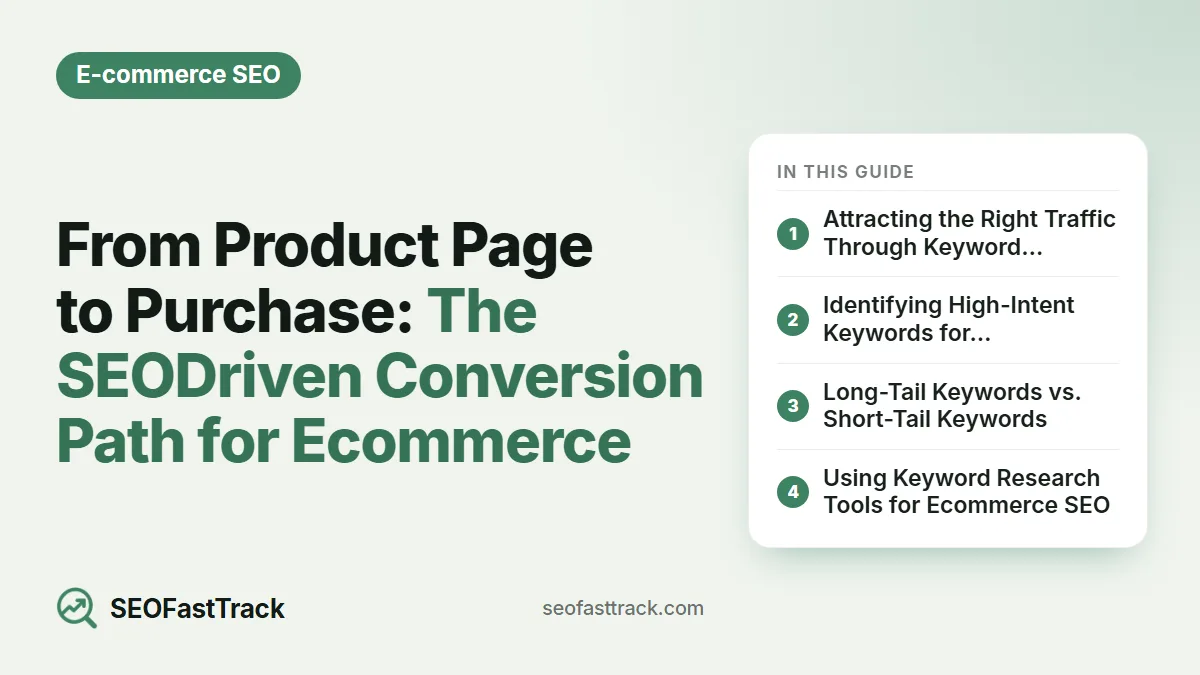
From Product Page to Purchase: The SEODriven Conversion Path for Ecommerce

Welcome to SEOFastTrack, your launchpad for mastering search engine optimization.
Ready to transform clicks into conversions? Discover how to navigate the competitive ecommerce landscape with our in-depth guide to SEO conversion strategies for ecommerce. We’ll reveal actionable tactics to optimize your product pages, boost your rankings, and ultimately, drive more sales. Dive in and unlock the hidden potential of your online store!
-
Stage 1: Attracting the Right Traffic Through Keyword Research for Product Pages
- Identifying High-Intent Keywords for Ecommerce Product Pages
- Long-Tail Keywords vs. Short-Tail Keywords: Which to Target for Product Pages?
- Using Keyword Research Tools for Ecommerce SEO: Semrush, Ahrefs, and Google Keyword Planner
- Competitive Analysis: Spying on Competitor Keywords for Product Listings
-
Frequently Asked Questions
- What are the most important on-page SEO elements to optimize on my ecommerce product pages to improve conversion rates?
- How can keyword research specifically help boost ecommerce conversion rates through SEO?
- What link-building strategies are most effective for driving qualified traffic and conversions to an ecommerce website?
- How does technical SEO impact an ecommerce site's ability to convert visitors into customers?
- How can I use SEO tools to identify and fix conversion rate optimization (CRO) issues on my ecommerce site?
- Final Reflection: Illuminating the Path to Purchase
- Ignite Your Ecommerce Growth!
Stage 1: Attracting the Right Traffic Through Keyword Research for Product Pages
Identifying High-Intent Keywords for Ecommerce Product Pages
For ecommerce product pages, the cornerstone of attracting qualified traffic lies in identifying and targeting high-intent keywords. These are search terms that strongly signal a user's readiness to make a purchase. Generic keywords like "shoes" might attract a broad audience, but high-intent keywords such as "Nike Air Max 90 men's running shoes size 10" precisely target users actively looking to buy a specific product.
Incorporating these specific keywords into your product page SEO ensures that you're reaching individuals who are much closer to the conversion point. Prioritizing keywords that include product names, brands, model numbers, and specific attributes like size, color, or material is crucial for capturing users with a clear purchase intent.
Effective keyword identification starts with understanding your target audience's search behavior. Consider the language they use when searching for products like yours. For example, someone looking for a new coffee maker might search for "best drip coffee maker," "buy Cuisinart coffee maker," or "coffee maker with thermal carafe."
These phrases demonstrate varying levels of purchase intent, from research to a brand-specific purchase. Tools like Google Keyword Planner can reveal search volume and keyword difficulty, helping you gauge the potential traffic and competitiveness of different keywords. Focus on keywords with a balance of decent search volume and manageable competition to optimize your product pages for maximum conversion potential from search engine traffic.
Long-Tail Keywords vs. Short-Tail Keywords: Which to Target for Product Pages?
In the realm of ecommerce SEO, understanding the distinction between long-tail and short-tail keywords is paramount for crafting effective product page strategies. Short-tail keywords are typically broad and generic terms, such as "dress" or "laptop." These keywords often boast high search volumes but also come with intense competition and generally lower conversion rates.
Users searching with short-tail keywords are often in the initial stages of their buying journey, exploring options rather than ready to buy. Conversely, long-tail keywords are longer, more specific phrases, like "floral maxi dress with sleeves size 12" or "lightweight 13-inch laptop with SSD and 16GB RAM."
Long-tail keywords, while having lower search volume individually, collectively drive significant qualified traffic to product pages with higher conversion rates. They cater to users who know precisely what they want and are further down the purchase funnel. For product pages, prioritizing long-tail keywords is often the more effective approach.
By targeting these specific searches, you attract a highly targeted audience actively seeking products like yours. For instance, instead of solely targeting "coffee beans," a product page should aim for long-tail variations like "organic fair trade arabica coffee beans whole bean" to capture users with specific preferences, leading to improved conversion rates and a better return on SEO investment.
Using Keyword Research Tools for Ecommerce SEO: Semrush, Ahrefs, and Google Keyword Planner
Leveraging keyword research tools is indispensable for effective ecommerce SEO, particularly when optimizing product pages. Tools like Semrush, Ahrefs, and Google Keyword Planner offer a wealth of data and functionalities to uncover relevant keywords, analyze competition, and track performance. Semrush, for example, provides features like Keyword Magic Tool and Organic Research, enabling users to find keyword variations, analyze keyword difficulty, and investigate competitors' keyword strategies. Ahrefs, known for its robust backlink analysis, also offers a powerful Keyword Explorer, allowing users to identify keyword opportunities, assess search volume trends, and understand click distribution.
Google Keyword Planner, while primarily designed for Google Ads, remains a valuable free tool for foundational keyword research. It provides search volume data, keyword suggestions, and competition insights directly from Google's search engine data. For ecommerce businesses, these tools are essential for identifying not only high-volume keywords but also long-tail keywords with strong purchase intent.
By inputting seed keywords related to your product categories, these tools can generate lists of related keywords, along with crucial metrics like search volume, keyword difficulty, and cost-per-click (CPC). Analyzing these metrics helps prioritize keywords that are both relevant to your products and feasible to rank for, ensuring your product pages attract targeted traffic and contribute to higher conversion rates.
Competitive Analysis: Spying on Competitor Keywords for Product Listings
Competitive analysis in ecommerce SEO is not about imitation, but strategic insight. By "spying" on competitor keywords for product listings, you gain a valuable understanding of the keywords driving traffic to successful products in your niche. Tools like Semrush and Ahrefs offer features to analyze competitor websites and reveal the keywords they are ranking for organically.
This allows you to identify keyword gaps – terms your competitors are successfully targeting that you might be missing – and uncover new keyword opportunities you may not have initially considered. Examining competitor product pages also provides clues about their on-page optimization strategies, such as keyword usage in titles, descriptions, and image alt text.
Analyzing competitor keyword strategies goes beyond simply copying their keywords. It's about understanding the competitive landscape and identifying opportunities to differentiate yourself. For instance, if competitors are heavily targeting broad keywords, you might discover an advantage in focusing on more specific long-tail keywords to capture a niche audience.
Competitive analysis also helps gauge keyword difficulty and understand the level of effort required to rank for specific terms. By analyzing competitor backlink profiles and content strategies related to product pages, you can gain insights into effective SEO tactics within your industry. This intelligence allows you to refine your keyword targeting, optimize your product pages more effectively, and ultimately gain a competitive edge in search engine rankings and drive more qualified traffic to your ecommerce store.
Frequently Asked Questions
What are the most important on-page SEO elements to optimize on my ecommerce product pages to improve conversion rates?
Prioritize compelling product descriptions, high-quality images, and optimized meta descriptions. Also ensure fast page loading speeds for a better user experience.
How can keyword research specifically help boost ecommerce conversion rates through SEO?
By identifying high-intent keywords related to product searches, you can tailor your content to directly address customer needs and increase the likelihood of a purchase. This also helps you understand customer search patterns.
What link-building strategies are most effective for driving qualified traffic and conversions to an ecommerce website?
Focus on earning backlinks from relevant industry websites and blogs. Also, consider guest blogging and broken link building to acquire high-quality, targeted referrals.
How does technical SEO impact an ecommerce site's ability to convert visitors into customers?
Proper technical SEO ensures your site is easily crawlable and indexable by search engines. This leads to better visibility and more organic traffic, which can translate into increased conversions.
How can I use SEO tools to identify and fix conversion rate optimization (CRO) issues on my ecommerce site?
Tools like Google Analytics and heatmaps can reveal user behavior patterns, such as where users are dropping off in the conversion funnel, allowing you to address usability issues. They can also help you track and measure the impact of your SEO changes on conversion rates.
Final Reflection: Illuminating the Path to Purchase
The journey from a simple product page to a completed purchase is a complex dance, and as we've explored, SEO conversion strategies are the choreography that guides the customer. In today's fiercely competitive ecommerce landscape, simply attracting traffic is no longer enough. We must meticulously craft a seamless and persuasive path that transforms casual browsers into loyal customers, and that transformation hinges on a deep understanding and implementation of the principles outlined in this article.
The power of SEO extends far beyond mere search engine rankings; it shapes the entire customer experience. This realization underscores the profound responsibility we have as marketers and business owners to create online environments that are not only discoverable but also genuinely valuable and trustworthy. People shop and learn in a whole new way compared to just a few years ago, so marketers need to adapt or risk extinction.
- Brian Halligan, HubSpot. This quote perfectly encapsulates the need for continuous adaptation and refinement of our SEO conversion strategies to meet the ever-evolving needs of the modern ecommerce shopper.
Now, armed with these insights, I encourage you to reflect on your own ecommerce presence. Are you truly optimizing every touchpoint for conversion? Are you providing a compelling and trustworthy experience that resonates with your target audience? The path to purchase is not a static route, but a dynamic journey. Embrace the principles of SEO conversion, experiment with new strategies, and continuously refine your approach. By doing so, you can illuminate the path for your customers and unlock the full potential of your ecommerce business.
Ignite Your Ecommerce Growth!
Thank you for exploring the SEO-driven conversion path! Now that you've learned strategies to turn product page visits into sales, it's time to apply this knowledge and see real results.
Here's how to begin:
- Immediately optimize your lowest-performing product page using the strategies discussed in this article. Monitor the results over the next week and compare them to the previous week's performance.
- Share this article with a fellow ecommerce business owner who's struggling with conversions – help them boost their online success!
- Brainstorm three innovative keywords related to one of your top-selling products and integrate them strategically into your product descriptions.
What's the key improvement you're most excited to implement on your product pages today? Share your plan in the comments below!