
The Top 10 Local Citation Sites You Absolutely Need to Be On in [Year]

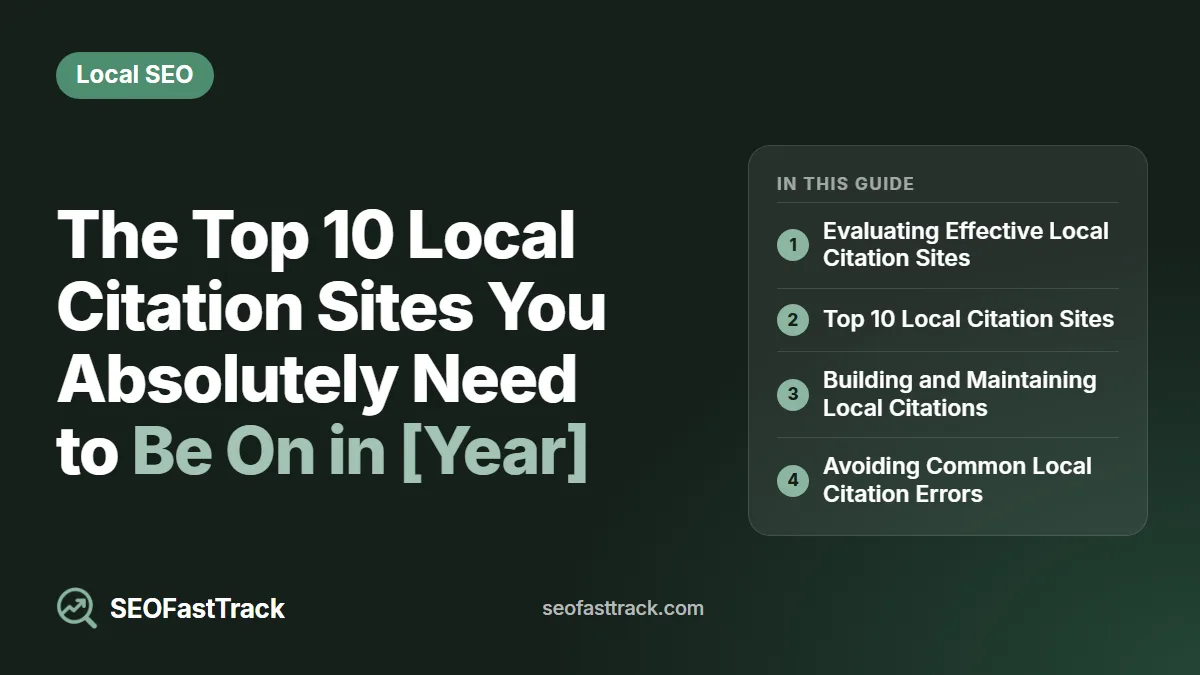
Welcome to SEOFastTrack, your one-stop destination for mastering search engine optimization! Are you ready to boost your local visibility and attract more customers? Then you've come to the right place. In today's hyper-competitive digital landscape, local citations are more crucial than ever. Dive in to discover the best local citation sites 2023 that can dramatically improve your search rankings and drive targeted traffic to your business. Curious which platforms made the cut and how they can impact your local SEO strategy? Let's get started!
- Top 10 Local Citation Sites for Enhanced Visibility
- Introduction: Why Local Citations Enhance Business Presence
- Evaluating Effective Local Citation Sites
-
Top 10 Local Citation Sites: A Detailed Overview
- 1. Google Business Profile: Your Local SEO Core
- 2. Yelp: Broad Audience Reach Through Reviews
- 3. Bing Places for Business: An Important Search Engine Listing
- 4. Facebook: Leveraging Social Media for Local Presence
- 5. Apple Maps: Essential for Reaching iPhone Users
- 6. Yellow Pages (YP.com): A Respected Directory
- 7. Foursquare: Connecting with Mobile Users
- 8. Better Business Bureau (BBB): Building Trust
- 9. Avvo: Connecting with Potential Legal Clients
- 10. Healthgrades: Connecting with Patients
- Building and Maintaining Local Citations: Best Practices
- Avoiding Common Local Citation Errors
- Measuring Local Citation Strategy Success
- Conclusion: Mastering Local Citations for Local SEO
-
Frequently Asked Questions
- What are local citation sites, and why are they important for my small business's SEO?
- How do I choose the best local citation sites for my business in 2023?
- What information should I include when submitting my business to local citation sites?
- How often should I update my local citations?
- What tools can help me manage and track my local citations effectively?
- Final Reflection: Amplifying Local Voices
- Claim Your Local Presence Now!
Top 10 Local Citation Sites for Enhanced Visibility
Introduction: Why Local Citations Enhance Business Presence
Understanding Local Citations and Their SEO Impact
Local citations are online mentions of your business's Name, Address, and Phone number (NAP). These citations appear on various online platforms, including business directories, social media sites, and review websites. Think of them as digital footprints that help search engines like Google and Bing verify your business's existence, location, and legitimacy.
In the realm of Search Engine Optimization (SEO), particularly for local businesses, citations play a crucial role in improving visibility within local search results. A strong citation profile signals to search engines that your business is a recognized entity within its geographic area and industry, which can lead to improved rankings in local search results pages (SERPs) and map listings.
The impact of local citations extends beyond simply listing your business details online. They are a fundamental component of local SEO because they contribute to building trust and authority. Search engines use citations to cross-reference information about businesses across the web.
The more consistent and accurate your business information is across reputable citation sites, the more confidence search engines have in the validity of your business. This increased confidence translates into better local search performance. For instance, a study by BrightLocal indicated that citation consistency is a top ranking factor for local pack results, highlighting their direct influence on local SEO success.
The Critical Role of Consistent NAP (Name, Address, Phone Number)
NAP consistency, which stands for Name, Address, and Phone number, is paramount in local citation management. It refers to ensuring that your business name, physical address, and phone number are exactly the same across all online citations. Inconsistencies, even minor variations like "St." versus "Street" or different phone number formats, can confuse search engines.
This confusion can dilute the positive SEO impact of your citations and potentially harm your local search ranking. Search engines interpret inconsistent NAP information as a lack of credibility or, in some cases, as multiple listings for the same business, which can negatively affect your search visibility.
Imagine a scenario where your business is listed on one directory as "Acme Plumbing" at "123 Main Street" and on another as "Acme Plumbing Services" at "123 Main St.". Search engines might interpret these as two separate entities, weakening the authority signals for your actual business. Maintaining consistent NAP details is not just about accuracy; it's about building a unified and trustworthy online presence that search engines can easily understand and rely on. Tools like Moz Local and Yext offer NAP consistency checks and management features, underscoring the industry's recognition of its importance.
Improving Local Search Ranking with Local Citations
Local citations directly contribute to improved local search rankings in several ways. Firstly, they broaden your business's online presence, making it easier for potential customers to find you through various online channels. Each citation acts as a vote of confidence in your business's legitimacy and relevance in your local area. Search engines aggregate these signals from numerous citation sources to determine the authority and ranking of local businesses. A robust citation profile, built on reputable and relevant sites, significantly enhances your chances of ranking higher in local search results, including the coveted local pack or map pack.
Secondly, citations often include links back to your website, although these are typically no-follow links, their primary value lies in the citation itself, not the direct link equity. However, these mentions of your website URL within citations can still indirectly boost your SEO. They increase brand visibility and can drive referral traffic as users discover your business through these directories.
Furthermore, many citation sites allow for business descriptions, keywords, and categories. Optimizing these elements within your citations, while maintaining NAP consistency, further reinforces your business's relevance to specific search queries and geographic locations, thereby contributing to improved local search rankings.
Evaluating Effective Local Citation Sites
Defining a High-Quality Local Citation Site
A high-quality local citation site is characterized by several key attributes that contribute to its effectiveness in boosting your local SEO efforts. Firstly, domain authority is a crucial factor. Sites with high domain authority, as measured by metrics like Moz's Domain Authority (DA) or Ahrefs' Domain Rating (DR), are generally considered more trustworthy by search engines. Citations from these sites carry more weight and are more likely to positively impact your rankings. For example, a citation from Yelp (DA 94) is likely to be more impactful than one from a lesser-known directory with a DA of 20.
Secondly, relevance is paramount. A high-quality citation site should be relevant to your industry and geographic location. General business directories are useful, but industry-specific directories can be even more effective. For instance, a restaurant should prioritize listings on restaurant-specific sites like OpenTable or TripAdvisor, in addition to general directories.
Similarly, geographically relevant directories, particularly those focused on your city or region, can be highly valuable. Finally, user traffic and engagement are indicators of a site's visibility and reach. Sites with substantial user traffic and active communities are more likely to be seen by potential customers, enhancing the direct marketing benefits of your citations beyond just SEO.
Key Factors in Selecting Citation Sites
When selecting local citation sites, businesses should consider several key factors to maximize the effectiveness of their citation strategy. Relevance to your industry and target audience is a primary consideration. Prioritize sites that are frequently used by your potential customers and are relevant to the products or services you offer. For example, a healthcare provider should focus on healthcare-specific directories like Healthgrades or Vitals, while a legal firm should prioritize legal directories like Avvo or FindLaw.
Geographic focus is another important factor. Target citation sites that are popular within your local area or region. City-specific directories, local business associations, and community websites can be highly effective in reaching local customers. Site quality and reputation are also crucial. Avoid low-quality, spammy directories.
Focus on reputable sites with established domain authority and a good user experience. Checking online reviews and ratings of citation sites can help assess their quality. Finally, ease of use and cost should be considered. Some citation sites are free, while others offer paid premium listings. Choose sites that are easy to navigate, update, and manage, and align with your budget and SEO goals.
Top 10 Local Citation Sites: A Detailed Overview
1. Google Business Profile: Your Local SEO Core
Google Business Profile (GBP), formerly Google My Business, is arguably the most crucial local citation and SEO tool for any business aiming to improve its local online presence. It's essentially your business listing on Google Search and Maps, allowing you to manage how your business information appears when people search for your business or related services in your area.
Optimizing your GBP profile is not just about creating a citation; it's about establishing your business's digital storefront on the world's most dominant search engine. A complete and optimized GBP profile significantly increases your chances of appearing in the local pack and local map results, which are prominently displayed for local search queries.
Beyond basic NAP information, GBP allows you to add a wealth of information, including business hours, website link, customer reviews, photos, posts, and Q&A sections. Actively managing and optimizing these features is essential for maximizing your local SEO impact. Encouraging and responding to customer reviews on your GBP profile is particularly important, as reviews are a major ranking factor in local search and build trust with potential customers.
In 2023, Google continues to prioritize GBP in local search algorithms, making it the cornerstone of any effective local citation strategy. Neglecting GBP is akin to ignoring the front door of your physical store in the digital world.
2. Yelp: Broad Audience Reach Through Reviews
Yelp is a powerful local citation site and review platform with a broad audience reach and a strong emphasis on customer reviews. With millions of users actively searching for local businesses and relying on reviews to make purchasing decisions, Yelp is an essential platform for businesses across various industries, particularly restaurants, retail, and service-based businesses. Creating and optimizing your Yelp business page ensures that your business is discoverable by Yelp's vast user base and allows you to manage your online reputation through review monitoring and response.
Yelp's strength lies in its robust review system, which is highly influential for consumers. Positive reviews on Yelp can significantly impact a business's reputation and attract new customers. Conversely, negative reviews, if not addressed properly, can deter potential customers.
Actively engaging with Yelp reviews, both positive and negative, demonstrates your commitment to customer service and can help mitigate the impact of negative feedback. In addition to reviews, Yelp allows businesses to list detailed information, including services, specialties, photos, and business hours, making it a comprehensive citation source and marketing platform. While managing Yelp reviews can be demanding, its potential reach and influence make it a critical component of a well-rounded local citation strategy.
3. Bing Places for Business: An Important Search Engine Listing
Bing Places for Business is Bing's equivalent to Google Business Profile, and while Bing's search engine market share is smaller than Google's, it still represents a significant audience, particularly for certain demographics. Claiming and optimizing your business listing on Bing Places for Business is a crucial step in ensuring comprehensive online visibility across major search engines. Just like GBP, Bing Places allows you to manage your business information, including NAP, website link, business hours, photos, and more, ensuring consistent branding and discoverability on Bing Search and Bing Maps.
While Google dominates search, Bing's user base is substantial and often overlaps with specific demographics, such as users of Microsoft products and older demographics. Ignoring Bing Places means missing out on potential customers who primarily use Bing for search. Furthermore, maintaining consistency across both Google and Bing listings strengthens your overall online presence and sends positive signals to all search engines.
Bing Places also offers features similar to GBP, including review management and business posts, allowing you to engage with Bing users and promote your business within the Bing ecosystem. In the context of local citations, Bing Places is a non-negotiable platform for comprehensive search engine coverage.
Facebook, primarily known as a social media platform, also serves as a valuable local citation site for businesses. Creating a Facebook Business Page provides a strong online presence and allows you to list essential business information, including NAP, website, hours, and services. While Facebook's primary function is social engagement, its business pages are indexed by search engines and contribute to your overall citation profile. Furthermore, Facebook's massive user base and local search capabilities make it a significant platform for local discovery and customer interaction.
Beyond basic citation information, Facebook Business Pages offer numerous marketing and engagement opportunities. You can share updates, run ads, interact with customers through messages and comments, and build a community around your brand. Facebook reviews and recommendations are also influential, contributing to your online reputation.
For many small businesses, Facebook is often the first point of online interaction for potential customers. Maintaining an active and informative Facebook Business Page is not only essential for social media marketing but also strengthens your local citation profile and enhances your overall online visibility. In 2023, Facebook's role in local search and discovery continues to grow, making it a vital citation platform.
5. Apple Maps: Essential for Reaching iPhone Users
Apple Maps is the default mapping application on iPhones and other Apple devices, representing a significant user base, particularly in affluent demographics. Ensuring your business is accurately listed on Apple Maps is crucial for reaching iPhone users who rely on Apple Maps for local search and navigation. While Apple Maps data is partly sourced from other providers, claiming and verifying your business listing through Apple Business Connect ensures accuracy and allows you to enhance your listing with additional information, such as photos and detailed business descriptions.
Apple Maps is deeply integrated into the Apple ecosystem, including Siri voice search. Users often use Siri to search for local businesses, and accurate listings on Apple Maps are essential for being found through voice search. Furthermore, Apple Maps is increasingly used in CarPlay, Apple's in-car infotainment system, making it a critical platform for reaching drivers and commuters.
While Apple Maps may not have the same market share as Google Maps globally, its dominance within the Apple ecosystem makes it a vital citation source, particularly for businesses targeting iPhone users. Ignoring Apple Maps means missing out on a significant segment of mobile and local search traffic.
6. Yellow Pages (YP.com): A Respected Directory
Yellow Pages (YP.com) is a legacy directory that has transitioned to the digital age while retaining its brand recognition and user base. Despite the decline of print directories, YP.com remains a respected online directory and citation source, particularly for older demographics and users who still rely on the Yellow Pages brand. Listing your business on YP.com ensures visibility on a well-established directory and can attract customers who specifically search within the Yellow Pages ecosystem.
YP.com offers both free and paid listings, with enhanced features available for paid subscribers. Even the free listing provides basic NAP information and business categories, contributing to your citation profile. While YP.com may not be as cutting-edge as newer platforms, its long-standing reputation and established user base make it a valuable citation source, especially for businesses targeting a broad demographic or those in traditional industries. In the context of local citations, YP.com provides a reliable and recognizable platform to enhance your online presence and reach a segment of users who may not be as active on newer digital platforms.
7. Foursquare: Connecting with Mobile Users
Foursquare is a location-based social networking and discovery app that serves as a valuable citation site, particularly for businesses targeting mobile users and those seeking local recommendations. While Foursquare's social networking aspect has evolved, its extensive database of business listings and user-generated reviews and tips make it a relevant platform for local discovery. Listing your business on Foursquare ensures visibility to Foursquare users who actively search for local places and rely on Foursquare's recommendations.
Foursquare is particularly popular among mobile users seeking recommendations for restaurants, bars, and entertainment venues. Its check-in feature and user-generated tips provide rich location-based content and enhance the user experience. For businesses in the hospitality and entertainment industries, Foursquare can be a particularly effective citation and marketing platform. While Foursquare's overall user base may be smaller than Yelp or Facebook, its focus on location-based discovery and mobile users makes it a valuable addition to a comprehensive local citation strategy, especially for businesses targeting a mobile-savvy audience.
8. Better Business Bureau (BBB): Building Trust
The Better Business Bureau (BBB) is a non-profit organization focused on promoting ethical business practices and consumer trust. Listing your business with the BBB, especially if you become BBB accredited, significantly enhances your credibility and builds trust with potential customers. While the BBB is not primarily a citation site in the traditional sense, a BBB listing serves as a strong endorsement of your business's legitimacy and commitment to ethical conduct. A BBB listing and accreditation can be a powerful trust signal, particularly for businesses in service-based industries and those targeting customers who prioritize trust and reliability.
The BBB website is a widely recognized platform for consumers to research businesses and check their ratings and reviews. A positive BBB rating and accreditation badge can instill confidence in potential customers and differentiate your business from competitors. While BBB accreditation involves a fee and requires adherence to BBB standards, the trust and credibility it provides can be a significant asset, particularly for businesses in industries where trust is paramount, such as home services, financial services, and healthcare. In the context of local citations, the BBB adds a layer of trust and authority that goes beyond basic NAP information.
9. Avvo: Connecting with Potential Legal Clients
Avvo is a leading online legal directory and marketplace connecting individuals with lawyers. For law firms and attorneys, Avvo is an essential citation site and marketing platform. Listing your practice on Avvo ensures visibility to potential clients searching for legal services in your area. Avvo profiles allow lawyers to showcase their experience, expertise, and client reviews, providing a comprehensive online presence for legal professionals. For law firms focused on local clients, Avvo is a highly targeted and effective platform for client acquisition and local SEO.
Avvo's strength lies in its niche focus on the legal industry and its large user base actively seeking legal services. Avvo's lawyer directory is highly ranked in search engine results for legal-related queries, making it a prime platform for reaching potential clients online. Avvo also offers features like lawyer ratings, client reviews, and Q&A forums, enhancing its value as a legal resource and marketing platform. For law firms, Avvo is not just a citation site; it's a critical component of their online marketing and client acquisition strategy.
10. Healthgrades: Connecting with Patients
Healthgrades is a leading online healthcare directory and marketplace connecting patients with doctors and healthcare providers. For doctors, dentists, hospitals, and other healthcare practices, Healthgrades is an essential citation site and patient acquisition platform. Listing your practice on Healthgrades ensures visibility to potential patients searching for healthcare services in your area. Healthgrades profiles allow healthcare providers to showcase their specialties, credentials, patient reviews, and hospital affiliations, providing a comprehensive online presence for healthcare professionals. For healthcare providers focused on local patients, Healthgrades is a highly targeted and effective platform for patient acquisition and local SEO.
Healthgrades' strength lies in its niche focus on the healthcare industry and its large user base actively seeking healthcare providers. Healthgrades' doctor directory is highly ranked in search engine results for healthcare-related queries, making it a prime platform for reaching potential patients online. Healthgrades also offers features like doctor ratings, patient reviews, appointment scheduling, and health condition information, enhancing its value as a healthcare resource and marketing platform. For healthcare practices, Healthgrades is not just a citation site; it's a critical component of their online marketing and patient acquisition strategy.
Building and Maintaining Local Citations: Best Practices
Claiming and Verifying Business Listings
Claiming and verifying your business listings on citation sites is the first crucial step in building a strong and accurate citation profile. Many citation sites automatically create business listings based on publicly available data, but these listings may be incomplete or inaccurate. Claiming your listing gives you control over the information displayed and allows you to add missing details, correct errors, and enhance your profile. Verification typically involves confirming your business's legitimacy through a phone call, postcard verification, or email verification, depending on the platform.
The claiming and verification process varies slightly across different citation sites, but generally involves searching for your business on the platform, creating an account (if necessary), and following the platform's verification steps. Prioritize claiming listings on the top citation sites mentioned earlier, starting with Google Business Profile, Bing Places for Business, Yelp, and Facebook. For industry-specific sites, focus on claiming listings that are most relevant to your business. Regularly check your listings on these platforms to ensure they remain claimed and verified, as listings can sometimes become unclaimed due to platform updates or changes in business ownership.
Ensuring NAP Consistency
Ensuring NAP (Name, Address, Phone Number) consistency across all your local citations is paramount for effective local SEO. This means using the exact same business name, address, and phone number format on every citation site. Create a standardized NAP format and use it consistently across all online platforms, including your website, social media profiles, and citation listings. Pay attention to minor details like abbreviations (e.g., "Street" vs. "St."), suite numbers, and phone number formats (e.g., with or without parentheses or dashes).
Use tools like Moz Local or Yext to scan your existing citations and identify any inconsistencies. These tools can help you pinpoint listings with incorrect NAP information and provide guidance on how to correct them. When creating new citations, double-check your NAP information before submitting it to ensure accuracy. Maintain a spreadsheet or document to keep track of your citations and your standardized NAP information for easy reference and future updates. Consistency is key; even minor variations can dilute the SEO benefits of your citations.
Regular Monitoring and Updating of Citations
Local citations are not a "set it and forget it" task. Regular monitoring and updating of your citations are essential to maintain accuracy, address errors, and ensure your listings remain effective over time. Business information can change – you might move locations, change phone numbers, update your business name, or adjust your service offerings. When such changes occur, it's crucial to update your citations across all platforms promptly to maintain consistency and accuracy.
Set a schedule for regular citation audits, perhaps monthly or quarterly, to check for any inaccuracies or outdated information. Use citation monitoring tools to help automate this process and alert you to any issues. Monitor customer reviews and feedback on citation sites and respond promptly to address concerns and engage with customers. Keep your business descriptions, photos, and other listing details up-to-date to reflect your current offerings and branding. Regularly updating your citations demonstrates to search engines that your business is active and well-maintained, which can positively impact your local search rankings.
Streamlining with Local Citation Management Tools
Managing local citations manually across numerous platforms can be time-consuming and complex. Local citation management tools are designed to streamline this process, saving time and ensuring accuracy and consistency. These tools typically offer features like citation creation, citation monitoring, NAP consistency checks, duplicate listing detection, and bulk updating capabilities. Using a citation management tool can significantly simplify the process of building and maintaining a strong citation profile.
Popular local citation management tools include Yext, Moz Local, BrightLocal, and Whitespark. These tools vary in features and pricing, so choose one that best suits your budget and needs. While these tools often come with a subscription fee, the time savings and efficiency they provide can be well worth the investment, especially for businesses with numerous locations or those actively expanding their local SEO efforts. Citation management tools not only simplify the initial citation building process but also facilitate ongoing monitoring and maintenance, ensuring your citation profile remains accurate and effective over time.
Avoiding Common Local Citation Errors
Inconsistent NAP Information
Inconsistent NAP (Name, Address, Phone Number) information is one of the most common and detrimental errors in local citation management. As previously emphasized, even minor variations in your business name, address, or phone number across different citation sites can confuse search engines and dilute the SEO benefits of your citations. Inconsistencies can also negatively impact user experience, as customers may become confused or distrustful if they find conflicting information about your business online.
Avoid using variations of your business name or address on different citation sites. Always use your standardized NAP format consistently. Double-check your listings for any inconsistencies and correct them promptly. If you've moved locations or changed your phone number in the past, conduct a thorough citation audit to ensure all your listings reflect your current information. Inconsistent NAP is a significant local SEO mistake that can be easily avoided with careful attention to detail and proactive citation management.
Identifying and Removing Duplicate Listings
Duplicate business listings occur when the same business is listed multiple times on the same citation site or across different platforms. Duplicate listings can create confusion for search engines and users, dilute your citation authority, and even trigger penalties from some platforms. Identifying and removing duplicate listings is crucial for maintaining a clean and effective citation profile.
Use citation audit tools or manually search for your business name on various citation sites to identify potential duplicate listings. Common causes of duplicates include variations in business name or address, listings created by third-party data providers, or accidental creation of multiple listings. Once you've identified duplicates, follow the platform's procedure for merging or removing them. This typically involves contacting the citation site's support team and providing proof of business ownership to request the removal of the duplicate listing. Regularly check for duplicate listings, especially after business information changes or when expanding your citation profile.
The Importance of Monitoring and Updating
Failing to monitor and update your local citations is another common mistake that can undermine your local SEO efforts. Business information can become outdated over time, citation sites can change their formats or policies, and errors can creep into your listings. Neglecting to monitor and update your citations can lead to inaccurate information being displayed online, which can negatively impact customer experience and SEO performance.
Implement a system for regular citation monitoring and updates, as discussed in the "Best Practices" section. Set reminders to check your listings periodically, review customer reviews and feedback, and update any outdated information promptly. Stay informed about changes to citation sites and adjust your listings accordingly. Proactive monitoring and updating ensure that your citations remain accurate, effective, and contribute positively to your local SEO strategy over the long term.
Measuring Local Citation Strategy Success
Tracking Local Search Rankings
Tracking your local search rankings is a primary way to measure the success of your local citation strategy. Improved rankings in local search results, particularly in the local pack and map listings, indicate that your citation efforts are contributing to increased visibility. Monitor your rankings for relevant keywords related to your business and your geographic area. Use SEO ranking tracking tools to automate this process and track your progress over time.
Before implementing your citation strategy, establish a baseline for your local search rankings. Then, track your rankings regularly after building and optimizing your citations. Look for improvements in your average ranking position, the number of keywords you rank for in the local pack, and your overall visibility in local search results. While citation building is just one factor influencing local rankings, significant improvements after implementing a citation strategy can be a strong indicator of its success.
Monitoring Website Traffic from Citations
Monitoring website traffic referred from citation sites provides another tangible measure of your citation strategy's effectiveness. Many citation sites include a link to your website in your business listing. Track referral traffic from these sites using website analytics tools like Google Analytics. This allows you to see how many users are clicking through from your citations to your website and engaging with your content.
Set up UTM parameters in your citation website links to accurately track referral traffic from specific citation sources. Analyze the traffic data to identify which citation sites are driving the most valuable traffic to your website. Monitor metrics like bounce rate, pages per session, and conversion rates for referral traffic from citation sites to assess the quality of traffic and the effectiveness of your citations in driving website engagement and potential customers.
Analyzing Customer Reviews and Feedback
Analyzing customer reviews and feedback on citation sites offers valuable insights into the impact of your citation strategy on customer perception and reputation. Positive reviews and high ratings on platforms like Google Business Profile, Yelp, and Facebook can significantly influence customer decisions and attract new business. Monitor your reviews regularly and track changes in your average ratings and the volume of reviews over time.
Respond to customer reviews, both positive and negative, to demonstrate your engagement and commitment to customer service. Use review sentiment analysis tools to gain insights into customer perceptions and identify areas for improvement. While reviews are not directly a measure of citation effectiveness in SEO terms, they are a crucial indicator of how your online presence, including your citations, impacts customer perception and ultimately drives business success. Positive reviews often correlate with improved local search performance, as reviews are a ranking factor.
Conclusion: Mastering Local Citations for Local SEO
Key Takeaways for Local Citation Management
Mastering local citations is a fundamental aspect of effective local SEO in 2023. The key takeaways for successful local citation management are centered around consistency, accuracy, and proactive management. NAP consistency is paramount – ensure your business name, address, and phone number are identical across all citation sites. Choose high-quality and relevant citation sites, prioritizing platforms like Google Business Profile, Yelp, Bing Places for Business, and industry-specific directories. Claim and verify your listings to take control of your online presence and enhance your profiles with rich business information.
Regularly monitor and update your citations to maintain accuracy and address errors. Utilize citation management tools to streamline the process and save time. Avoid common errors like inconsistent NAP and duplicate listings. Finally, measure the success of your citation strategy by tracking local search rankings, website referral traffic, and customer reviews. By adhering to these best practices, businesses can leverage local citations to significantly enhance their local online visibility, improve search rankings, and attract more local customers.
The Evolution of Local Citations and SEO
The landscape of local citations and SEO is constantly evolving, driven by changes in search engine algorithms, user behavior, and technological advancements. While the fundamental principles of NAP consistency and citation relevance remain crucial, the specific tactics and platforms may shift over time. Mobile-first indexing and voice search are increasingly influencing local search, making accurate listings on mobile-friendly platforms and voice search-compatible directories like Apple Maps even more important.
The rise of hyperlocal search and the increasing importance of proximity in local rankings emphasize the need for geographically relevant citations and localized content. Structured data markup for local businesses is becoming more prevalent, enhancing the way search engines understand and display local business information. Staying informed about these evolving trends and adapting your local citation strategy accordingly is crucial for maintaining a competitive edge in local search. While the core principles of local citations endure, continuous learning and adaptation are essential for long-term success in local SEO.
Frequently Asked Questions
What are local citation sites, and why are they important for my small business's SEO?
Local citation sites are online directories and platforms that list your business name, address, and phone number (NAP). They're vital for SEO because they help search engines verify your business's existence and improve your local search ranking.
How do I choose the best local citation sites for my business in 2023?
Focus on high-authority sites that are relevant to your industry and geographic area. Look for sites with a strong reputation and a large user base, as they can drive more referral traffic.
What information should I include when submitting my business to local citation sites?
Ensure your NAP information is consistent across all citations. Include a detailed business description, website URL, business hours, and relevant categories to help customers find and understand your core offerings.
How often should I update my local citations?
Regularly update your citations, especially if your business information changes. Monitor your listings for accuracy and consistency to maintain a positive online presence and avoid confusing potential customers.
What tools can help me manage and track my local citations effectively?
Several SEO tools can help you find, manage, and track your local citations. These tools often automate the submission process and provide insights into your citation performance.
Final Reflection: Amplifying Local Voices
The proliferation of online information has made it more crucial than ever for local businesses to establish a strong digital presence, and local citations remain a cornerstone of that strategy. This list of the top 10 citation sites for 2023 isn't just about rankings; it's about ensuring that valuable local businesses are discoverable and thriving in an increasingly competitive digital landscape.
The impact of these citation sites extends far beyond mere SEO benefits. They are vital threads in the fabric of local communities, connecting customers with the unique offerings and personalized service that only local businesses can provide. In the digital age, local citations are the new word-of-mouth, amplifying the voices of businesses that contribute so much to our neighborhoods.
This ongoing influence shapes how we discover and interact with the places around us, fostering a sense of community and supporting economic growth at the grassroots level.
As you navigate the ever-evolving digital world, remember the power you hold to support and uplift the businesses that make your community unique. Take a moment to consider the local gems in your own neighborhood and ensure they are visible and accessible online. By actively engaging with and promoting these businesses, you contribute to a vibrant and thriving local economy, ensuring that the heart of your community continues to beat strong for years to come.
Claim Your Local Presence Now!
Thanks for reading about the crucial local citation sites that can boost your online visibility! You've learned where to list your business to reach more local customers. Now it's time to put that knowledge into action and make your business stand out.
Here's what you can do right now:
- Prioritize claiming and optimizing your profiles on the top three citation sites discussed. This is your fast track to better local SEO!
- Explore a citation site you haven't considered and see if you can enhance your online authority.
- Share this list with a fellow business owner so they can benefit from enhanced local discoverability!
What's the first local citation site you're going to optimize today to attract more customers? Share your plan in the comments below!