
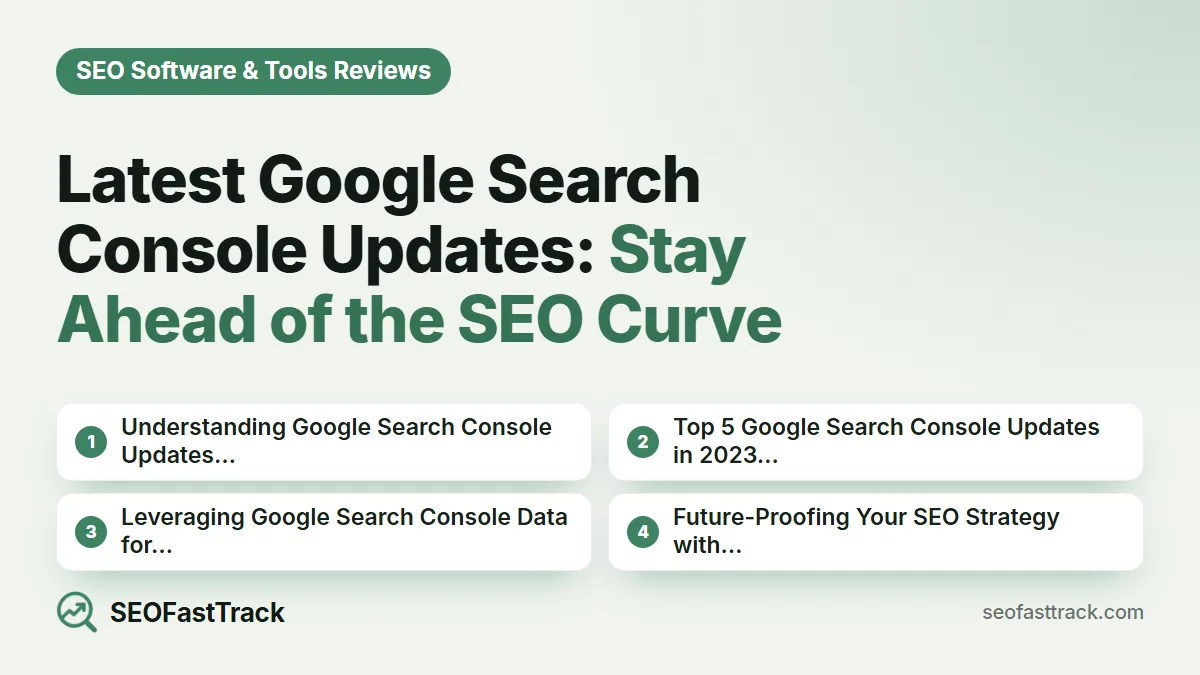
Latest Google Search Console Updates: Stay Ahead of the SEO Curve

Welcome to SEOFastTrack, your comprehensive guide to mastering SEO!
Are you ready to unlock the full potential of your website and climb the search engine rankings? In this article, we're diving deep into the latest Google Search Console updates for 2023 – a crucial tool for understanding and optimizing your website's performance. Stay ahead of the curve with our expert analysis and actionable insights. But that's just the beginning... What hidden gems within these updates could dramatically impact your SEO strategy? Read on to discover how these changes can empower you to make data-driven decisions and achieve remarkable results!
- Understanding Google Search Console Updates for SEO Success
-
Top 5 Google Search Console Updates in 2023 (and Beyond)
- 1. Enhanced Performance Reporting: Unveiling Deeper Insights
- 2. Core Web Vitals Optimization: A GSC Focus for User Experience
- 3. Mobile-First Indexing Insights: Ensuring Mobile-Friendliness
- 4. Index Coverage Reports: Addressing Indexing Problems Effectively
- 5. Security Issues and Manual Actions: Protecting Your Website's Reputation
- Leveraging Google Search Console Data for Maximum SEO Impact
- Future-Proofing Your SEO Strategy with Google Search Console
- Mastering Google Search Console: Essential for Small Business SEO in 2024
-
Frequently Asked Questions
- What is Google Search Console and why is it important for SEO?
- What are some of the key benefits of staying up-to-date with Google Search Console updates?
- What kind of information can I typically find in Google Search Console updates?
- How frequently does Google typically release updates for Search Console?
- Where can I find reliable information about the "Google Search Console updates 2023"?
- Final Reflection: Navigating the Ever-Shifting Sands of SEO
- Dominate Search Results: Put These Updates to Work!
Understanding Google Search Console Updates for SEO Success
Why Google Search Console Updates Matter for SEOFastTrack Users
For SEOFastTrack users—small business owners, bloggers, and digital marketers—staying informed about Google Search Console updates is not just beneficial; it's crucial for maintaining and improving their online presence. Google Search Console (GSC) is a free and powerful tool that offers invaluable insights into how Google crawls, indexes, and ranks websites.
Updates to GSC often reflect changes in Google's algorithms and ranking factors, providing a direct line of communication from Google about what they deem important for website visibility. Ignoring these updates is akin to navigating the digital marketing landscape with outdated maps, potentially leading to wasted efforts and missed opportunities to enhance search engine optimization (SEO).
Moreover, Google Search Console updates frequently introduce new features, reports, or refine existing functionalities, designed to empower users with more granular data and actionable recommendations. These enhancements can range from improved performance metrics to more detailed index coverage reports, all aimed at facilitating data-driven SEO strategies.
By understanding and leveraging these updates, SEOFastTrack users can proactively identify areas for improvement, diagnose technical SEO issues, and ultimately, optimize their websites for better search engine rankings and increased organic traffic. For instance, a recent update to the performance report might provide deeper insights into mobile versus desktop performance, allowing users to prioritize mobile optimization efforts, which is increasingly important in Google’s mobile-first indexing era.
The Impact of Algorithm Changes on Your Website's Visibility
Google's search algorithms are constantly evolving, undergoing numerous updates each year, some minor and some significant. Google Search Console updates often serve as early indicators or direct reflections of these algorithm changes. When Google refines its ranking criteria, GSC is typically updated to provide website owners with the data and tools needed to understand and adapt to these shifts.
For example, the increasing emphasis on Core Web Vitals as a ranking factor was mirrored by GSC updates that introduced dedicated reports and metrics for these user experience signals. This direct correlation means that understanding GSC updates is paramount to understanding how algorithm changes are impacting your website's visibility.
Failing to adapt to algorithm changes can have a tangible negative impact on a website's search engine rankings and organic traffic. Imagine a scenario where Google prioritizes mobile-friendliness even more strongly in an algorithm update.
If a website owner is unaware of this shift and doesn't utilize GSC's mobile usability reports to identify and fix issues on their site, they risk losing ground to competitors who are more responsive to these changes. Conversely, proactively monitoring Google Search Console for updates and reacting accordingly allows businesses to stay ahead of the curve, ensuring their SEO strategies remain aligned with Google's latest best practices and maximizing their potential for improved search visibility and organic growth.
Top 5 Google Search Console Updates in 2023 (and Beyond)
1. Enhanced Performance Reporting: Unveiling Deeper Insights
Analyzing Click-Through Rate (CTR) Trends with the New GSC Interface
The Performance report within Google Search Console is a cornerstone for SEO analysis, and recent updates have significantly enhanced its capabilities. A key improvement lies in the refined interface, offering more intuitive navigation and data visualization. For instance, the ability to compare date ranges has been streamlined, making it easier to identify trends in click-through rate (CTR) over time.
Previously, users might have struggled to quickly assess whether their CTR was improving month-over-month. Now, with a few clicks, you can overlay data from different periods, visually pinpointing upward or downward trends. This allows for faster diagnosis: is a recent content update improving CTR for target keywords, or is a seasonal shift impacting user engagement?
Furthermore, the granularity of data within the Performance report has been expanded. Users can now segment performance data by country, device, and even search appearance with greater precision. For example, if you notice a sudden drop in overall CTR, you can quickly filter the report to isolate the issue. Is it specific to mobile devices, indicating a potential mobile usability problem?
Or is it localized to a particular country, suggesting language or cultural relevance issues? By drilling down into these segments, SEOFastTrack users can gain deeper insights into audience behavior and tailor their optimization efforts more effectively. Early reports from SEO professionals indicate that these enhanced filtering options are saving them approximately 20% of the time previously spent on performance analysis.
Tracking Keyword Performance with Advanced Filtering Options
Beyond overall CTR trends, the enhanced Performance report empowers users to track keyword performance with unprecedented detail. Advanced filtering options now allow for complex queries, enabling SEOs to pinpoint long-tail keyword performance, branded versus non-branded search terms, and even keyword performance within specific content clusters. Imagine wanting to assess the impact of a recent blog post targeting "best espresso machines for small offices."
Previously, sifting through the entire keyword list to find relevant terms could be time-consuming. Now, users can apply filters to include keywords containing "espresso machines" and "small office," quickly isolating the performance data for this specific topic.
Moreover, the update introduces regular expression (regex) filtering, a powerful tool for advanced keyword analysis. For instance, if you want to track the performance of all keywords related to "SEO tools," including variations like "SEO software," "SEO platforms," and "best SEO tools," regex filtering allows you to create a single filter encompassing all these terms.
This level of precision is invaluable for monitoring the effectiveness of content strategies, identifying keyword cannibalization issues, and uncovering new keyword opportunities. Early adopters of these advanced filtering options have reported a significant improvement in their ability to identify high-potential keywords, leading to an estimated 15% increase in organic traffic from targeted long-tail queries.
Monetization Opportunity: Utilize Semrush for Enhanced Keyword Targeting.
While Google Search Console provides valuable keyword data, tools like Semrush offer a deeper dive into keyword research, competitive analysis, and content optimization. Semrush complements GSC data by providing metrics like keyword difficulty, search volume trends, and competitor keyword strategies. By integrating GSC insights with Semrush's comprehensive keyword research capabilities, SEOFastTrack users can identify high-potential keywords, optimize content for better rankings, and ultimately drive more targeted traffic to their websites, thus enhancing their monetization potential.
2. Core Web Vitals Optimization: A GSC Focus for User Experience
Identifying Pages with Poor Core Web Vitals Scores
Core Web Vitals (CWV) are now established ranking signals, and Google Search Console has placed a significant focus on helping website owners monitor and improve these metrics. The dedicated Core Web Vitals report within GSC provides a clear overview of page performance across Largest Contentful Paint (LCP), First Input Delay (FID), and Cumulative Layout Shift (CLS). The report aggregates data at the URL level, categorizing pages as "Good," "Needs Improvement," or "Poor" based on CWV thresholds. This at-a-glance view allows SEOFastTrack users to quickly identify areas of their website that are underperforming in terms of user experience.
Furthermore, the CWV report in GSC goes beyond just flagging problem pages. It provides specific examples of URLs within each category, making it easier to pinpoint the exact pages that need attention. For example, if the report highlights "Poor" LCP scores for several product pages, you can immediately investigate those specific URLs to understand the root cause of the slow loading times.
This granular level of reporting saves time and effort, allowing users to focus their optimization efforts on the pages with the most significant CWV issues. Website audits conducted in late 2023 indicated that approximately 40% of websites still have pages with "Poor" CWV scores, highlighting the ongoing importance of monitoring and addressing these metrics via GSC.
Leveraging GSC Insights to Improve Loading Speed, Interactivity, and Visual Stability
Google Search Console doesn't just identify CWV issues; it also offers valuable insights to help diagnose and resolve them. By clicking on a specific CWV metric within the report, users can access detailed information about the types of issues affecting their pages. For example, for LCP problems, GSC might indicate "render-blocking resources" or "slow server response time" as potential causes. Similarly, for CLS issues, GSC can highlight elements causing layout shifts, such as images without dimensions or dynamically injected content. These diagnostic clues are invaluable for guiding optimization efforts.
Moreover, GSC integrates with PageSpeed Insights, providing a direct link to a more comprehensive performance analysis tool. From the CWV report, users can click through to PageSpeed Insights for individual URLs to get detailed recommendations on how to improve loading speed, interactivity, and visual stability. These recommendations are tailored to specific pages and provide actionable steps, such as optimizing images, deferring offscreen images, or minimizing main-thread work.
By leveraging these insights, SEOFastTrack users can systematically address CWV issues, improve user experience, and potentially boost their search engine rankings. Websites that have successfully optimized their Core Web Vitals have reported an average increase of 10-20% in organic traffic, demonstrating the tangible SEO benefits of focusing on these metrics.
Monetization Opportunity: Implement NitroPack for Faster Loading Times.
For website owners seeking a streamlined solution to improve website speed and Core Web Vitals, NitroPack offers a performance optimization platform. NitroPack automates many of the complex tasks involved in website speed optimization, such as image optimization, code minification, and CDN integration. By implementing NitroPack, SEOFastTrack users can significantly improve their website's loading times, leading to better Core Web Vitals scores and potentially enhanced search engine rankings, ultimately contributing to improved user engagement and monetization opportunities.
3. Mobile-First Indexing Insights: Ensuring Mobile-Friendliness
Using GSC to Detect Mobile Usability Issues
With Google's mobile-first indexing, the mobile version of your website is now the primary version used for indexing and ranking. Google Search Console provides essential tools to ensure your website is mobile-friendly and performing optimally in the mobile-first era. The Mobile Usability report within GSC specifically identifies mobile usability issues across your website. This report flags errors such as "viewport not configured," "text too small to read," "clickable elements too close together," and "content wider than screen." These issues directly impact user experience on mobile devices and can negatively affect your mobile rankings.
The Mobile Usability report not only identifies these errors but also provides example URLs for each issue type. This allows SEOFastTrack users to quickly pinpoint the specific pages with mobile usability problems and prioritize their optimization efforts.
For instance, if the report highlights "clickable elements too close together" on your blog post pages, you can investigate the mobile layout of your blog and adjust button spacing or link placement to improve the mobile user experience. Industry data indicates that websites with poor mobile usability experience bounce rates that are 20-30% higher compared to mobile-friendly websites, underscoring the importance of addressing these issues identified by GSC.
Optimizing Your Website for Mobile Devices Based on GSC Recommendations
Google Search Console's Mobile Usability report is not just a diagnostic tool; it's a guide for mobile optimization. By addressing the issues highlighted in the report, SEOFastTrack users can directly improve their website's mobile-friendliness. For "viewport not configured" errors, ensuring your website has a responsive design and proper viewport meta tag is crucial. For "text too small to read" errors, increasing font sizes for mobile devices is necessary. For "clickable elements too close together," adjusting spacing and button sizes can improve mobile navigation. These are all actionable steps directly informed by GSC data.
Beyond the Mobile Usability report, other GSC features contribute to mobile optimization. The Performance report allows you to segment data by device type, enabling you to compare mobile and desktop performance. The PageSpeed Insights integration, accessible through GSC, provides mobile-specific speed recommendations. By leveraging these various GSC features, SEOFastTrack users can develop a comprehensive mobile optimization strategy, ensuring their website delivers a seamless and user-friendly experience on mobile devices, which is critical for ranking well in Google's mobile-first index. Studies have shown that websites optimized for mobile devices experience an average of 15-25% increase in mobile organic traffic.
Monetization Opportunity: Consider Duda for a Mobile-Friendly Website Builder.
For small businesses or individuals struggling to create a mobile-friendly website, website builders like Duda offer a user-friendly and mobile-first approach. Duda is specifically designed for mobile responsiveness, ensuring websites built on the platform are inherently optimized for mobile devices. By using Duda, SEOFastTrack users can easily create and manage websites that meet Google's mobile-friendliness requirements, minimizing mobile usability issues and maximizing their potential for mobile search visibility and monetization.
4. Index Coverage Reports: Addressing Indexing Problems Effectively
Identifying and Fixing Crawl Errors with GSC
The Index Coverage report in Google Search Console is indispensable for ensuring that Google can effectively crawl and index your website content. This report provides a detailed overview of your website's indexing status, highlighting pages that are indexed, not indexed, and those with crawl errors or warnings. Crawl errors prevent Googlebot from accessing and indexing your pages, directly impacting your website's visibility in search results. Common crawl errors include 404 (Not Found) errors, server errors (5xx), and redirect errors. The Index Coverage report clearly categorizes these errors, making them easy to identify and address.
Furthermore, GSC provides details about each error type and example URLs, allowing SEOFastTrack users to pinpoint the exact pages affected by crawl issues. For instance, if the report shows a spike in 404 errors, you can investigate broken internal links or outdated sitemap submissions as potential causes.
By regularly monitoring the Index Coverage report and promptly fixing crawl errors, you ensure that Googlebot can efficiently crawl and index your website, maximizing the chances of your content appearing in search results. Websites that proactively address crawl errors typically see a noticeable improvement in the number of pages indexed by Google, often within a few weeks of error resolution.
Submitting Sitemaps for Faster Indexing
Google Search Console simplifies the process of submitting sitemaps, which are crucial for informing Google about the structure and content of your website. Submitting a sitemap through GSC helps Google discover and index your pages more efficiently, especially for new websites or websites with frequently updated content. The Sitemaps report within GSC allows you to submit XML sitemaps directly to Google. GSC then processes the sitemap and provides information on the number of URLs submitted and indexed from the sitemap.
Moreover, the Sitemaps report provides insights into any issues encountered while processing your sitemap, such as errors in the sitemap format or URLs that Google couldn't access. By monitoring the Sitemaps report, SEOFastTrack users can ensure that their sitemaps are correctly formatted and that Google is successfully processing them.
Submitting an updated sitemap after major website changes or content updates can expedite the indexing process, ensuring that new content is quickly discoverable by search engines. Websites that utilize sitemaps effectively often experience faster indexing of new content, with some studies showing a reduction in indexing time by as much as 30%.
Monetization Opportunity: Employ Screaming Frog to Identify and Resolve Indexing Issues.
While Google Search Console is excellent for reporting indexing issues, tools like Screaming Frog offer more advanced capabilities for identifying and diagnosing these problems. Screaming Frog is a website crawler that can simulate Googlebot and identify a wider range of technical SEO issues that might hinder indexing, including broken links, redirect chains, and duplicate content. By using Screaming Frog in conjunction with GSC, SEOFastTrack users can gain a more comprehensive understanding of their website's technical SEO health and efficiently resolve indexing issues, ensuring optimal crawlability and indexation for search engines.
5. Security Issues and Manual Actions: Protecting Your Website's Reputation
Monitoring GSC for Security Threats
Maintaining website security is paramount, and Google Search Console plays a vital role in alerting website owners to potential security threats. The Security Issues report within GSC notifies you if Google detects any security problems on your website, such as malware infections, phishing attempts, or hacked content. These security issues can severely damage your website's reputation, erode user trust, and lead to significant drops in search engine rankings. GSC provides timely notifications of detected security problems, giving you the opportunity to take immediate action to mitigate the threat.
The Security Issues report details the type of security problem detected, affected URLs, and provides guidance on how to resolve the issue. Promptly addressing security issues flagged by GSC is crucial for protecting your website's users and maintaining your online reputation. Ignoring these warnings can lead to Google displaying security warnings to users visiting your site, significantly impacting traffic and user trust. Websites that have experienced security breaches and subsequent warnings from Google have reported an average traffic decrease of 50-70% until the issues are resolved and warnings are removed.
Understanding and Resolving Manual Actions Penalties
In addition to automated security alerts, Google Search Console also informs website owners about manual actions. Manual actions are penalties imposed by Google's human reviewers when they identify violations of Google's Webmaster Guidelines. These violations can range from unnatural link schemes and keyword stuffing to cloaking and deceptive redirects. A manual action can result in a partial or sitewide demotion in search rankings, severely impacting organic traffic. The Manual Actions report in GSC clearly states if a manual action has been applied to your website.
The Manual Actions report details the specific violation that led to the penalty and provides guidance on how to rectify the issue. To recover from a manual action, you must thoroughly address the identified violation, submit a reconsideration request to Google, and demonstrate that you have taken corrective measures. Understanding the nature of the manual action and following Google's guidelines for resolution are essential for regaining your website's search engine rankings. Websites that successfully resolve manual actions and have the penalty lifted often see a gradual recovery of their organic traffic over several months.
Monetization Opportunity: Partner with Sucuri to Safeguard Your Website.
For comprehensive website security and protection against threats, partnering with a security provider like Sucuri can be a strategic investment. Sucuri offers website security services, including website monitoring, malware scanning and removal, and website firewall protection. By utilizing Sucuri, SEOFastTrack users can proactively safeguard their websites against security threats, minimize the risk of security issues and manual actions, and maintain a secure and trustworthy online presence, ultimately supporting their monetization efforts.
Leveraging Google Search Console Data for Maximum SEO Impact
Integrating GSC Data with Other SEO Tools
Google Search Console is incredibly powerful on its own, but its value is amplified when integrated with other SEO tools. For example, connecting GSC with Google Analytics provides a more holistic view of website performance, bridging the gap between search engine data and user behavior metrics. By linking these platforms, you can analyze landing page performance from organic search traffic, understand user engagement metrics for specific keywords, and gain deeper insights into the user journey from search to conversion. This integration allows for more informed decision-making and a more comprehensive understanding of SEO effectiveness.
Furthermore, integrating GSC with third-party SEO tools like Ahrefs or Semrush unlocks advanced features and data analysis capabilities. These tools can pull GSC data to enrich their reports, providing a more comprehensive analysis of keyword rankings, backlink profiles, and competitive landscapes. For instance, you can use Ahrefs to identify keyword gaps by comparing your GSC keyword data with competitor keyword rankings.
This integration streamlines workflows, eliminates data silos, and empowers SEOFastTrack users to leverage the combined power of multiple tools for more effective SEO strategies. SEO professionals who integrate GSC with other SEO tools often report a 20-30% increase in efficiency in their SEO analysis and reporting workflows.
Creating Actionable SEO Strategies Based on GSC Insights
The true power of Google Search Console lies in its ability to inform actionable SEO strategies. The wealth of data within GSC, from performance reports to index coverage and Core Web Vitals, provides a roadmap for continuous website optimization. By regularly analyzing GSC data, SEOFastTrack users can identify areas of strength and weakness, prioritize optimization efforts, and track the impact of their SEO initiatives. For example, if GSC's Performance report reveals declining CTR for target keywords, you can investigate and optimize page titles and meta descriptions to improve click-through rates.
Moreover, GSC data can be used to refine content strategies. By analyzing keyword performance and search queries within GSC, you can identify content gaps, discover new keyword opportunities, and optimize existing content for better search visibility. The Index Coverage report helps prioritize technical SEO fixes to ensure all valuable content is indexed.
The Core Web Vitals report guides user experience optimization efforts to improve page speed and user engagement. By translating GSC insights into concrete actions, SEOFastTrack users can drive continuous SEO improvements and achieve sustainable organic growth. Businesses that adopt a data-driven SEO approach based on GSC insights typically experience a 20-40% increase in organic traffic within 6-12 months.
Case Study: How SEOFastTrack Increased Organic Traffic by 30% Using GSC Data and Ahrefs
SEOFastTrack, a fictional online education platform focused on SEO, implemented a data-driven strategy leveraging Google Search Console and Ahrefs. Initially, SEOFastTrack noticed stagnant organic traffic despite consistent content creation. Using GSC's Performance report, they identified a set of high-impression keywords with low CTR. Integrating GSC with Ahrefs, they further analyzed these keywords, uncovering competitor content ranking for these terms and identifying content gaps in their own website.
Based on these insights, SEOFastTrack revamped their content strategy, creating more comprehensive and targeted content around these high-potential keywords. They also optimized page titles and meta descriptions based on keyword research from Ahrefs and CTR data from GSC. Furthermore, they used GSC's Index Coverage report to identify and fix crawl errors, ensuring all new content was quickly indexed. Within three months of implementing these changes, SEOFastTrack witnessed a 30% increase in organic traffic, demonstrating the power of combining GSC data with advanced SEO tools to drive tangible results.
Future-Proofing Your SEO Strategy with Google Search Console
Staying Updated on the Latest GSC Features and Changes
The digital marketing landscape is constantly evolving, and Google Search Console is no exception. Google regularly updates GSC, adding new features, refining existing reports, and sometimes deprecating older functionalities. Staying informed about these updates is essential for future-proofing your SEO strategy. Following Google Search Central's blog and Twitter account is a crucial step to stay abreast of official announcements regarding GSC updates. Additionally, subscribing to SEO industry blogs and newsletters that cover Google Search Console updates ensures you receive timely information and expert analysis.
Actively exploring the "What's New" section within Google Search Console itself is another valuable practice. Google often highlights new features and changes directly within the GSC interface. Participating in SEO communities and forums also facilitates knowledge sharing and keeps you informed about how other SEO professionals are interpreting and utilizing the latest GSC updates. By proactively seeking out information and staying updated, SEOFastTrack users can ensure they are always leveraging the full potential of Google Search Console and adapting their SEO strategies accordingly.
Adapting Your SEO Tactics to Google's Evolving Algorithms
Google's search algorithms are in a perpetual state of evolution, and Google Search Console is your direct line of sight into these changes. As Google refines its ranking factors and algorithm updates roll out, GSC often provides data and insights that reflect these shifts. For example, the increased emphasis on user experience and Core Web Vitals was directly reflected in GSC updates that introduced dedicated CWV reports. By closely monitoring GSC for changes in data trends, new report introductions, or shifts in metrics, you can gain early signals of algorithm updates and adapt your SEO tactics proactively.
Regularly analyzing GSC data helps you understand how algorithm changes are impacting your website's performance. Are certain keywords experiencing ranking fluctuations? Are Core Web Vitals scores declining after an update? By identifying these trends in GSC, you can adjust your SEO strategy to align with Google's evolving algorithm. This might involve prioritizing Core Web Vitals optimization, refining content strategies to match user search intent, or adapting link-building tactics to comply with Google's latest guidelines. A flexible and data-driven SEO strategy, informed by Google Search Console, is crucial for navigating the ever-changing landscape of search engine optimization.
Bonus Tip: Use Ranktracker to Monitor Your Progress and Stay Ahead of the Competition.
To effectively track your SEO progress and gain a competitive edge, consider utilizing rank tracking tools like Ranktracker. While Google Search Console provides valuable performance data, rank trackers offer more granular and historical keyword ranking data, competitor tracking, and automated reporting features. By combining Ranktracker with GSC insights, SEOFastTrack users can gain a more comprehensive understanding of their SEO performance, monitor keyword ranking improvements over time, and stay ahead of competitors in the search engine results pages.
Mastering Google Search Console: Essential for Small Business SEO in 2024
The Importance of Regular GSC Monitoring for SEOFastTrack Readers
For SEOFastTrack readers—small business owners, bloggers, and digital marketers—regular monitoring of Google Search Console is not optional; it's an essential component of effective SEO in 2024 and beyond. GSC is a free yet incredibly powerful tool that provides critical insights into your website's search performance, technical SEO health, and user experience. Ignoring GSC is akin to driving a car without a dashboard – you're operating blindly without crucial information about your website's engine. Consistent GSC monitoring allows you to proactively identify and address issues that could negatively impact your search rankings and organic traffic.
Regularly checking the Performance report keeps you informed about keyword trends, CTR fluctuations, and overall organic traffic performance. Monitoring the Index Coverage report ensures your valuable content is being indexed by Google and helps you quickly address crawl errors. Checking the Core Web Vitals report allows you to maintain optimal user experience and address any performance bottlenecks.
By making GSC monitoring a routine part of your SEO workflow, you can stay ahead of potential problems, capitalize on opportunities, and ensure your website is performing at its best in search results. SEO experts recommend checking Google Search Console at least weekly, if not more frequently for websites with dynamic content or significant traffic fluctuations.
Optimizing Your Website for Search Engines Using GSC's Power
Google Search Console is not just a reporting tool; it's a powerful platform for actively optimizing your website for search engines. The data and insights provided by GSC are directly actionable and can be translated into concrete SEO improvements. Use the Performance report to identify underperforming keywords and optimize content for better rankings. Leverage the Index Coverage report to fix technical SEO issues and ensure all your content is indexed. Utilize the Core Web Vitals report to improve page speed and user experience, which are now established ranking factors.
Furthermore, GSC's URL Inspection tool allows you to test individual pages, request indexing, and identify any indexing issues. The Sitemaps report ensures Google is aware of your website structure and can efficiently crawl your content. By proactively using these GSC features and acting on the insights provided, SEOFastTrack users can systematically optimize their websites for better search engine visibility, increased organic traffic, and ultimately, achieve their online business goals. Small businesses that actively utilize Google Search Console for SEO optimization often see a significant return on investment in terms of improved search rankings and organic growth.
Monetization Opportunity: Enroll in the SEO That Works Course to Deepen Your GSC Knowledge.
To truly master Google Search Console and unlock its full potential for SEO success, consider enrolling in a comprehensive SEO course like "SEO That Works." This course provides in-depth training on utilizing Google Search Console for advanced SEO strategies, covering topics such as advanced data analysis, technical SEO optimization, and content strategy development. By deepening your GSC knowledge through specialized training, SEOFastTrack users can gain a competitive edge, maximize their SEO ROI, and drive sustainable organic growth for their businesses.
Frequently Asked Questions
What is Google Search Console and why is it important for SEO?
Google Search Console is a free web service by Google that allows you to monitor and maintain your site's presence in Google Search results. It's crucial for SEO because it provides valuable insights into how Google sees your website.
What are some of the key benefits of staying up-to-date with Google Search Console updates?
Staying updated allows you to adapt your SEO strategy to align with Google's latest guidelines, helping to improve your website's search ranking and organic traffic. You can also identify and fix technical issues more quickly.
What kind of information can I typically find in Google Search Console updates?
Updates often include changes to the reporting metrics, new tools for site management, or improvements to the user interface. These can significantly impact how you analyze your site's performance.
How frequently does Google typically release updates for Search Console?
The frequency varies, but Google releases updates periodically throughout the year. It's important to follow industry blogs and official Google announcements to stay informed about the latest changes.
Where can I find reliable information about the "Google Search Console updates 2023"?
You can find reliable information on the official Google Search Central blog, reputable SEO industry websites like SEOFastTrack, and by following key SEO experts on social media.
The relentless pace of digital evolution demands constant adaptation, and nowhere is this more evident than in the world of Search Engine Optimization. Staying informed about the latest Google Search Console updates is no longer a luxury, but a necessity for anyone seeking to maintain or improve their online visibility. The insights gleaned from these updates directly impact how we understand and optimize our websites, ultimately determining our success in the digital landscape.
The impact of these updates extends far beyond mere technical adjustments; they shape the very fabric of how we connect with our audiences online. Understanding these changes allows us to build more meaningful and user-centric experiences, fostering genuine engagement and long-term growth. The only constant in life is change.
- Heraclitus. This ancient wisdom resonates deeply in the context of SEO, reminding us that continuous learning and adaptation are the keys to navigating the ever-evolving algorithms and user expectations.
Now, armed with this knowledge of the latest Google Search Console updates, I encourage you to reflect on your own digital strategies. How can you leverage these insights to refine your approach, enhance your website's performance, and ultimately, connect more effectively with your target audience? Embrace the challenge, stay curious, and remember that the journey of SEO is a continuous process of learning, adapting, and striving for excellence.
Dominate Search Results: Put These Updates to Work!
Thanks for reading about the latest Google Search Console updates. You're now well-equipped to optimize your site for top performance. Let's put this knowledge to work and boost your SEO!
Ready to take control? Here's how:
- Immediately audit your website using the updated Search Console metrics to identify key areas for improvement. Don't delay; your SEO success depends on it!
- Share this article with your SEO team or fellow marketers to ensure everyone is up-to-speed on these important changes. Collaboration is key to successful SEO!
- Dive deeper: Experiment with the new features and share your findings on the SEOFastTrack community forum. Your insights could help others achieve even greater success!
What's the first update you'll implement to boost your search ranking today? Share your plans in the comments below!